

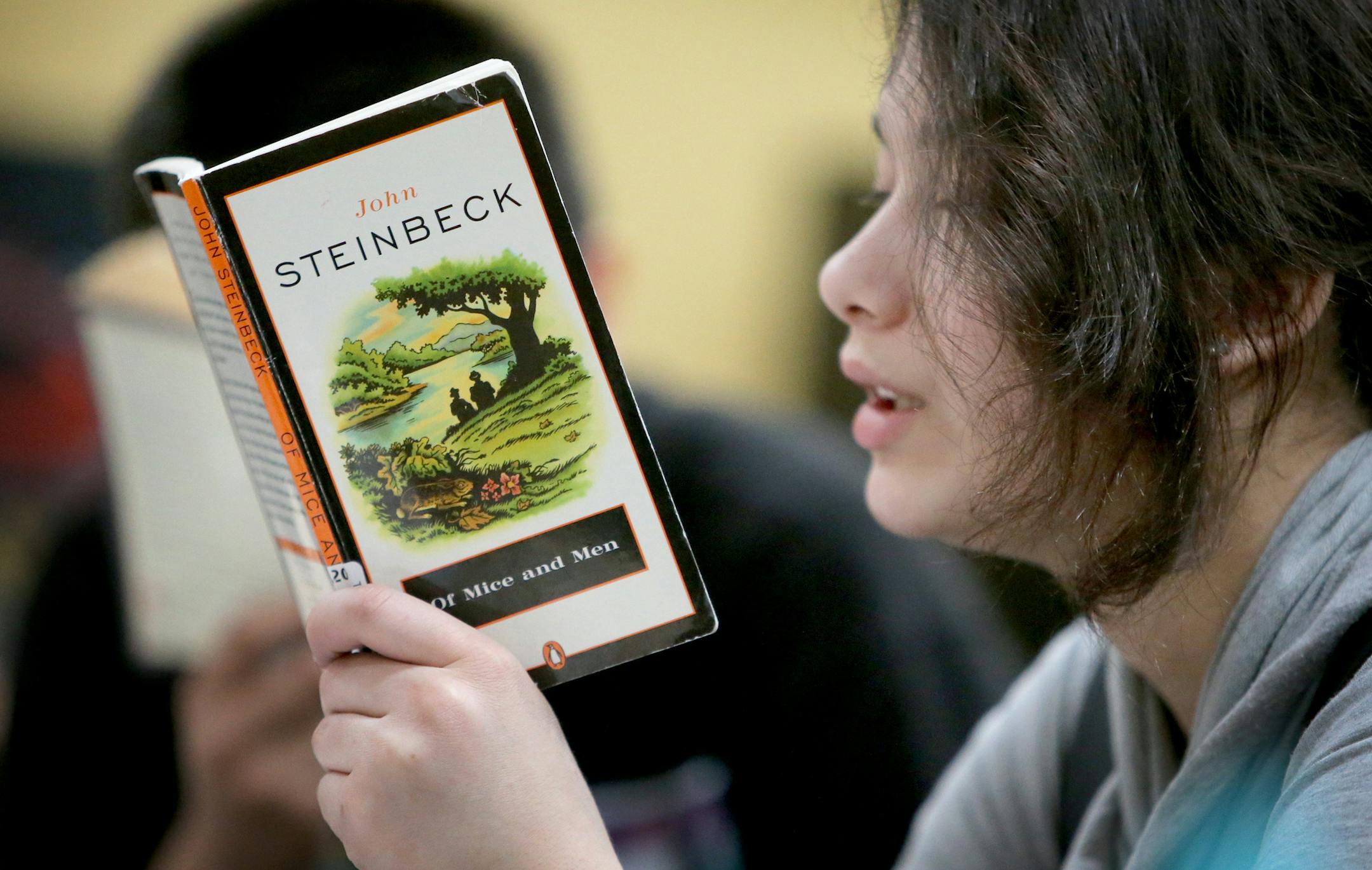
Book-banning is nothing new, so it is not surprising that Henry Sibley High School stopped teaching John Steinbeck's "Of Mice and Men" and Larry Watson's "Montana 1948" because they offended certain people ("High school halts teaching of 2 books," Dec. 28). And yet, every time a book is no longer taught, it should be a surprise. The stop on teaching these books raises questions that we might all pause to consider: How is this different from other book bans, say the Nazi burning of books that were deemed "un-German"? Where do we draw the line in determining what is, and is not, offensive, and who makes that determination? And can we find a way to approach literature with curiosity, and to use it as a springboard for reflection and discussion?
Miriam Karmel, Minneapolis
• • •
Rather than discussing the context behind the racial stereotypes and slurs in classics like "Of Mice and Men," Henry Sibley should remove any offensive books from the curriculum and concentrate more on stories about flowers and rainbows.
Richard Greelis, Bloomington
STUDENT LOANS
How about an interest rate fix?
Rather than forgive student loans, make them easier to pay back by reflecting the lower loan rates we have today ("Bankruptcy is the solution to the student loan crisis," Opinion Exchange, Dec. 26). Some students are paying two to four times the prime interest rate. It's not reasonable to expect today's graduates to pay such high interest rates on much larger loans when the prime rate is only 3.25%.
Bob Andersen, Minneapolis
MARIJUANA
We already use it responsibly
On any given day, tens of thousands or more regular people in Minnesota smoke marijuana. On a given weekend, at least 100,000 Minnesotans smoke marijuana. Rates of marijuana use have gone up in this year of quarantine. For the literally hundreds of thousands of regular and occasional marijuana users in this state, I want to use this space to say this: We don't want to be criminals anymore ("Marijuana and Minnesota: State is falling out of step," Opinion Exchange, Dec. 15, and "The case for pot is based on pipe dreams," Opinion Exchange, Dec. 22). Legalize it, and let us normal, regular Minnesotans exercise our personal responsibility in managing its use. We already are.
David Muench Huebert, Minneapolis
ENBRIDGE LINE 3
Good on Walz for taking climate change into account. Sometimes.
The plan for Gov. Tim Walz's administration to add climate change impacts to environmental reviews ("Climate impact may join reviews," Dec. 25) is a welcome proposal. It is consistent with other administration initiatives on climate action such as Clean Cars Minnesota and the governor's goal of zero carbon emissions in the electricity sector by 2050. It seems that this administration is taking the science behind climate change seriously.
Or is it? These proposals are marginalized by Minnesota's permitting of the Enbridge Line 3 project. According to the regulatory record, the total annual emissions from this project will be 193 million tons CO2 equivalent. Using 2016 numbers, this represents five times the total electricity emissions in Minnesota, five times the total transportation emissions in Minnesota, and 25% more emissions from the entire state, according to data from the Minnesota Pollution Control Agency.
We do need a transitional period to wean ourselves off of fossil fuels. But the regulatory record again shows that Enbridge never demonstrated a demand for this oil from Minnesota refineries or anywhere else. The pipeline will carry primarily new crude oil destined for dubious overseas markets. The Minnesota Department of Commerce agrees and has challenged the need for this project at the Minnesota Court of Appeals.
Minnesota is wholly complicit in this enormous expansion of fossil fuel use. Despite the laudable efforts by the administration to curb climate change, Line 3 is the climate elephant in the room. Unfortunately I fear that this project will be the real climate legacy of Gov. Walz.


