

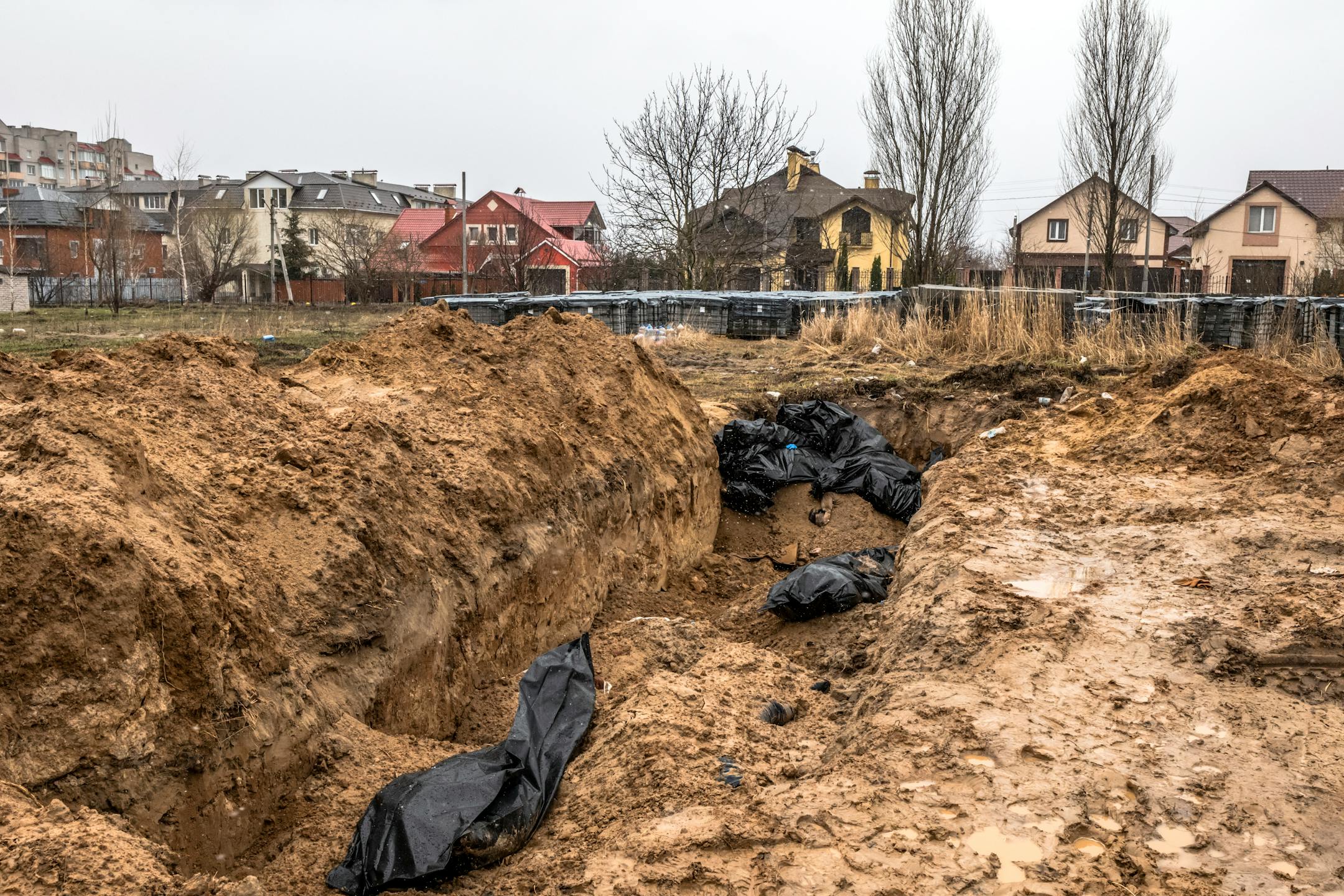
I studied Russian in high school. I had intended to learn German, but my French teacher (a remarkable woman from Armenia who spoke seven languages) persuaded me to take her Russian class instead. Once I mastered the unique alphabet, I realized that Russian is very phonetic, and I very much enjoyed learning the language and the culture.
My friend Julie and I became enchanted by a young Russian poet named Yevgeny Yevtushenko, who wrote elegant and haunting poems that appealed to our hearts and minds.
I read through his slim volume many times and wondered about his poem called "Babiy Yar."
In the 1990s, my daughter and I taught English to a family from Ukraine who had left after the Chernobyl accident. And now, in 2022, we learn every day about this country and its people as we watch Putin make war on it.
Today, I read a long article in the New Yorker by Masha Gessen in which she shares the stunning and shocking history of Babyn Yar (the Ukrainian name for a deep ravine in Kyiv). This was the place that Germans threw the bodies of Jews after they stripped them naked, stole all their possessions and shot them. They killed 33,771 Jews in 36 hours during the Second World War, one of the biggest mass executions of the Holocaust.
For some reason, the Soviet Union censored all documentation of the Holocaust for many years after the war, including attempts to memorialize Babyn Yar. Yevtushenko dared to write about a forbidden subject — so taboo that it took many decades before I learned the story behind his poem.
I have kept "Yevtushenko: Selected Poems" for all these years. Today I reread "Babiy Yar" in the light of this new understanding.
"Over Babiy Yar there are no memorials," he begins. "Over Babiy Yar … everything is one silent cry. Taking my hat off, I feel myself slowly going grey. And I am one silent cry over the many thousands of the buried; am every old man killed here, every child killed here. … No part of me can ever forget it. … When the last anti-semite on the earth is buried forever let the International ring out. … No Jewish blood runs among my blood, but I am as bitterly and hardly hated by every anti-semite as if I were a Jew."


