
Readers Write: Voter rolls, James Comey, presidential power, marijuana, fraud, data centers

Tell the executive branch to get lost.

The Minnesota Star Tribune
September 27, 2025 at 12:00AM
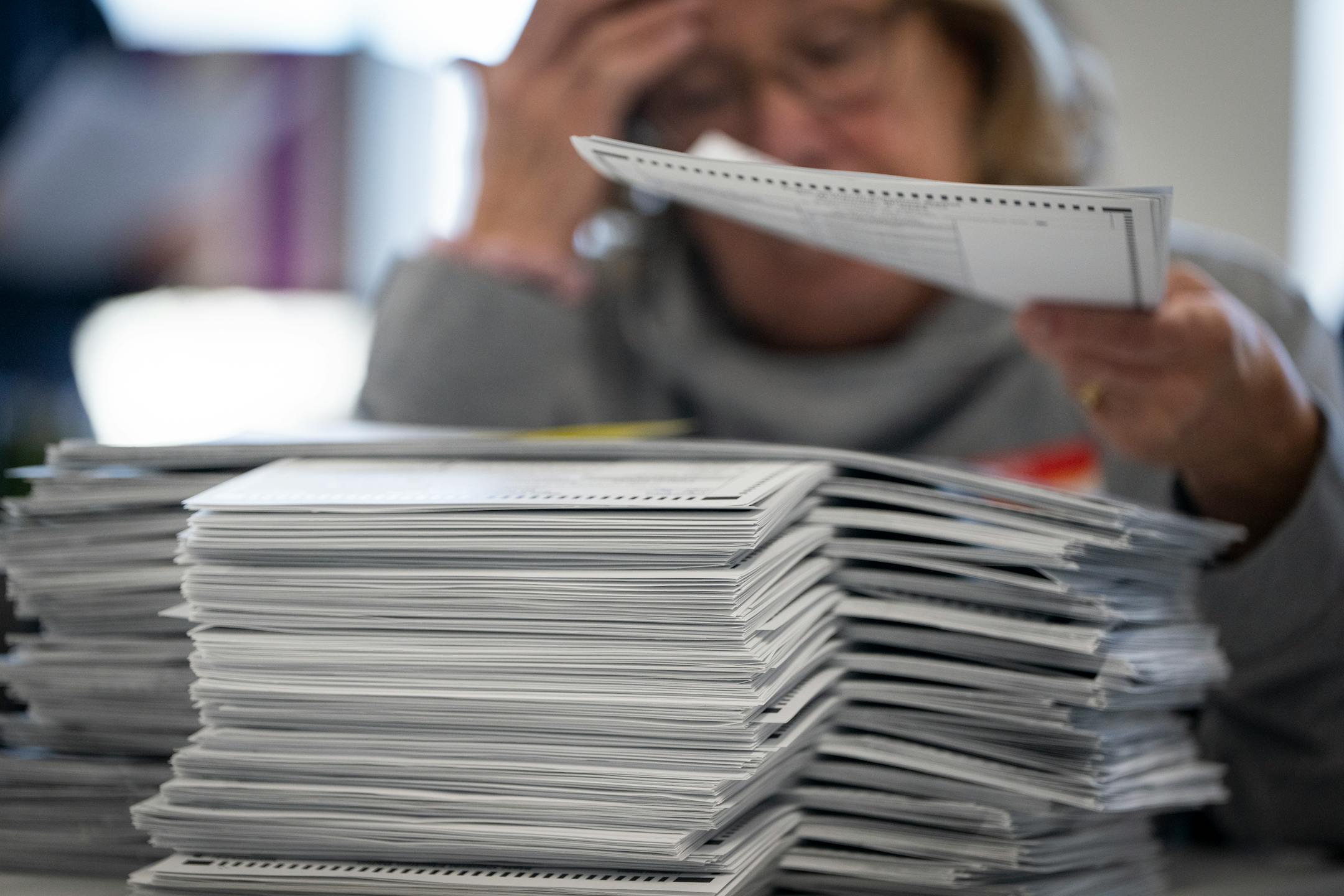
An election judge in Shakopee recounts ballots cast for a close state House race in November 2024. (Leila Navidi/The Minnesota Star Tribune)

Opinion editor’s note: Strib Voices publishes letters from readers online and in print each day. To contribute, click here.

•••

I hope our Secretary of State Steve Simon mounts a vigorous legal defense against the Trump administration’s efforts to obtain our confidential voter information (“DOJ suing state over voter rolls,” Sept. 26). This includes full names, dates of birth, addresses, driver’s license numbers and last four digits of our Social Security numbers.

Regardless of why the administration has requested this information, President Donald Trump’s motivations, and that of his administration, should be considered suspect. At a July 26, 2024, Turning Point Action campaign rally, Trump said the following, “In four years, you don’t have to vote again. We’ll have it fixed so good, you’re not gonna have to vote.” I don’t want to be “fixed.” I want to vote, and I want my vote to count.

Minnesota needs to protect its state sovereignty, and its constitutional role, in elections. It should not allow the federal government of this or any administration, regardless of party, to usurp its authority. We look to our state officials to hold that line.

Patricia Arneson, Wayzata

•••

The Constitution’s elections clause outlines the authority of states and Congress to regulate federal elections. It grants primary power to state legislatures to set the “times, places and manner” of elections for senators and representatives, while also granting Congress the ultimate power to “make or alter” those regulations (except the places of choosing senators).

The Constitution gives no authority to the executive branch over our elections, other than to faithfully execute the laws that Congress passes.

This is overreach and abuse of authority by the administration.

David Pederson, Excelsior

INDICTMENT OF JAMES COMEY

Legal ethics still applies

There are ethical standards and rules guiding prosecution of criminal cases. President Donald Trump may be immune from those rules and standards, but Lindsey Halligan, Trump’s appointed interim U.S. district attorney for the Eastern District of Virginia, and other attorneys in her office are not immune. If Halligan or her staff failed to present important exculpatory evidence in the James Comey grand jury proceeding, then they may be subject to attorney disciplinary sanctions including disbarment (“Trump closes in on James Comey,” Sept. 25). On Sept. 25, MSNBC’s Lawrence O’Donnell reported that such exculpatory evidence was well known. If so, and if not presented, then professional discipline should be considered. Even attorneys loyal to Trump must be responsible to execute their duties faithful to the rules of law and standards of the legal profession. Perhaps the appropriate bar association could even impose financial penalties to reimburse costs of defense.

Thomas Wexler, Edina

The writer is a retired judge.

PRESIDENTIAL POWER

That’s enough, please

It was with great concern that I read the article in the Minnesota Star Tribune about draft legislation that is circulating in both the White House and on Capitol Hill. This legislation would give, to quote the article, “sweeping power” to the president to wage war against drug cartels he has determined are terrorists or nations that may have assisted them (“Trump would get more lethal power,” Sept. 20).

My impression is that Trump already has almost unlimited power, thanks, in part, to rulings of the Supreme Court. He has exercised that power recently in attacks on two boats possibly used by drug smugglers. Along with the vast majority of people, I am worried about the wide availability and use of illegal drugs. The usual process of stopping the shipment of those drugs with boats is to interdict them legally and inspect them for smuggling. Such boats, while perhaps deserving of destruction, are not typically blown out of the water with the crew most likely killed.

I ask our elected representatives to resist further enhancing the power of Trump by refusing to enact such legislation.

Gary F. Anderson, Hugo

MARIJUANA

Legalization’s downsides getting clearer

Advocates for the legalization of marijuana promised us that legalization would benefit small businesses. New opportunities would blossom and even empower us. No longer would selling a product popular with many people be illegal. A new business model would open, especially for newcomers. But a leading supporter of legalization now tells us this is not happening (“Minnesota’s recreational weed rollout leaves small businesses behind,” Strib Voices, Sept. 25). Big corporations rushed into the field and prevented small operators from competing or even establishing a foothold.

In short, legalization just made the rich richer. Such a negative development was not supposed to happen. We are left to wonder what other negatives from legalization will happen. And I wonder if the media will be as quick to report them.

David Wiljamaa, Minneapolis

FRAUD

Corruption isn’t limited to Minnesota

We have all been justly concerned about the massive fraud committed by providers in the Feeding Our Future program. Then in last Saturday’s paper I read of three cases of securities fraud in which the individuals were convicted and required to pay fines or restitution (“Trump allies get pass on penalties,” Sept. 20). All three were given pardons or commutations by the president. Now the SEC has dropped the cases, meaning that the fines and restitutions to victims, totaling over $800 million, will not have to be paid.

This is corruption of the worst sort by a man who promised to “drain the swamp.”

Roger Purdy, St. Paul

DATA CENTERS

Require electricity and safety standards

A wave of massive artificial intelligence data centers is arriving, each drawing as much electricity as a small city. Without guardrails, that new demand will be met by fossil-fuel plants — because that’s how our grid fills gaps today. The climate doesn’t care whether emissions come from a steel mill or a server farm. A ton of CO2 is a ton of CO2.

AI can deliver real benefits. But benefits don’t erase responsibility. The rule should be simple: no new large data-center load without verifiable, time-matched clean electricity and basic safety standards.

Annual “green” claims are not enough. Companies often buy renewable energy credits (RECs) to offset a year’s consumption on paper, even if their facility runs on gas-fired electricity most nights. That’s not decarbonization; it’s accounting. What matters is whether clean generation exists when the data center consumes power — hour by hour — and where that power flows on the grid. The good news is that 24/7 carbon accounting is doable and already practiced by leaders in the field. If the companies building the largest AI systems are as advanced as they say, they can meet this basic standard.

Second, do not approve interconnections that assume fossil “backfill.” Utilities sometimes propose building new gas capacity as a quick fix to serve big loads. That locks in emissions and costs for decades. Regulators should insist that transmission, storage and nonfossil-fuel generation are online — or fully financed and under construction — before an AI project flips the switch.

Third, make disclosures real. The public deserves to know how much electricity and water these facilities use, what their hour-by-hour carbon footprint is, and what safety testing is performed on the most powerful models. If a plant in your town used millions of gallons of water and megawatts around the clock, you’d expect transparency. The same should apply to AI installations.

Finally, we need a precautionary pause on training the very largest AI models until safety and energy standards exist. This isn’t a blanket ban on AI. It’s the same logic we use for other high-risk activities: first set the safety bar, then scale up. If companies want to build systems that demand gigawatts of electricity, they should prove they can do it without dumping the costs — climate, health and grid reliability — onto everyone else.

AI should compete on its merits, not on its ability to externalize environmental costs. If AI truly is the future, it should power that future cleanly and safely. Let’s make that the price of admission.

Thomas Hultquist, Richfield

about the writer

about the writer