Readers Write: University of Minnesota presidents, the state flag and seal, cigars

Isn't one job enough?

December 12, 2023 at 11:45PM
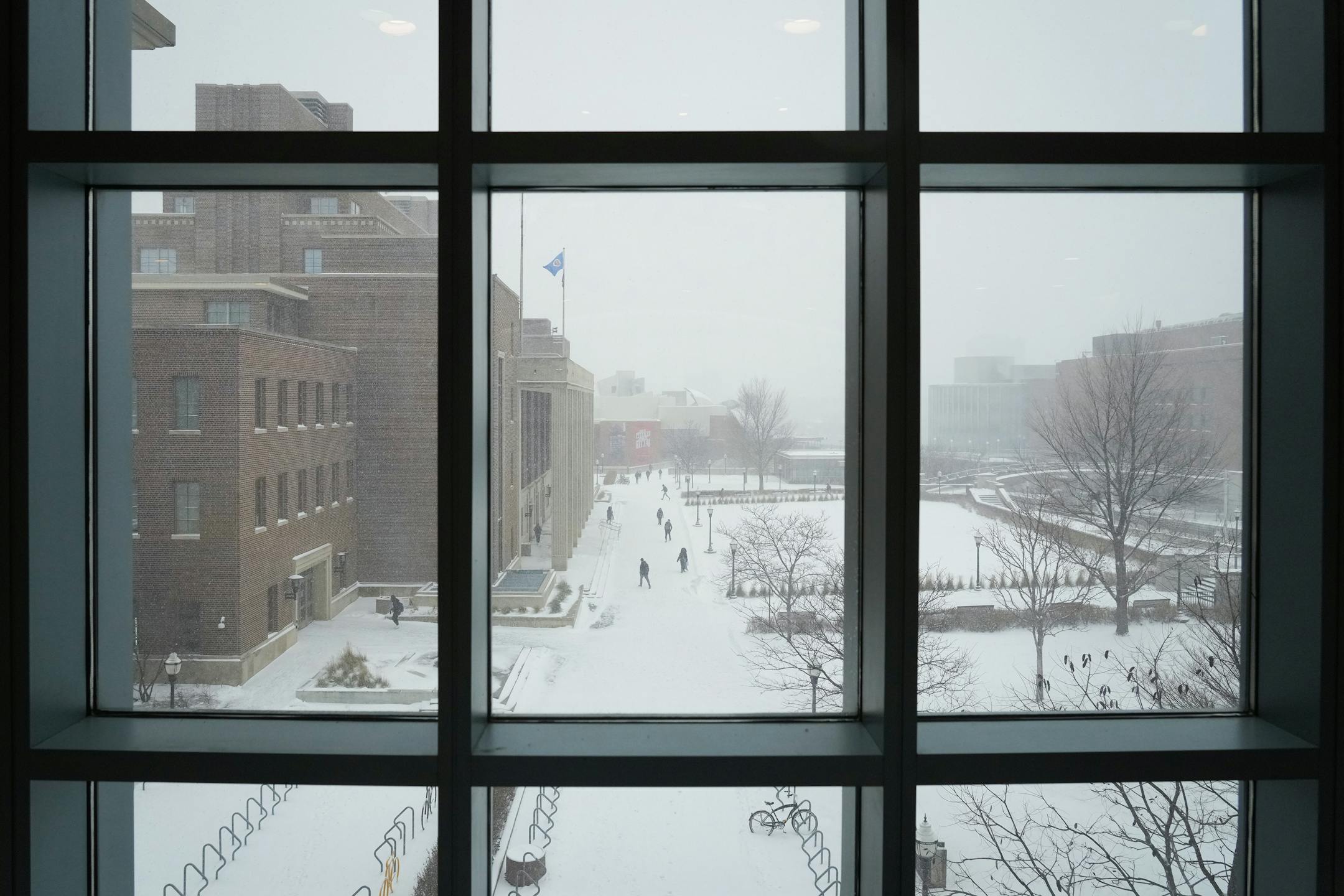
Students make their way across a snowy University of Minnesota Twin Cities campus last winter. (Shari L. Gross, Star Tribune/The Minnesota Star Tribune)

Opinion editor's note: Star Tribune Opinion publishes letters from readers online and in print each day. To contribute, click here.

•••

It appears that the University of Minnesota Board of Regents is focused on potential conflicts of interest in considering whether its president should accept outside positions in the for-profit sector ("Regents consider stricter oversight," Dec. 9). Might I suggest that, conflict or not, the president of the University of Minnesota has an enormously challenging job leading a large, highly complex entity, with multiple, often conflicting, constituencies, all of which require the president's full attention? Forget about recruiting a committee to evaluate potential conflicts — just prohibit outside employment, conflict or not.

Lindsay Arthur, Edina

•••

How disappointing that it should be thought necessary to have a special panel to oversee any conflicts of interest of our state university president, and that the Board of Regents has such little confidence in its president selection process to believe that such a panel is necessary.

Bernard P. Friel, Mendota Heights

•••

Not long ago, we saw the president of the University of Minnesota and the president of Hamline University (both alma maters of mine) announcing they were leaving their jobs, under clouds of controversy. And now we see the president of the University of Pennsylvania forced out ("Penn president resigns over remarks," Dec. 10); and the presidents of Harvard and the Massachusetts Institute of Technology facing calls to resign.

These departures raise questions regarding arrogance, academic freedom, the limits of free speech on campus and undue political pressure. But given that the controversies faced by all five of these highly educated presidents were created and/or aggravated by their own cluelessness, the question that jumps to my mind is: Why is it so hard for universities to hire reasonably competent people? The position seems to be well-paid; is there a national shortage of academic competence?

John K. Trepp, Minneapolis

STATE SYMBOLS

Another melodious bird

Recent articles and letters about the proposed state flag and state seal designs have prompted me to toss in two cents of my own. It's a difficult task, I'm sure, to satisfy Minnesotans who hail from all the varied regions of our state, especially when the objective is for the symbolism to be uncomplicated and somehow unifying. There will always be something that some of us would like to have represented that will be left out.

My favorite Minnesota bird — the Western meadowlark — will likely not make it onto the flag. I don't see it in any of the mock-ups. Still, I suggest that you haven't really lived until you have heard its distinctive, melodious, cascading trill. Any recorded renditions I've heard just don't do justice to the real thing.

So next spring, I recommend that readers make their way to those regions of our state where there is sufficient prairie habitat (western and southwestern Minnesota are good bets), and train your ears to hear the song of the meadowlark.

The meadowlark won't be on the flag, but its delightful song will be forever in your Minnesota heart.

Lisa Wersal, Vadnais Heights

•••

The Nov. 30 Star Tribune reached out to a self-referenced expert — a vexillologist — to help sort through the trials of our Minnesota flag replacement ("Expert who wrote the book on flags grades finalists"). The professional, in response, offered five rules for sound flag creation. This observer — a children's author and illustrator — was thinking the professional would know or should know that originality in science or art, or brilliance in design or execution, often arises unexpectedly as the result of sudden epiphany, and it can rarely be prescribed or circumscribed by rules.

One of the flag-replacement finalists does reach the level of brilliance and epiphany in this observer's opinion: It's the one the expert refers to as fifth and the commission identifies as F1435. Number F1435 excels as abstract design and color — that is to say, with reference only to itself, before any interpretation or attribution of meaning. F1435 is unusually lively from a distance, and in flight, and seems to fly even standing still. More important, F1435 invites and rewards interpretation. For example, rather than pointing to Northern European or Christian associations (association with the star of Bethlehem is unavoidable during the Christmas season), its star welcomes interpretation as a First Nations motif. Second, F1435's "plants," as the article calls them, invite an imagining of our Minnesota woodlands, possibly from a time before the Paul Bunyan clear-cut. The plants can also suggest Minnesota wetlands and prairies (including wild rice), possibly from a time before we repurposed them for agriculture. Finally, the lines, left and right, read as bars from a distance, ingeniously (if subtly) reference our first tribal nations. F1435 is a brave, and bravely inclusive, design.

I very much fear F1435 will not be chosen, but imagine if it were. Minnesota could be a state with a flag designed by a Native American. There is so much to heal and, it sometimes seems, so little interest.


Jim Latimer, Minneapolis

•••

We could send a nod toward our farmers with one small change in the design chosen for the seal of the state of Minnesota. Replace the stem of wild rice with a cornstalk. Yes, we lose the Minnesota state grain, but we gain a stronger symbol of what our state was and continues to be. Corn is a Native American staple with centuries of cultivation and development at the hands of first peoples. It has also become a staple crop for farmers ("Farmers weigh in on changing flag," Dec. 7). Both ways, it is symbolic of our state.

Another thought. It seems only the flag committee is excited about the six finalists. The seal, however, is widely liked. Simplify the design of the seal, retaining the center symbols and some sort of border. We would then have our North Star, corn for history and agriculture, water and beloved loon. On a flag, it would even make sense to highlight the loon's piercing red eye.

John M. Widen, Minneapolis

CIGARS

Let me enjoy mine in peace

As a lifelong author, finding time to write in my sunset years is a rare luxury. However, I feel compelled to address the misguided proposal put forth in late November regarding the closure of the cigar sampling loophole by Minneapolis City Council Member LaTrisha Vetaw ("Push against indoor smoking may doom Uptown cigar lounge," Nov. 30).

While I acknowledge the initial commendable intention to curb new tobacco addiction and safeguard workers, the decision to pass legislation that wills for the closure of Anthony's Pipe & Cigar Lounge fails to achieve these goals. Notably, the targeted demographic of teenagers is not the one benefiting from this protection. One does not witness adolescents casually walking in, igniting a $25 cigar, only to collapse on the floor screaming about their newfound addiction. Additionally, the dedicated ventilation system shields workers from harm, who are often seen sampling new products. This practice enables them to engage with patrons, discussing the evolving complexities of flavors from the initial light to the last draw.

This myopic decision directly impacts patrons like myself. Comparable cities, such as Washington, D.C., implement stricter smoking bans but permit establishments like Shelly's Back Room to thrive. This favored spot for elected representatives and several presidents serves cigars alongside a full liquor bar and exceptional culinary offerings, all allowed under the same loophole law created and now oppressed by Vetaw.

Even in the conservative state of Florida, "nonfiltered" cigar smoking is permitted on public beaches, contrasting with the statewide ban on all filtered products. Many states and cities set precedents on how to protect cigar sampling, making Vetaw's stance appear regressive.

Will our anti-smoke evangelist Vetaw reconsider her position in light of these examples? Predictably, the answer is no. Unfortunately, Anthony's is now likely condemned, and a small group of elderly gentlemen will no longer have the opportunity to recline, light up to sample $25 or $30 cigar while savoring their time left with friends, watching the sunset.

Robert W. Kuhn, Rochester

about the writer

about the writer