
Readers Write: U Regent Sviggum's comments, election claims

Full dialogue was cut short

October 26, 2022 at 10:45PM
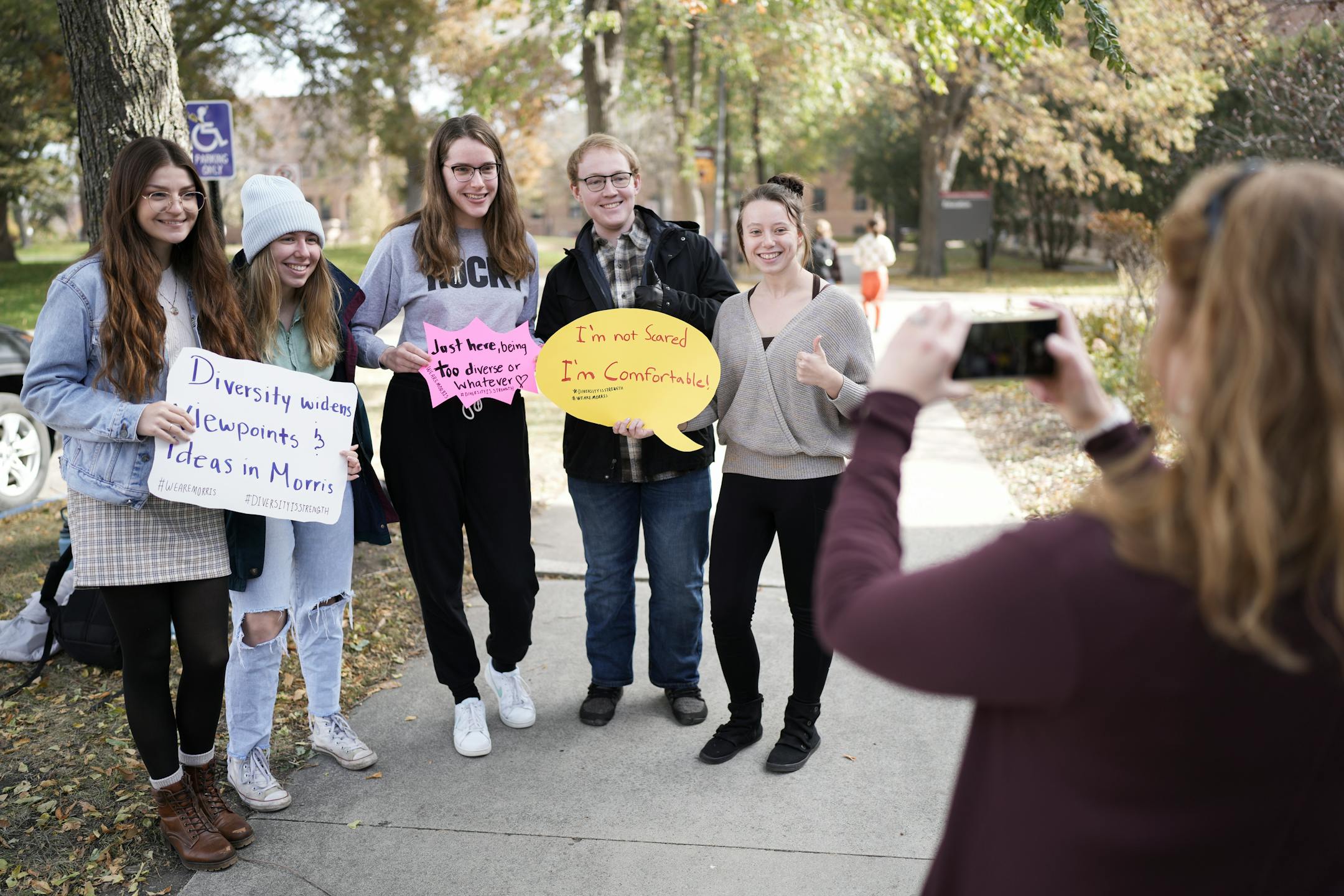
Students chanted, held signs and posed for pictures in support of campus diversity on Oct. 20 in Morris, Minn. The rally was a response to University of Minnesota regent Steve Sviggum positing that growing shares of Native American, Black and other students of color could be related to overall enrollment declines on the small campus. (Mark Vancleave, Star Tribune/The Minnesota Star Tribune)

Opinion editor's note: Star Tribune Opinion publishes letters from readers online and in print each day. To contribute, click here.

•••

I was incredibly disappointed in the reaction to University of Minnesota Regent Steve Sviggum's recent question about diversity at the Morris campus, especially in the Star Tribune's editorial on Oct. 20 ("Lessons learned from Sviggum's blunder"). Questions serve two main purposes in my opinion: to seek (1) knowledge and information or (2) understanding, which should lead to dialogue. I saw Sviggum's question as an opportunity to start a dialogue in the paper about diversity. I would hope that the answer would have been "no" that there isn't too much diversity on the campus or anywhere else. Instead, dialogue was shut down, and he was vilified for asking a question. Unfortunately, the dialogue became about Sviggum and not the question. A question was raised and that should have remained the issue. Actually, it says something about the parents who felt that they needed to raise the issue and send the letter in the first place. Instead, citizens of Minnesota and readers of the Star Tribune chose not to participate in a constructive dialogue, perhaps out of fear of ridicule and shame. It would have been a perfect opportunity for the Star Tribune to initiate a dialogue on this (or any other critical subject) or perhaps have a special section in the paper.

I am not on social media because it doesn't seem to be the place for mature, constructive dialogue. Perhaps that's the problem. People don't know how to discuss subjects constructively anymore, and they are afraid of trying to do so. It's a sad commentary on the state of dialogue and discussion these days. This would have been an excellent opportunity for the Star Tribune to initiate such a dialogue in the paper (only excluding "unhelpful" and inappropriate comments) without the shouting and the name-calling.

Jane Pagenkopf, Golden Valley

•••

Thanks to the reporter of "Sviggum quits as U regents vice chair" for her fact-finding and reporting (Oct. 26). I had thought Sviggum's asking the Morris chancellor if her campus was too diverse from a marketing standpoint really was a warning that the regents felt she shouldn't be so aggressive in marketing the free-tuition program to the reservations surrounding the Morris campus. Because the campus originally was an Indian school, when the land was given to the Minnesota college system, it was stipulated that college tuition on the Morris campus would be free to Indigenous students. The reporter made clear that parents who wrote to Sviggum felt that the 50% drop in enrollment at Morris from peak enrollment was due to the presence of Black and Indigenous students and students of color and not due to college unaffordability. Melanie Benjamin, chair of the Mille Lacs Band of Ojibwe, said that if the presence of minorities was a factor in declining enrollment of white students, which she doubted was true, the problem would be white racism, not BIPOC presence.

College affordability is the most likely cause for substantial enrollment decline.

Susan Frenzel, Minneapolis

•••

Regarding the saga of Sviggum's question about diversity:

I wish Sviggum had not asked whether there is "too much diversity" on the Morris campus (a question that suggests he believes in the existence of "too much diversity," i.e., the level of diversity that causes those in the majority to feel uncomfortable).

I wish instead he had asked those who wrote him letters saying their children felt uncomfortable on the Morris campus whether their discomfort resulted from experiencing too little diversity in their lives. If that is the case, then the solution is not less diversity on the campus but rather exposure to more diversity with the hope it results in growth, learning and better understanding.

After all education involves learning new ideas, considering other ways of looking at the world and pondering differing perspectives, all of which can and maybe should be uncomfortable, yet are, in the end, beneficial.

Rob Ruff, New Brighton

ELECTIONS

Claims that disqualify

It should go without saying that those who promote or refuse to denounce former President Donald Trump's wicked lie that the 2020 election was stolen are unfit for office. Why? Because passively or actively endorsing Trump's lie poisons people's minds with the notion that our elections cannot be trusted.

Ill-informed members of the public who have been relentlessly pummeled by the dissembling chorus of election deniers may perhaps be forgiven for falling for Trump's lie. But those in office and running for office know better. As people steeped in electoral politics, they are certainly aware that the intense scrutiny of the 2020 presidential election showed overwhelmingly that the election was conducted fairly and the votes were counted accurately. And they are aware that Trump lost by many millions of votes. Furthermore, the recent Jan. 6 committee hearing showed that, disgustingly, Trump himself has been aware all along that he lost.

Candidates and officeholders who support the lie of stolen elections are knowingly using their public platforms in a way that recklessly risks toppling our democratic institutions. Promoting pernicious, destructive nonsense should be condemned no matter who is doing it. But if someone actually in office or putting himself forward as a candidate does this — effectively helping to incite a mob that would set fire to American democracy — he or she should be declared unqualified to hold public office and sent packing. If such people are on the ballot, it should be obvious that no one should vote for them.

Charles Hathaway, Grand Marais, Minn.

•••

I agree with the letter writer of "Can't take much more of this" (Oct. 25). I am more than ready to be done with campaign ads that are insulting to all of us. I wonder what the campaign planners think of us.

  1. I wonder if campaigns think we aren't smart enough to figure out not to trust an ad from an opponent. Honestly, would you trust Ford to help you buy a Chevrolet?
    1. I wonder why we teach emotional intelligence in schools and then give examples of what not to do in campaigns. Name-calling, exaggerations, words out of context. Why is this not OK for students but OK for leadership?
      1. I wonder if candidates know that we, the voters, can identify when promises are being made that are impossible to keep, such as, "I will stop violence." I wonder how law enforcement officials who have spent a lifetime working to stop violence hear this promise.
        1. I wonder if candidates know if they blame everything on a single person or the other party, they are indicating that person or organization has a lot of power. And this approach promotes hate.
          1. I wonder if good leaders are not stepping up because the process is so aversive. The political parties aren't going to do anything about the incivility. Is it because it works?

            Do we really believe all those ads, respect incivility, believe outrageous promises, think blaming others is a good idea and that we can attract good leaders with this process? We know campaign ads are not accurate, we know name calling is not a policy discussion but personal attack, we know the limits of a single position, and we would not tolerate most campaign behavior in workplace. Spending millions on campaigns that present inaccurate information or poor leadership is not a good investment.

            Leeann Jorgensen, Alexandria

            about the writer

            about the writer