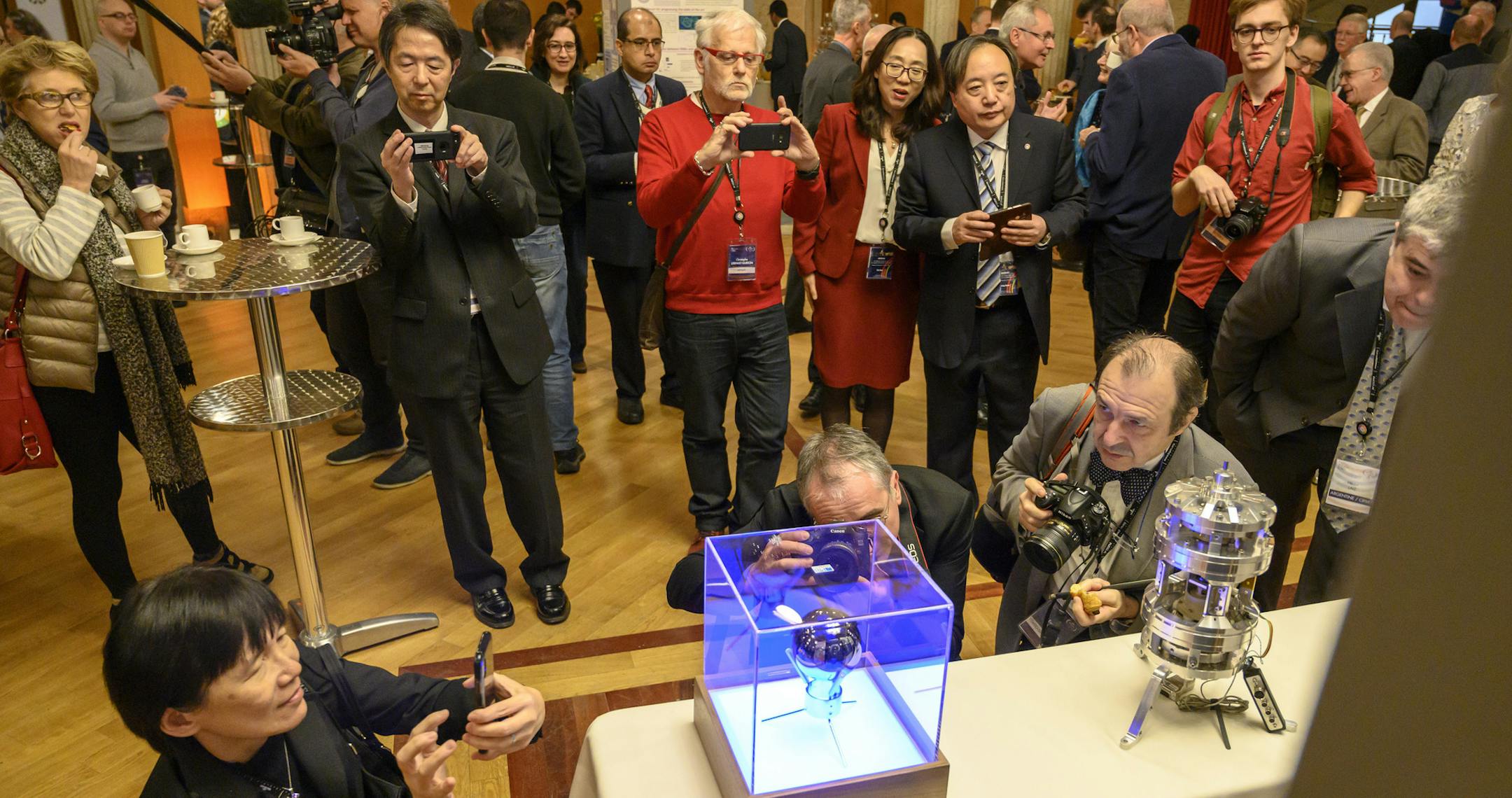
For everyone who always suspected that their scale is lying to them and that the butcher had a heavy thumb, you have been vindicated! After decades of arduous engineering, there has been a revolutionary breakthrough in how weight and mass are measured, or so the article about the redefinition of the kilogram claims. The new method is accurate to 32 decimal places and is no longer dependent upon the old gold standard, actually a platinum/iridium cylinder, maintained under carefully controlled conditions in France. Yes, for more than 125 years the accuracy of everything we weigh has relied on the engineering acumen of, not the Germans, but the French. Think Renault. But now, that is all about to change. The new definition of mass is based not on a hunk of metal in France but on "numerical values" (actually an equation involving the Planck constant). This piqued my "nerdiness" enough to compel me to do additional research. Turns out the article totally misrepresents the breakthrough. The equation in and of itself is actually circular in that it includes a measure of mass, which is the very thing it intends to define. In order to sort this all out, Planck's constant must be independently measured using an extremely complex Rube Goldberg device called a Kibble balance located 40 feet under the ground in Gaithersburg, Md. So actually, the real breakthrough here is that we no longer need to rely on the French.
Thank you for the Nov. 18 front-page article "A victim heard, justice served," part of the ongoing "Denied Justice" series, about rape reporting and prosecution. It's refreshing to finally read a story of victim triumph while sexual assault remains a heated topic. To read how Investigator Steve Heinrich's compassionate approach to the victim's traumatic event really shifted her trust, allowing her to share pertinent information, shows how small shifts in interactions really do matter.
The statistics stated in the article (in more than half of reported sexual assault cases reviewed by the Star Tribune, neither the victim nor suspect were formally interviewed or questioned) are appalling but not shocking. According to Rape, Abuse & Incest National Network (RAINN), 13 percent of sexual assault victims don't report because they believe the police would not help. Two percent believe police cannot help. This needs to change. It would only take a small shift to do so
I think about the current co-responder pilot program being put into practice with the Minneapolis Police Department in response to mental health crisis calls. It wouldn't take much to implement a similar co-responder program for sexual assault cases. A social worker specialized in trauma/sexual assault case management could accompany an officer and help interview the victim, get the victim to needed services and provide follow-up visits or court appearances. This would allow the victim to feel safe and the police to focus on their job.
Co-responder programs have been in practice in several cities around the world for mental health crisis for several years. Why shouldn't we use them for sexual assault cases as well?
Vice President Mike Pence was quite justified in criticizing China's unfair trading practices and theft of intellectual property and technology at a recent Asia-Pacific summit ("U.S.-China dispute puts Asia-Pacific forum on edge," Nov. 19). He also accused China of luring developing nations into a debt trap through loans it offers for infrastructure, much of which is related to its "One Belt, One Road" initiative, an effort to create the world's largest economic platform. This sounds very much like our playbook from the 1960s and '70s, when U.S. corporations, lenders and our government encouraged Latin American and other countries to borrow huge sums for projects that never seemed to deliver the economic benefits that the rosy forecasts indicated. And while it may or may not be a trap, remember that we owe China more than $1 trillion in the U.S. Treasury debt it holds. China is very strategic and may be quite successful in achieving its economic and defense goals by developing strong relationships and alliances with the 60 countries involved in its belt-and-road plan and with other countries and regions. We would be well-served to consider what our influence in many of those countries will be in the future compared to China.