

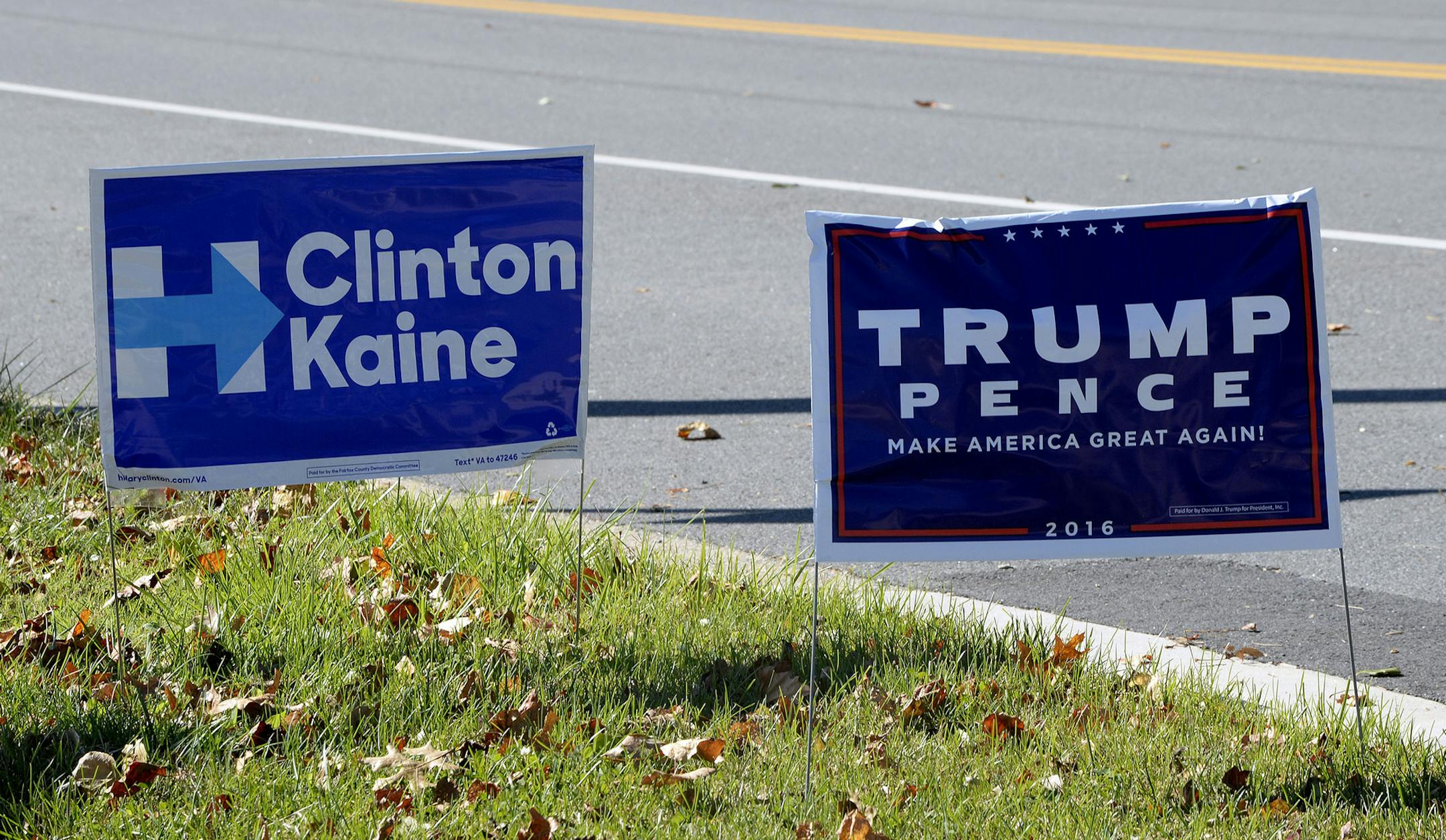
What came to my mind while reading D.J. Tice's March 11 column "What do the cool kids wear to an election?" was our family's 2016 trip to New Hampshire and Maine in late October/early November. There, the landscape was awash in political signs. They were everywhere — crowded onto tiny medians between traffic lanes, precariously jammed amid rock and gravel on steep grades leading down into ravines, perched high up on sharp mountain curves that had to have made for hazardous conditions in which to place the signs. In many places, multiple copies of the same sign lined roadways every 5 or 6 feet. To our Minnesotan sensibilities, it was overwhelming and obnoxious.
Even many of the locals complained. People were overstressed after months of this political inundation. Some were even arrested for removing signs.
What a relief to return to Minnesota, where our laws would prohibit the placement of many of the signs we saw in New Hampshire and Maine. It just isn't done here. We're a little more restrained, and perhaps more geared toward public safety and being able to read street signs. Still, our people are well-informed, and we have some of the highest voter turnout rates in the country.
So, perhaps Tice finds fault with our restrained approach to Election Day, but I'm happy to err on the side of "solemnity" and "decorum." Iron out the "kinks" so that the rules are applied evenhandedly, and let's keep electioneering away from polling places on Election Day.
Lisa Wersal, Vadnais Heights
GUN POLICY
Free up the research? Nope, don't trust it, if federally funded
The Star Tribune Editorial Board's March 11 offering ("Assessing the ban on assault-style weapons") seemed sincere and thought-provoking. The gist of the editorial was to call for more funding for research on gun-related crimes. It was a bit ironic after quoting a 30-year analysis from the Louis Klarevas book "Rampage Nation," which bookended the 1994 assault weapon ban. There are voluminous sources of gun crime data from federal, state and professional sources.
So what does this call for more research really mean? The conclusion of the 1993 Kellermann study, funded by the Centers for Disease Control and Prevention, was that the presence of a gun in the home for protection was counterproductive to its intent. Using federal funds in this fashion was a bridge too far. As a result, the 1996 Dickey Amendment drastically cut federal funding. When "research" becomes advocacy, one must question the objectivity. The Editorial Board's appeal for the return of federal funding may seem heartfelt. But in reality, it is a slippery slope and an end-run for more legislation. Nice try.
Joe Polunc, Cologne
• • •
I am not going to be critical of the editorial because, most likely, you (the members of the Editorial Board) would be dismissive of such comments. Instead, I think more about how much the American people are beginning to really disrespect and dislike news operations, news coverage, and the thoughts and views of editorial writers like you. I don't know if you think about this, too. If not, maybe you should, because your editorial about "assault-style" guns asked the wrong questions and implied the wrong solutions. There is an old saying (the words of which I don't recall exactly), but the gist of which was that generals often plan for war thinking the tactics of the next war will be the same as the last. We should have learned that lesson when terrorists used boxcutters and our own airlines as weapons on 9/11.


