
Readers Write: Roof Depot site, crime, masking

Intimidation is unacceptable.

February 28, 2023 at 11:45PM
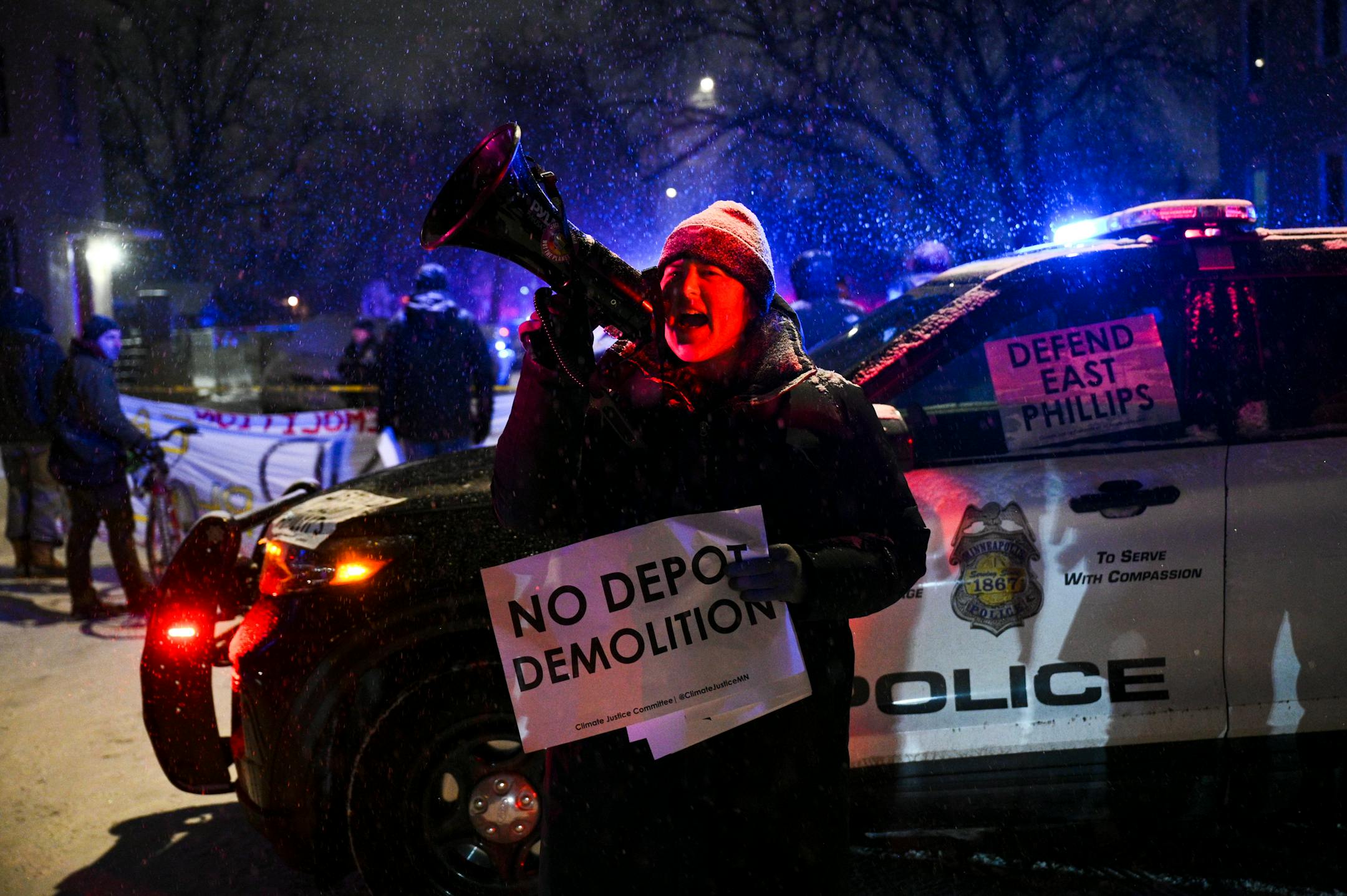
A protester chants anti-police slogans and demonstrates against the planned demolition of the Roof Depot building on Feb. 21 in Minneapolis. East Phillips neighborhood activists objected after Minneapolis police cleared and arrested protesters, who set up more than a dozen tents at the site on Tuesday. (Aaron Lavinsky, Star Tribune/The Minnesota Star Tribune)

Opinion editor's note: Star Tribune Opinion publishes letters from readers online and in print each day. To contribute, click here.

•••

I found the article describing intimidating behavior and threats of violence against Minneapolis City Council members by activists opposed to their position on the Roof Depot site to be extremely disturbing ("Council members report threats," Feb. 25). I do not know what is the just and proper decision for the city to make and believe this is the kind of decision in which traditionally disadvantaged groups deserve particular respect and attention to their perspective. At the same time, I believe in the democratic process, and in the same way I do not want right-wing activists intimidating elected officials, school boards or voting administrators, I believe intimidation by left-wing activists is wrong.

I would like to see a clean 13-0 vote by the City Council condemning intimidation or threats of violence against council members for any reason. Any council member who would not vote for such a resolution does not deserve his or her place on the City Council.

John McGuire, Rochester

•••

The Roof Depot demolition planned for the East Phillips neighborhood of south Minneapolis is the product of environmental racism. The neighborhood is a primarily low-income, BIPOC community that has historically faced environmental injustices. This area is already home to disproportionately high rates of asthma and a low life expectancy, as it was previously a Superfund site, and contains high levels of arsenic in the ground. The neighborhood also has a severe lack of green space. The East Phillips Neighborhood Institute proposed a community space and urban farm at the site in order for the neighborhood to reclaim the land that has been harming their health for decades. The city instead plans to build a Public Works facility and diesel truck yard on the site, both of which would only increase the air pollution and toxicity of the surrounding area.

Systemic racism in the city has led to this primarily nonwhite neighborhood being repeatedly targeted through policy to keep polluting and hazardous facilities localized. If the city's plan goes through, it will perpetuate the environmental racism in the area and make the site, and therefore the people, even more vulnerable to climate-related impacts in the future. As someone who has grown up in south Minneapolis and witnessed the systemic racism in the city, I believe it is vital the East Phillips communities' voices are the loudest in the discussion for the site. They should not take any compromises on the division of the site, and the city's plan cannot go through.

Grace Solorzano, Minneapolis

•••

I find it perplexing that people seem to constantly complain about lack of effective city services, and yet get outraged over decisions by elected city officials and department heads to utilize existing or obtained properties owned by the city to build new, upgrade, modernize and potentially improve needed services. These cases have included the previously proposed building of a new Third Precinct police station to replace the one destroyed by rioters, or the long-considered and studied plans to re-purpose the old Roof Depot site for consolidating Public Works equipment, offices and personnel — especially since the site is already zoned for industrial use and has been for decades.

The city of Minneapolis needs to upgrade and improve facilities on a periodic basis to provide the services it is tasked by law and expected by its citizens to provide. The whole NIMBY attitudes of some of the activist groups could use a little dose of reality. Just one person's opinion.

Dana Smyser, Coon Rapids

CRIME

Rehabilitation is harder than it seems

I was assaulted in a violent attempted carjacking and read with interest the commentary by Patrick Connolly ("What my family learned after a St. Paul carjacking," Opinion Exchange, Feb. 19). I empathize and understand the trauma and helplessness of the experience and the emptiness of the interventions offered by the court and corrections systems.

Although we share a similar experience of being victimized by young impulsive violent kids, I do not agree with the proposal to develop intensive therapeutic homes to treat these offenders. I am a licensed mental health provider, have worked in treating court-order youth and ran a residential treatment facility for juvenile offenders. I know these programs are expensive and largely fail at rehabilitating these kids. The data, confirmed by my experience, reveals that almost 80% of these kids commit another felony and are incarcerated as adults. Unfortunately, many of these kids do not live long into their 20s, dead due to reckless acts with guns, drugs and alcohol, and vehicles.

The challenge in this social issue is to establish strategies and programs that foster an environment that prevents this behavior, not an intervention with limited success. These are not mental health issues, but symptoms of a social issue. The community that supports economic and educational access, reinforces the family, provides resources for health care, physical activity and recreation will not develop the reckless, lost kids that endanger our communities and themselves.

These are lofty, difficult initiatives, but working to build opportunities and pathways for everyone to be a stakeholder in the community is where we should be making our investment.

Michael Nystuen, St. Louis Park

•••

I was hopeful that the Feb. 23 article "Police boost patrols on airport light rail" would describe a comprehensive plan to address the rampant social dysfunction I encounter on light-rail rides between downtown and the Minneapolis-St. Paul International Airport. But then I read the article and was disappointed to learn the new patrols are only at the two airport stations. Good news for those airport employees who consider the short ride between terminals a harrowing experience, but this Band-Aid "solution" will do nothing to protect those who rely on the light rail for transportation, especially those who work late downtown or at the Mall of America. Will Metro Transit ever take action to restore the light rail as a viable transportation option for workers, those who live by the line and visitors?

Jerry Anderson, Minneapolis

MASKING

Focus. What will we do next time?

It's unfortunate that folks are debating whether or not masks help reduce the spread of the deadly COVID rather than brainstorming best practices for the next outbreak of perhaps something even more deadly ("Truth unmasked, at last," Opinion Exchange, Feb. 24, and "It's OK to think masks were a good idea," editorial, Feb. 28).

It's unfortunate everyone hasn't been directly affected by seeing someone struggling with COVID and/or dying. Perhaps they would be a little more caring about others and vulnerable people.

The present narrative leads to continued divisive responses. At the beginning of the pandemic, I was standing in line at the post office along with other masked folks as an unmasked customer came walking out, looking at us and laughing, then coughed in our faces, believing, I guess, that he was immune and didn't care if he spread it.

Sick.

Everyone knows that properly worn quality masks help. Period. If you think not, ask why hospital staff bother to wear them? Ask a hazardous waste worker if they'd go without. Ask, intelligently, what all the things are that we can do for the next pandemic. Nothing we do is foolproof. Everything we do that can help is worthy of trying.

Keith Myrmel, Arden Hills

about the writer

about the writer