

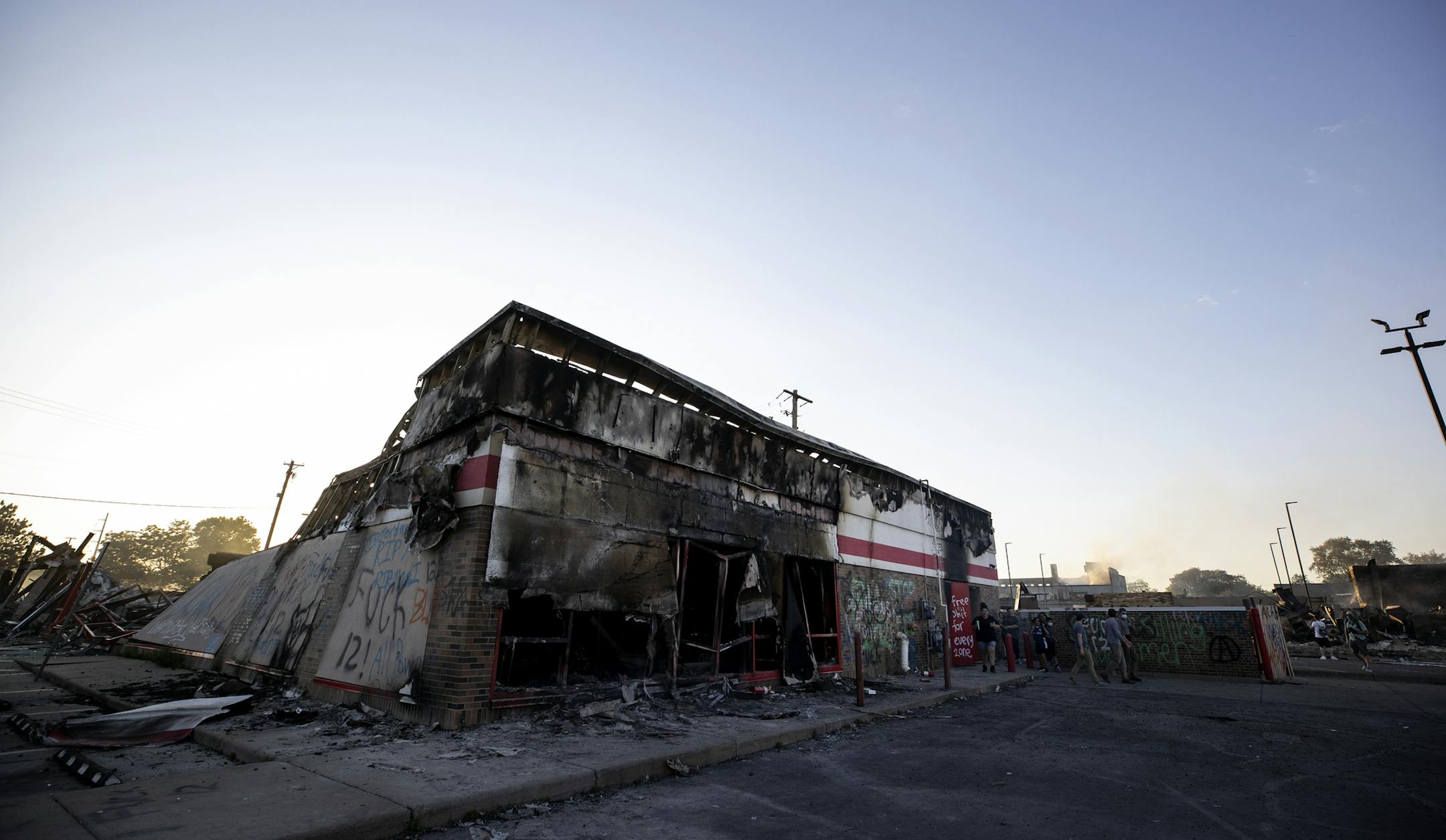
Last year, news reporters from many outlets were harassed by law enforcement during the protests after George Floyd's death, despite the reporters being clearly marked as press. Some were pepper-sprayed, some were shot with rubber bullets, and one was blinded in her left eye.
Now, almost a year later, during the Derek Chauvin trial, are law enforcement officers preparing to repeat the attacks on peaceful protesters and reporters while ignoring looters, arsonists and armed nationalists and letting the city burn? Twin Cities residents need to see the opposite. The marching orders for law enforcement must require protection of peaceful protesters, reporters and fire crews at all times in all places and capture of any looters, arsonists and armed nationalists who endanger our neighborhoods.
Some police may feel uncomfortable marching with and protecting people who are protesting against them for killing Black people without cause, but protecting our citizens is precisely their job. Citizen protection first!
Ron Bardell, St. Louis Park
• • •
"No justice, no peace." We are hearing and seeing a lot about that phrase lately as we watch our government board up the city, sometimes even with razor wire. How about the antithesis of that? "No peace, no justice." For those who are hellbent on disrupting the trial of Chauvin and the others going forward, there will be no justice for George Floyd or anybody else. The U.S. Constitution specifies the jury system to determine the guilt or innocence of the accused. It is not perfect, certainly not in the past, but it is how we keep order and peace in our nation. We need to let judicial system do its work in this case, without the threats of violence and the destruction of the city. That helps no one. Peaceful protests are our constitutional right, but disruptive violence is not included in that definition. Justice for all and peace!
Judith Stowe, Rogers
• • •
In anticipation of Chauvin's trial, Twin Cities law enforcement agencies are preparing for how they can respond if protests become violent. This training is largely focused around how to react in a dangerous situation. Although this type of training is important to keep law enforcement safe, why aren't there also measures being taken to communicate and work with organizers of the protests so that all parties involved can remain safe and First Amendment rights can be protected? If these conversations are happening, the focus of the news has not been around these conversations.
In the wake of the death of George Floyd, conversations have focused on keeping law enforcement officers and businesses safe and not so much on how to work on building relationships with organizers to keep everyone safe while continuing to work toward a more equitable community for everyone. Research and real-life examples have shown that focusing on the reactive strategies only increases the likelihood that these measures will be taken. We must begin to focus on working together and seeing others as people whose lives matter, and that starts with building space for conversations and relationships with organizers and the community.
Amanda Mann, Little Canada
INTERSTATE 94
Another idea: an original option
There is another option to the ingenious rerouting of Interstate 94 suggested by Jerome Johnson ("Don't just 'rethink' I-94 through Rondo, remove it," Opinion Exchange, March 5). In 1945, George Herrold, St. Paul's city planner, proposed routing I-94 between the two downtowns along the rail lines north of Pierce Butler Route. An elevated highway there was also proposed. Instead of subjecting drivers to years of delays as we repair the existing I-94, we could build a new highway where it should have gone 75 years ago, reroute traffic to it once completed and fill in the current I-94 trench, developing parks, affordable housing and other uses along it and using the revenue from land sales and increased taxes to partly pay for the new highway.
Thomas Fisher, St. Paul
• • •
I was captivated by Johnson's suggestion on how to rebuild the Rondo neighborhood by rerouting I-94. I'm a transplanted Minnesotan, having moved here in 1982, but I have read all the articles about Rondo over the years and how the interstate ruined a thriving community. Johnson's carefully considered suggestion of rerouting via the Ayd Mill corridor to I-35E makes incredible sense. One wonders why it wasn't constructed that way in the first place, but I guess we know why. This could be one form of reparation to the Black community in St. Paul.


