

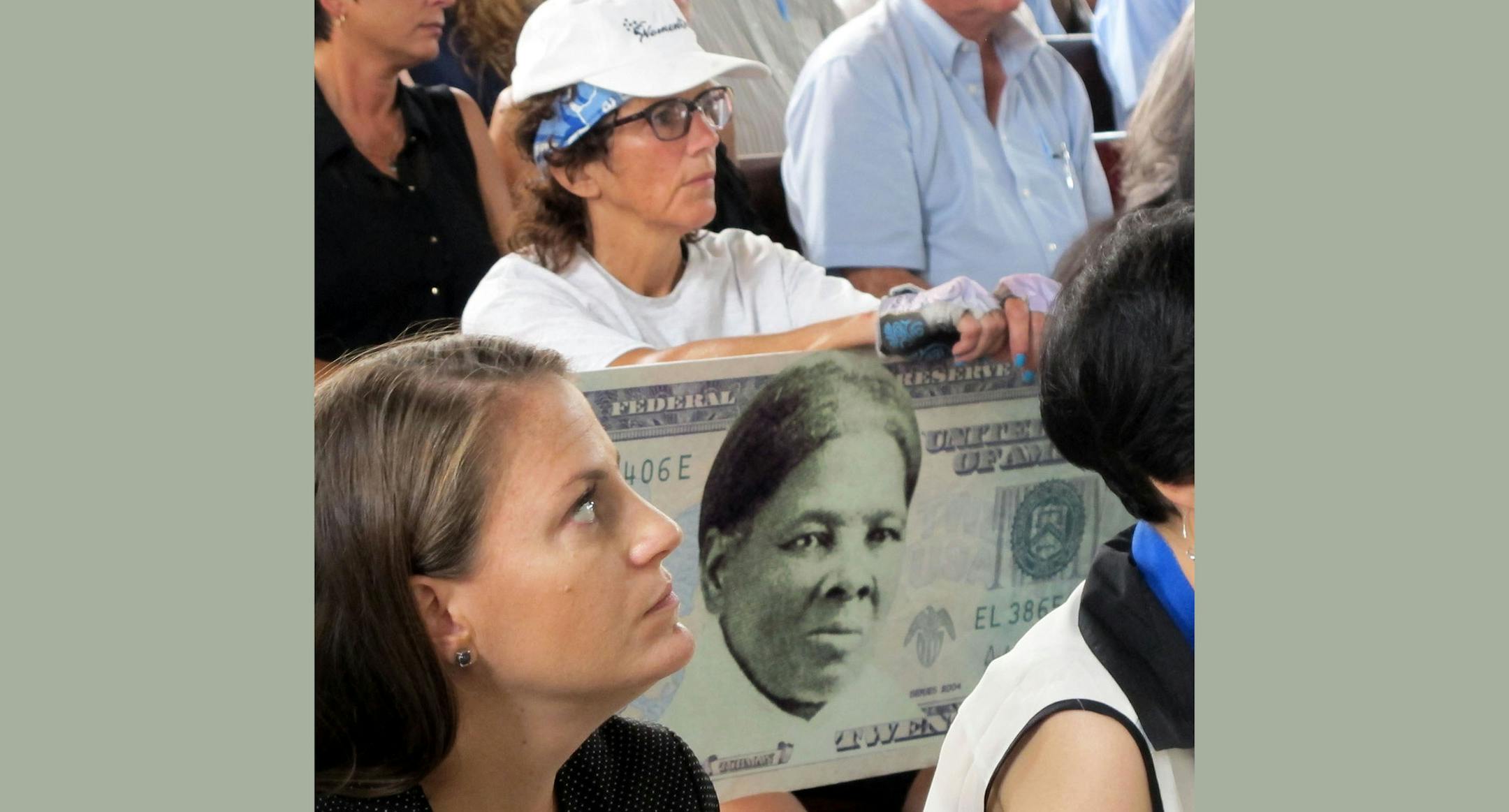
If educators rather than the Treasury Department had the greater say about portraits on U.S. paper currency, there might be more than one portrait on our bills ("Harriet Tubman's spot on $20 bill is not a done deal," Sept. 1).
Alexander Hamilton would be alongside George Washington on the dollar bill to honor teamwork during the Revolutionary War and close collaboration during the first presidency.
Portraits of two great leaders who preserved the Union during the Civil War — Presidents Abraham Lincoln and Ulysses S. Grant — could decorate the $5 bill.
The two prosperous slaveholders, Presidents Thomas Jefferson and Andrew Jackson, would rightfully share space and honors on the rarely used $2 bill. And once again, Lincoln could be engraved and enshrined on the $50 bill, near an image of our first African-American president.
As to the decision from the Obama era to place Harriet Tubman on the $20 bill: She earns that singular honor as a runaway slave, a Civil War veteran and a courageous U.S. civil rights pioneer — a woman for our times.
The imperfect history of the United States is currency for a wider public understanding of our national identity.
Steve Watson, Minneapolis
JUDICIAL NOMINATION
Editorial Board is wrong: Franken is showing courage
I have to disagree with the Star Tribune Editorial Board's opinion on U.S. Sen. Al Franken blocking the nomination of Minnesota Supreme Court Justice David Stras to the Eighth U.S. Circuit Court of Appeals ("On Stras, Franken opts for partisanship," Sept. 8). It is not comparable with the idea that we do the same to them as what they do to us. The heart of the false-equivalency argument is that the character of the Republican Party is such that tit-for-tat doesn't play anymore. And the Editorial Board is tatting here. Franken is doing his job to set a limit. One has to set limits with character disorders, and the Republican Party has a character disorder. We have to say "no" on occasion. It's no longer the same political bickering when we progressives fight back. Fighting is sometimes necessary, is it not? At this point, bipartisanship is not only worthless, it is inadvisable. We are dealing with a character disorder.
Larry LaVercombe, Minneapolis
• • •


