

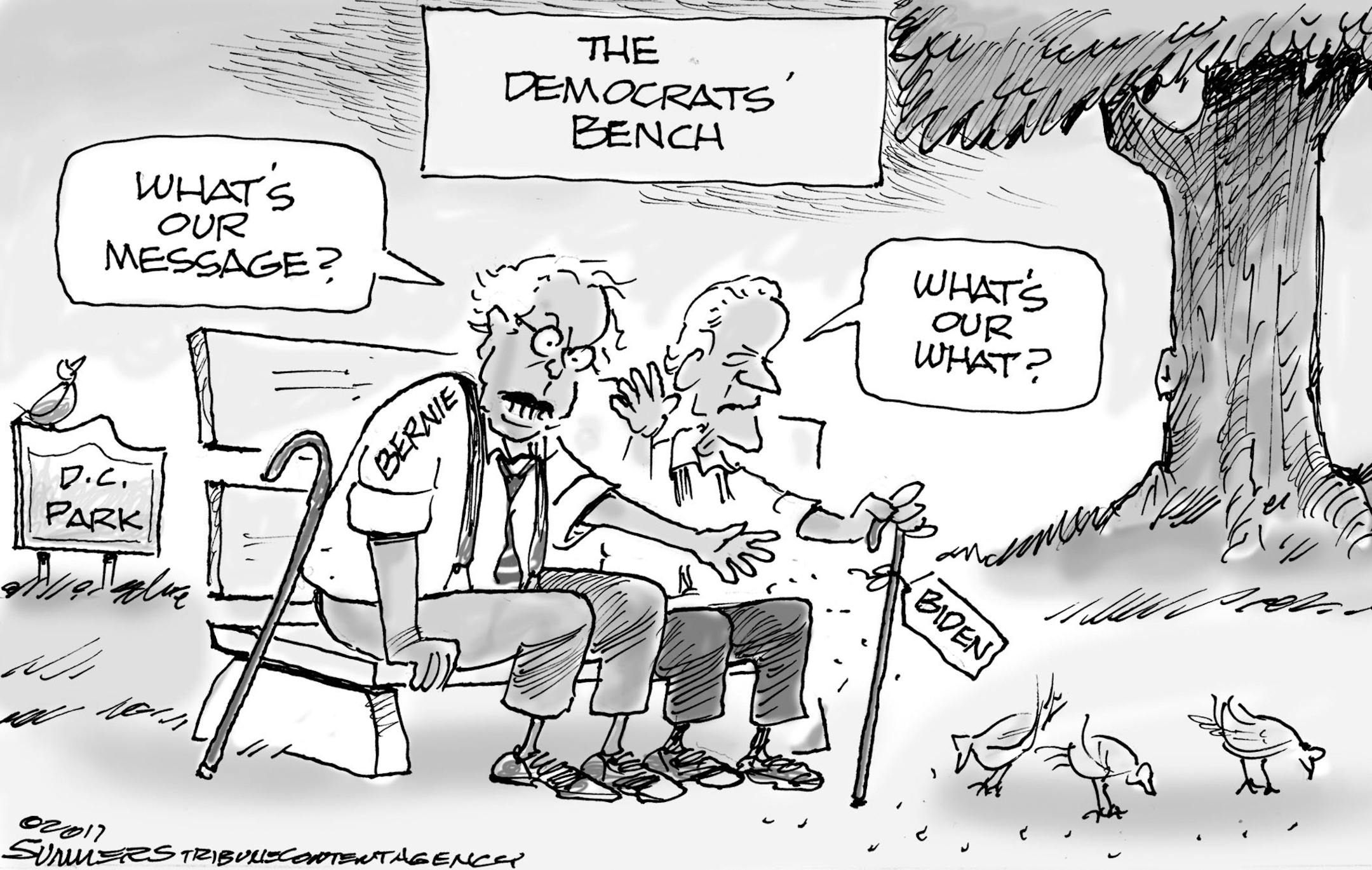
Recognizing that most Op-Ed cartoonists are on one side or the other of the political spectrum, and admitting that I am a fan of the Star Tribune's Steve Sack (so my leanings are pretty obvious), I think that a number of the cartoons the Strib has run from national sources lately are clearly mean-spirited and divisive. The one Friday depicting the media as a clown show is similar to the Trump White House's delegitimizing of the media as unprofessional and "fake news." The newspaper does a bad turn in furthering the nastiness of a president whose daily behavior has been so despicable that people seem to have forgotten how decent presidents behave.
David Miller, Mendota Heights
• • •
Informed and caring people do not like stereotyping. I don't like the editorial cartoon presented by the Star Tribune on July 5 (reprinted above). It depicts two 75-year-old men, Bernie Sanders and Joe Biden, with walking canes. In addition, Biden is depicted as having a hearing problem and possibly a severe visual problem. I happen to be 75, and am able to function quite well without a cane, hearing assistance or visual correction other than "readers." I'm certainly not alone. Even so, it's OK to need various kinds of assistance. Many people who do are not significantly limited in other ways.
I understand and even enjoy the role of political cartoons. Still — in a strained effort to be diplomatic — I do suggest the Strib be more selective.
Jim Bartos, Brooklyn Park
• • •
I found the Dana Summers cartoon showing only Sanders and Biden on the "Democrats' bench" more than a little strange, but the fact that a Minnesota paper ran it is even stranger. If the Star Tribune's opinion-page staff feels that this portrayal was accurate, I'd like to introduce them to two senators named Amy Klobuchar and Al Franken. I believe they would be on that bench, certainly ahead of Sanders, who isn't even a Democrat. Not to mention Elizabeth Warren, Cory Booker, Adam Schiff, Julian Castro, Kirsten Gillibrand, Tulsi Gabbard, etc.
David Frederick, Coon Rapids
UNDERGRADUATE EDUCATION
Commentary surveys situation and thoroughly misinterprets it
Jeffrey Selingo's rambling piece about college ("Three solutions for undergraduate education," July 3) cries out for comment. His arguments seem to me both uninformed and ill-advised. He confuses issues about tenure with issues about poorly paid adjuncts covering a disproportionate number of classroom hours. He makes a hollow cry for more "rigor" in undergraduate degrees (a cry that has resounded since the very first degrees were granted) but doesn't really offer any "solutions."
Selingo's worst mistake is his misunderstanding of how long it should take to become competent in a field of study. He suggests that, after a one-year "general education" term, those studying computer science might need three years to finish a degree, while those studying English or history might only need one, since they are "going to need further education throughout their lifetimes anyway."

