

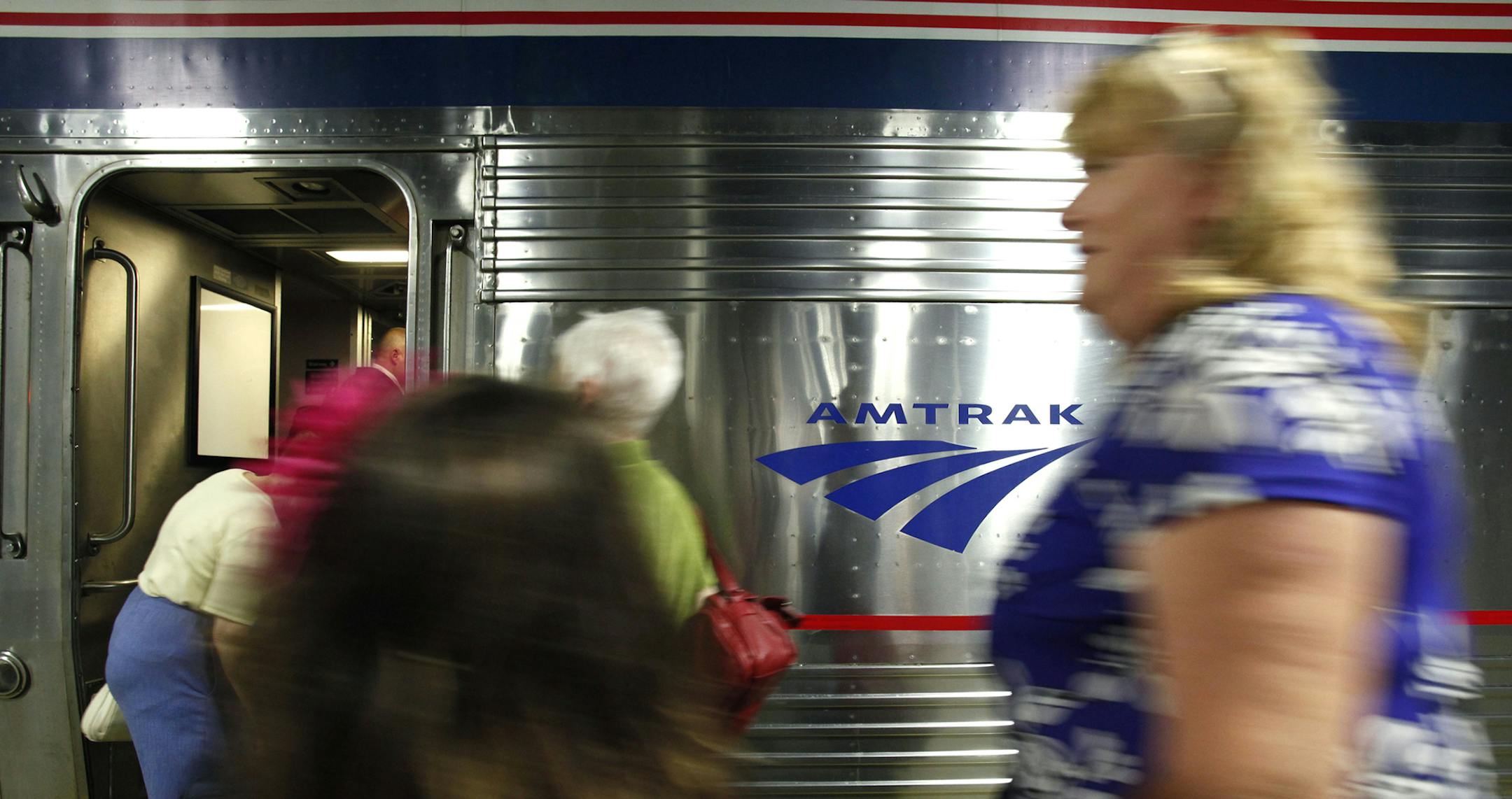
It was encouraging to learn (May 15) that more and more travelers in Minnesota — including the millennials who shun driving — are riding Amtrak's Empire Builder to both in-state and out-of-state destinations. It was even more encouraging to learn that the Midwest Interstate Passenger Rail Commission has documented that ridership would grow even faster if additional frequencies and routes were added to Minnesota's sole daily passenger-train service. But it was discouraging to learn that some members of the Legislature not only are opposed to the state's funding of passenger trains but are seeking to close the Minnesota Department of Transportation's three-person Office of Passenger Rail.
Such a move would put Minnesota out of touch with not only the latest trend in American mobility but with the 15 states that fund passenger trains. These states range literally from Maine — with five daily frequencies from Boston to Portland (plus two continuing to Brunswick) — to California, where 30 daily round-trips operate over three different routes. Oregon and Washington jointly support the Cascades Corridor, where five daily round-trips connect Seattle and Portland, with three extending south to Eugene and two north to Vancouver, B.C. North Carolina funds two daily round-trips between Charlotte and Raleigh and is investing more than $300 million in a major track-and-signal upgrade that will bring faster speeds and smoother rides. The state is also investing in new locomotives and coaches so it can double the frequencies on this route to four a day.
Michigan, Oklahoma, Texas, Illinois, Missouri, Wisconsin, Virginia, New York and Pennsylvania all support at least one daily train and several support multi-route networks. Ridership on all trains is up, and experience in Illinois and North Carolina has demonstrated that when a single daily round-trip is doubled, the ridership doubles almost immediately, suggesting that Minnesota riders will strongly support a second daily frequency connecting St. Paul and Chicago.
Minnesota needs to align itself with the nationwide passenger-train trend and get in step with the leaders quickly.
James E. Coston, Chicago
The writer is chairman and CEO of Corridor Capital LLC.
POST-INCARCERATION
What happens after release is still a public problem
The reality of being released from jail without transportation ("Free from jail — but stranded in Hastings," May 17) is compounded in rural areas, where there are often no transportation options for leaving town: no buses, no taxis, and often problems of distance if someone still cares. People are incarcerated 30 to 100 miles from home. I will never forget the man who came to the church I served in Thief River Falls one bitter January day. He was from the Twin Cities. Arrived in Thief River in June with a light jacket. It was below zero, and all he still had was that light jacket and a need for a ride home 250 miles away. The church I serve in Milaca is across the street from the Mille Lacs County jail. Local law enforcement has been helpful, but the problem continues.
The Rev. Timothy Bauer, Milaca, Minn.
TEACHER CREDENTIALS
Is this a union issue? A funding issue? A quality issue?
Regarding "GOP rewrites teaching rules" (May 17), I would offer up several questions. Why do Minnesota Republicans believe that it is appropriate to write a bill that says that some teaching positions would not be unionized? Is it constitutional for a political party to promote who can and/or who can't join a union? Is this ethical? Why does Education Commissioner Brenda Cassellius state that she would not recommend the bill to Gov. Mark Dayton (who vetoed it on Thursday) unless it ensured that there is money in the budget to deliver the bill's policy changes? Does this mean that she would then actually support the bill with specific monetary funds attached? In other words, she basically supports this bill. I would also like to be enlightened by the GOP as to what constitutes "lower-tier teaching positions." I did not choose to send my two children to public schools for 26 years to be taught by "lower-tier" teachers. Their public schools teachers were fully accredited and off-the-charts amazing! Both were fully prepared for postsecondary education. Contact your legislators and address concerns about this bill.
Christine Anderson, New Brighton
• • •


