

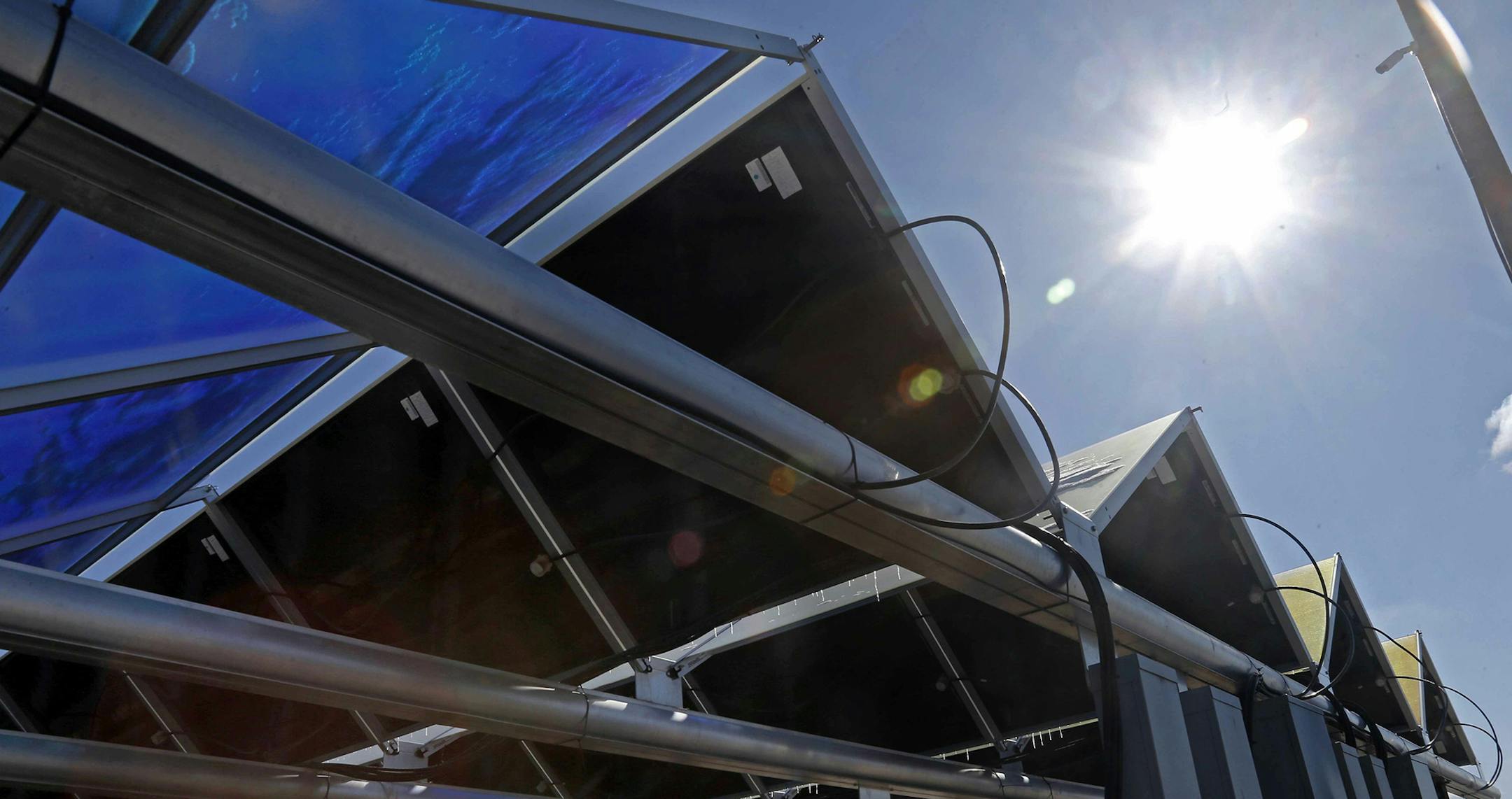
In response to state Rep. Pat Garofalo's letter on community solar, it is disingenuous to claim that "every dollar of savings" to community solar subscribers comes in the form of higher rates to other Xcel customers ("Sounds appealing until you consider the fine print," Readers Write, Nov. 22). There is well-documented analysis showing that the work of solar developers adds quite a high amount of value to the grid in the form of avoided costs of power plant construction, fuel costs and transmission lines — all investments that customers would otherwise have to pay to the utilities. The vast majority of the credits Community Solar subscribers receive are compensation for these direct benefits.
Community solar gardens enable residents to make their individual choices without as much government oversight, something that Republicans should love. Let's not accept red-herring arguments to prevent people from having choices where energy and finance intersect.
Focusing everyone's attention on the cost-shifting caused by solar might as well be the pot calling the kettle black. Rural Xcel customers with several miles of distribution line going to them get charged fairly at the same rate as urban customers, even though the infrastructure to serve them costs a lot more. Also, as the result of energy legislation this year, large energy users won the privilege to negotiate lower rates despite using the grid more strenuously.
It is also unfair to single out solar as costly without also acknowledging the climate and public-health externalities from coal and gas, which create far more major cost-shifts onto the public. People's health and economic well-being depend on clean air and water and a stable climate.
The scenarios where community solar would result in cost-shifting are projects that don't capture very much in avoided substation and transmission costs and when developers sell primarily to corporate consumers and wealthy residents rather than those in poverty who need stabilization of their electricity costs. However, there are people within the Just Community Solar coalition who are addressing that issue, as the article pointed out ("Solar gardens: A new choice for Xcel users," Nov. 15).
Lee Samelson, Minneapolis
FARMING
Cover crops can play a role in addressing climate change
The article "Farmers run for cover crops" (Business, Nov. 23) identified numerous benefits in planting cover crops. Carbon sequestration is another additional huge benefit that cover crops provide. Every plant takes in carbon from the air, and when that carbon is tilled back into the soil, it is sequestered, or essentially taken out of the air. The role that soil can play in carbon sequestration can be incentivized for all farmers to balance any costs that they must pay to plant the cover crop. Once cover-crop protocols are established for our northern climes, farmers will become real heroes in addressing climate change.
Kathryn Iverson, Edina
9/11 RECOGNITION
Consider these facts, too, before slamming U students
A Nov. 23 letter writer pleads for parents and grandparents to "intervene and guide" so as to provide the "insights and wisdom necessary so our youths graduate as proud, informed Americans" ("U student government looks like it needs parental guidance"). The writer wishes to keep "alive in our memories forever" the victims of 9/11. This is well and good.
I also sincerely hope that political correctness (PC), or "political coercion" as the writer calls it, will not prevent the possibility of Americans being encouraged to remember forever the tens of thousands of innocent men, women and children killed by Americans in the ill-conceived revenge war perpetrated upon the citizens of Iraq as a result of 9/11. (None of whom, as far as we know, was complicit in the 9/11 attacks.)


