

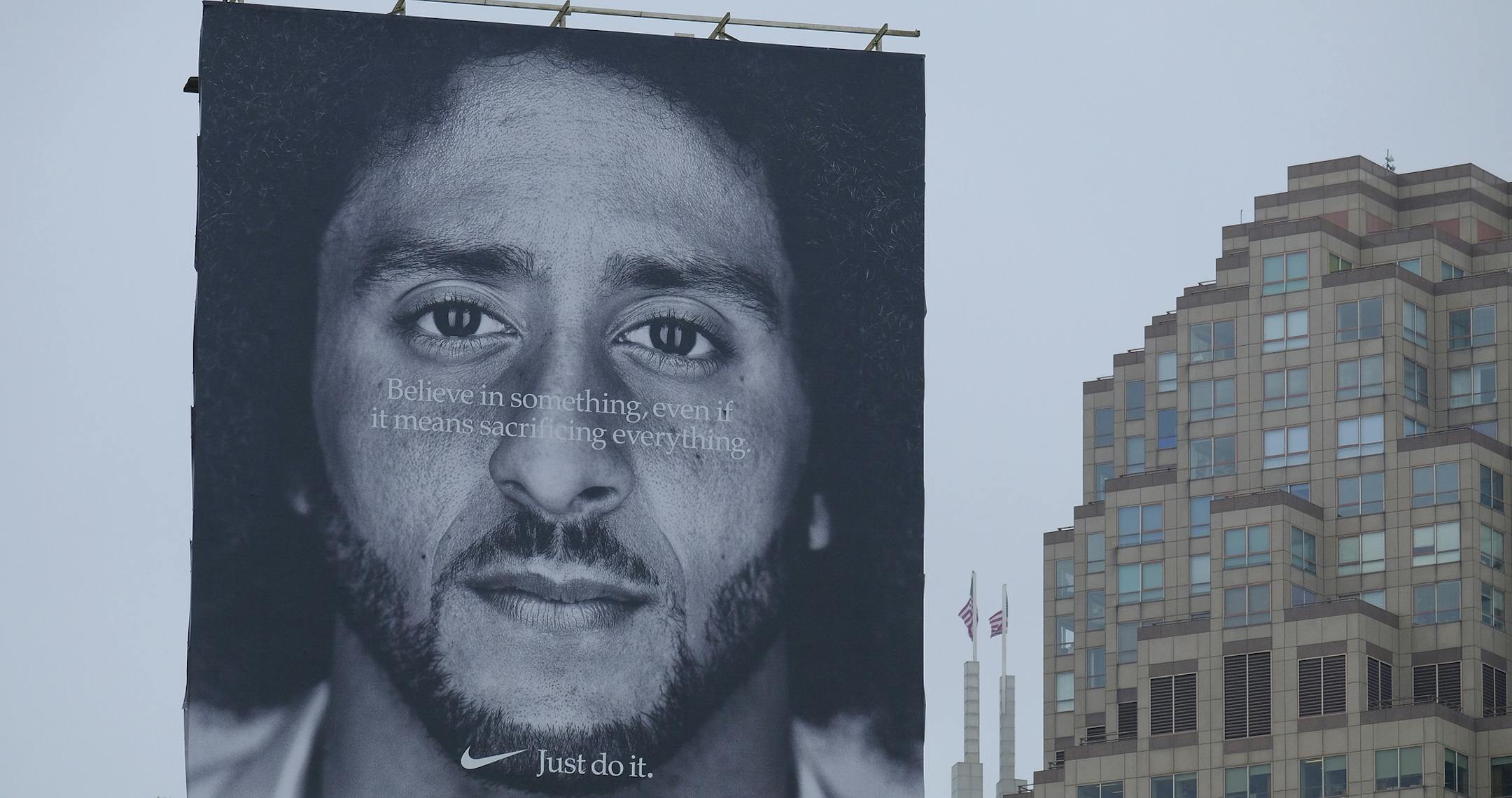
My jaw dropped when I read the article about Nike's new "Just Do It" ad campaign featuring Colin Kaepernick and the slogan: "Believe in something. Even if it means sacrificing everything" ("Nike's Kaepernick ad sparking controversy," Sept. 5). It takes some serious corporate courage to celebrate an athlete who has bucked the system as Kaepernick has. Clearly, Nike has taken a huge risk, betting there is a profit in tying its swoosh to an athlete who has sacrificed his career and reputation to raise awareness about racism and quicken its end.
Whether Nike's ad campaign yields an economic profit remains to be seen, but there are already some intangible benefits. We are thinking and talking again about what Kaepernick did and what it means. We're realizing it's a much more complicated, nuanced issue than can be summed up in a tweet that brands him as "unpatriotic."
Pinning down a definition of patriotism on which everyone can agree is not easy, but the definition of "true patriot" credited to Bob Dylan comes awfully close: "…a true patriot [is] one who, indeed loves her or his country, but also one who sees the way things are, and one who works for change to make things better."
That sure sounds like Kaepernick to me.
PEGGY BRENDEN, St. Paul
ENGLISH MAJORS
The field holds enduring, broad-based value
"My kingdom for an English major!"
Before chemists, economists, civil engineers, and every other professional group can even start to do what they do, they have to engage in highly creative problem-solving — applying their imaginations to consider what might be as much as what is — and then write, at least internally, about everything they do ("For English majors, not the best of times," Sept. 4).
According to the U.S. Naval Academy, "On commissioning, English majors become Medical Corps officers, pilots, SEALs, submariners, surface warfare officers (both conventional and nuclear), and all manner of Marines. They can advise leaders on matters of public affairs or educate an entire squadron on the intricacies of the mechanical, electrical, hydraulic, and weapons systems of its helicopter."
If colleges abandon liberal-arts degree programs, there won't be much left to differentiate them from technical schools.


