

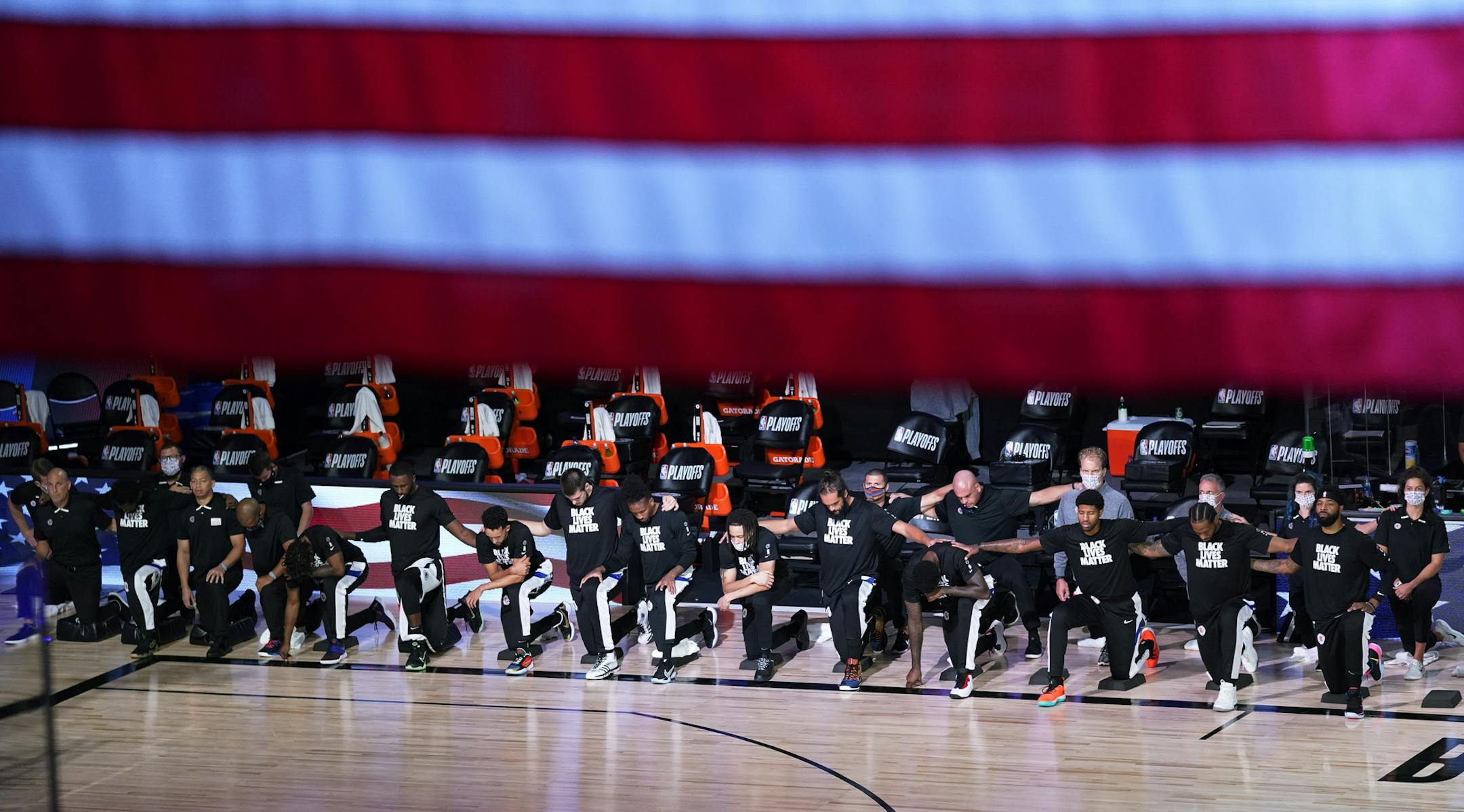
Mark Dvorak of the American Legion ("Why we must protest national anthem protests," Opinion Exchange, Sept. 16) insists on what he calls "unity" during performances of the national anthem. He and all members of the American Legion deserve respect for their service, in uniform, to the nation. The need for uniformity among those serving in that way is clear.
Yet uniformity is not unity, at least not in a nation whose founding documents, Pledge of Allegiance and anthem all declare freedom as our common value. Unity for the nation as a whole goes beyond uniformity in service. If we value freedom, we must value the freedom of individuals to choose how they show respect.
I stand for the anthem in public (and sometimes in private, in front of my TV). But I stand for the freedom it proclaims — the freedom that allows others to kneel, if they choose.
Remove that freedom, and you remove the meaning of the anthem and the flag. A flag that no longer stands for freedom may look the same, but it won't be the flag to which I have pledged my loyalty. Its meaning will be sacrificed to the insistence on uniformity over liberty.
Hal Keen, St. Paul
POLICING
More than one metric for racism
A retired Eagan police chief and recent letter writer criticizes journalists for "join[ing] in lockstep to the Black Lives Matter agenda" when discussing whether systemic racism exists in policing. ("What happened to digging deeper?" Sept. 10.) The writer goes on to suggest that systemic racism in policing is not a problem because African Americans constitute a high percentage of murder suspects, police killings make up a small percentage of African American death rates, and police rarely use lethal force in arrests. Even assuming these statements are true, they do not disprove the existence of systemic racism in policing — that argument assumes that lethal use of force is the only way of measuring systemic racism in policing.
But systemic racism in policing manifests itself in ways that do not involve lethal use of force. For example, the Star Tribune reported that police records show that from June 2019 through May 2020, Black and East African drivers accounted for 78% of police searches arising out of moving or equipment violations in Minneapolis, while white drivers accounted for only 12% of such searches ("MPD searches Black drivers more," Aug. 7). Of the Black and East African drivers stopped and searched in Minneapolis, only 26% were arrested, while 41% of the white drivers stopped and searched were arrested.
This suggests that Minneapolis police should be searching white drivers more often than they do. It also demonstrates that lethal use of force is not the only metric to consider when determining whether racism plays a role in policing.
Terrance Newby, Roseville
JUSTICE
A different approach is possible
What might have been different if officers responding to a call about a counterfeit bill had begun with de-escalation?

