

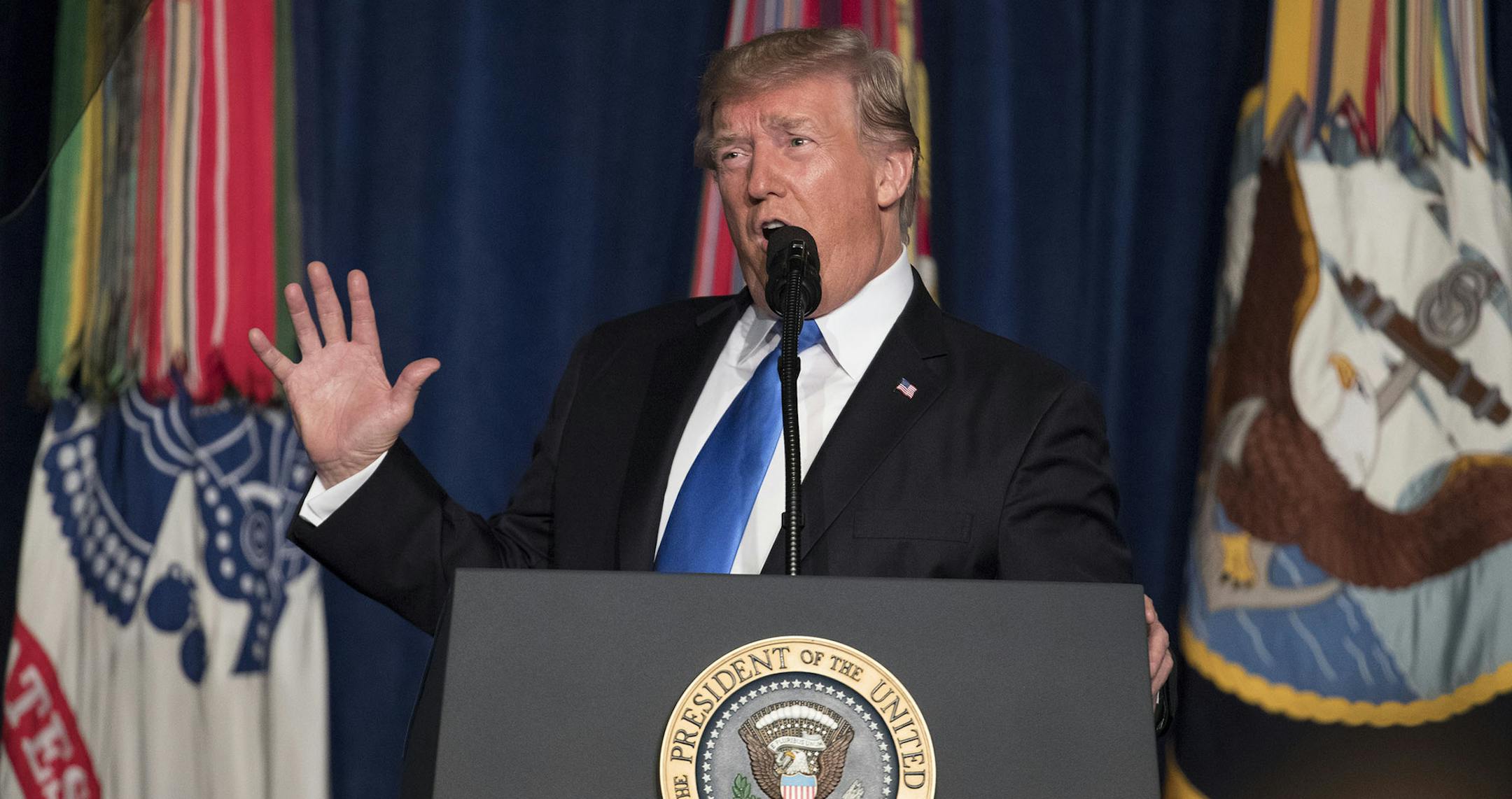
In his address Monday night, President Donald Trump articulated his strategy for the quagmire in Afghanistan, which clearly embodies his "America First" ideology. "We are not nation-building," he stated matter-of-factly, "we are killing terrorists." While that's a nice sound bite, the president's quip represents a failing foreign policy that leaves a power vacuum in our military's wake that allows America's enemies to flourish and undermines the safety of our homeland.
As the president correctly articulated in his address, a fragile or failed state provides exactly the type of environment necessary to foster terrorism. One need look no further than the now-declining Islamic State's presence in northern Iraq and eastern Syria to understand the danger posed by a nation without leadership. However, this very example demonstrates why nation-building is a critical tool in America's foreign-policy toolbox — because while the American military is unrivaled in its ability to decimate enemy forces, it is unable to prop up a new state in lieu of that which it destroys.
The problem with the president's strategy as articulated is that international affairs must leverage all our country's foreign-policy capabilities in handling conflict. Engaging America's diplomatic forces and international aid capabilities in establishing new nations after tyrants and terrorists have been defeated has always been a critical step in military affairs, from the Marshall Plan to the burgeoning Democracy in Afghanistan today. Killing terrorists might excite the president's core voting base, but it does not make for a safer world.
Sean Lynch, Minneapolis
THE PLIGHT OF AID WORKERS
Dispatch from South Sudan was an important look at complexities
The Associated Press article "Aid workers face unique crisis in South Sudan war, says ICRC" was an important piece to be featured recently on the Star Tribune website because it addresses issues that are faced by both South Sudan civilians and aid workers, rather than just one or the other. I am a journalism intern at the Borgen Project, a nonprofit fighting global poverty, and I am frequently reading and writing articles about the issues people face due to extreme poverty. I have also learned a lot about the volunteers and aid workers who help improve the lives of these individuals, but I seldom read about the issues that these workers are facing themselves. It was very interesting to read about the threats these refugees, specifically women and children, are facing from the view of the aid workers. While they are working to help these civilians in any way they can, they are also concerned with having to relocate and switch hospitals to avoid the violence and other dangers of the area. It was interesting to read about the protection of humanitarian laws protecting these refugees' rights, but it was also eye-opening to read about the intense problems they are facing and how helping them isn't necessarily as easy as it seems it would be.
Kassidy Tarala, Minneapolis
TRANSIT OPTIONS
Plans find their foes, yes, but also their supporters and riders
I'm writing in response to Lori Sturdevant's Aug. 11 column "There's no transit plan so needed, so far off that it can't find its foes." While I am personally excited that the Riverview study is moving forward, it is clear that intense opposition to certain routes and modes already exists — but equally clear that this fevered opposition is far from universal. I recently attended a much-less-acrimonious Riverview public meeting where numerous residents expressed a desire for transit improvements, especially along West 7th Street in St. Paul and toward the airport and Mall of America.
When I think about the current No. 54 bus service in the corridor, I think especially about the local riders — the array of working people who are already using it and deserve an enhanced transit option. The needs of these longtime, working riders are extremely important to consider, especially because the Ford site route would be longer and much less direct than the current bus service. I believe that arterial bus rapid transit would be great for the corridor, but the capacity of streetcars vs. buses is also important to consider, because streetcars could better absorb future ridership growth.
In the past year, I have seen firsthand what even a modest transit investment — the A Line — has done for the Snelling-Ford corridors. At the end of the day, the status quo (the no-build option) in the Riverview corridor, with packed buses, marginal stops and insufficient service, is not acceptable and will only worsen with continued population growth. Say yes to better transit!
Gordy Moore, St. Paul
ENDING RACISM
Yes, strengthen communities; that starts with ending denial
An Aug. 20 letter writer's recommendations for putting a "dent in the armor of racism" miss the mark ("Put your money where your mouth is to help fight racism"). By all means, we should roll up our sleeves and build homes and stock food shelves to strengthen our communities. But these actions simply address the end result of racism and poverty, not its sources. Ending racism and advancing social justice requires white people to do the hard work of addressing the sources of institutional racism — voter suppression and district gerrymandering, racial profiling and school segregation — to name a few.


