

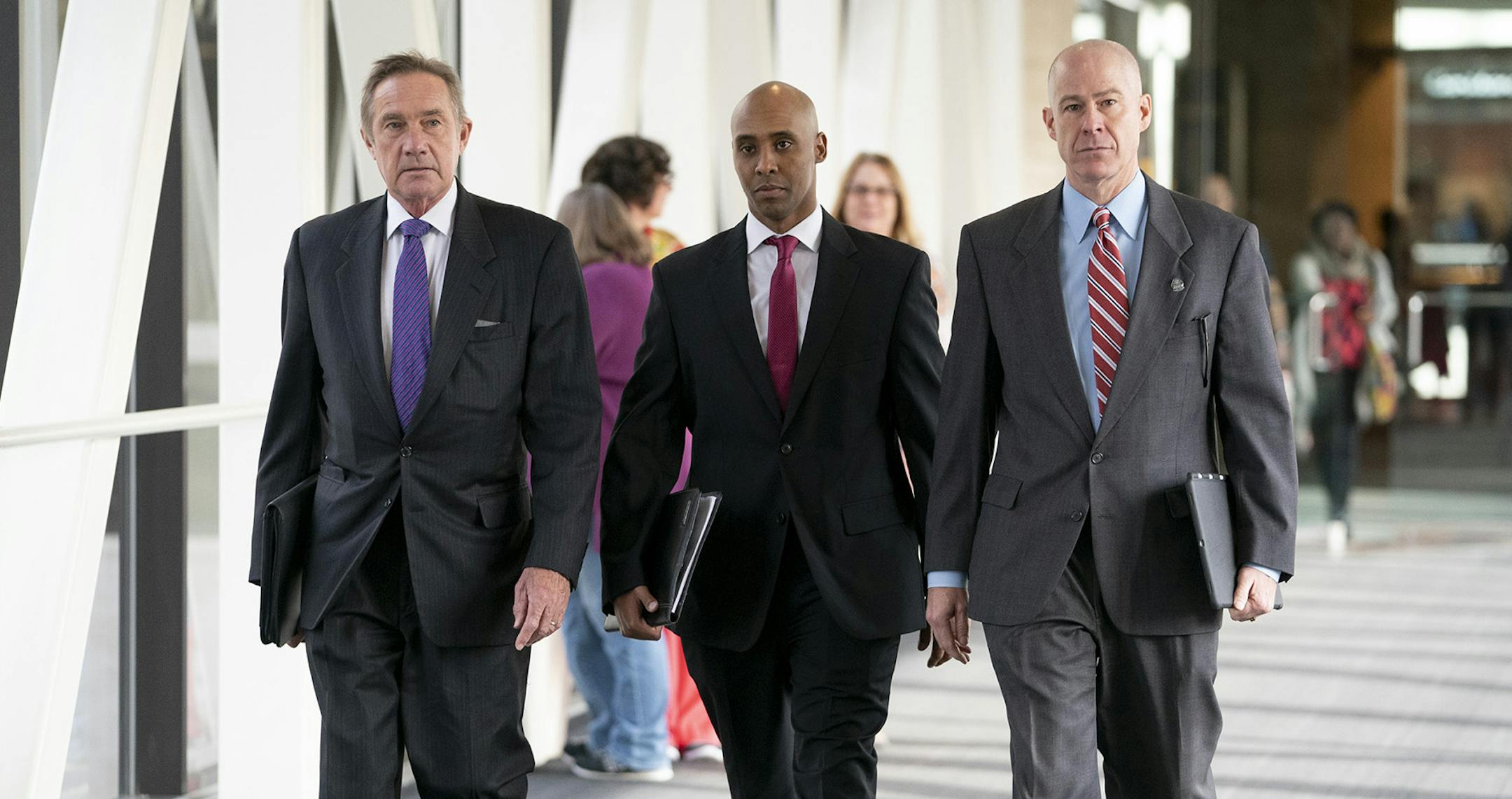
Have we learned nothing in four decades? Citing the need to preserve "order and decorum," Hennepin County District Judge Kathryn Quaintance has banned cameras and ordered "the highly anticipated trial" of Mohamed Noor into a courtroom with barely a few dozen seats. Never mind that this is reportedly "the first time in modern history a Minnesota police officer has been charged with murder for an on-duty death" ("Tight lid is put on access to Noor trial," March 29) and the first time the community would have an opportunity to hear in detail the actions of all those involved in this tragic incident. Never mind the international interest in the death of Australian-American Justine Ruszczyk Damond in the alleyway behind her home.
Instead of allowing the public to hear and weigh the evidence gathered in this high-profile case in a transparent fashion, the court has gone into full ostrich mode. Never mind whose tax dollars pay for the work of judges and prosecutors. Consider that this April marks the 40th anniversary of cameras being allowed in Florida state courtrooms. I know, because I used to be a TV reporter in Jacksonville, Fla., back then and covered televised trials. Before that I worked in Waterloo, Iowa, a state that allowed cameras in courts experimentally in 1979 and regularly since '81. Wisconsin has had them even longer — since '78. But not Minnesota.
The decision betrays a lack of trust in professional journalists to provide an unobtrusive pool news feed. This is not the only jurist to not trust the community to hear the same evidence presented to jurors. Worse, our entire legal system — and the Legislature that funds it — has failed to learn from the decades of success 34 states have had with cameras in the courtroom (in trials of all kinds) to administer justice, observe the First Amendment and inform the public.
Tom Garrison, Eagan
• • •
I have been watching all the angry people lambasting the decisions to limit certain types of access to the trial of Mohamed Noor. I have to ask these folks: What, exactly, will it contribute to the process of seeking a just decision if every detail is splashed across the media, made available to every curious onlooker? I do not need every photo; I can read transcripts that tell me every word that is said. And it's not my decision! We have become a nation of voyeurs, and we seem to think each one of us knows better than any official body. I applaud Judge Quaintance for trying to manage this circus intelligently.
Adair New, Minneapolis
PEDESTRIAN SAFETY
We have laws, but clearly they're not well-understood
Two recent letters to the editor suggested that to improve pedestrian safety at unmarked crosswalks, pedestrians need to be far more cautious and alert. These comments were made in reference to Minnesota Statute 169.21, Subd. 2, that states that "no pedestrian shall suddenly leave a curb or other place of safety and walk or run into the path of a vehicle which is so close that it is impossible for the driver to yield."
While their points regarding pedestrian precautions are certainly very valid, awareness of this law by drivers also needs to be significantly increased, because this same law also clearly states that "the driver of a vehicle shall stop to yield the right-of-way to a pedestrian crossing the roadway within a marked crosswalk or at an intersection with no marked crosswalk." I say this because as a pedestrian, I have crossed unmarked intersections on busy streets hundreds of times. And, yes, I am also very careful not to venture out in front of traffic and put my safety at risk. But I would estimate that fewer than 1 in 10 cars will slow down and stop and allow me to cross the street. This is scary!
And while intersections with flashing lights or markings for pedestrian crossing may improve safety at those types of intersections, drivers may still think that stopping for pedestrians is only necessary at these crossings.
So a serious public education on pedestrian safety, especially for all drivers, is also very clearly needed.


