

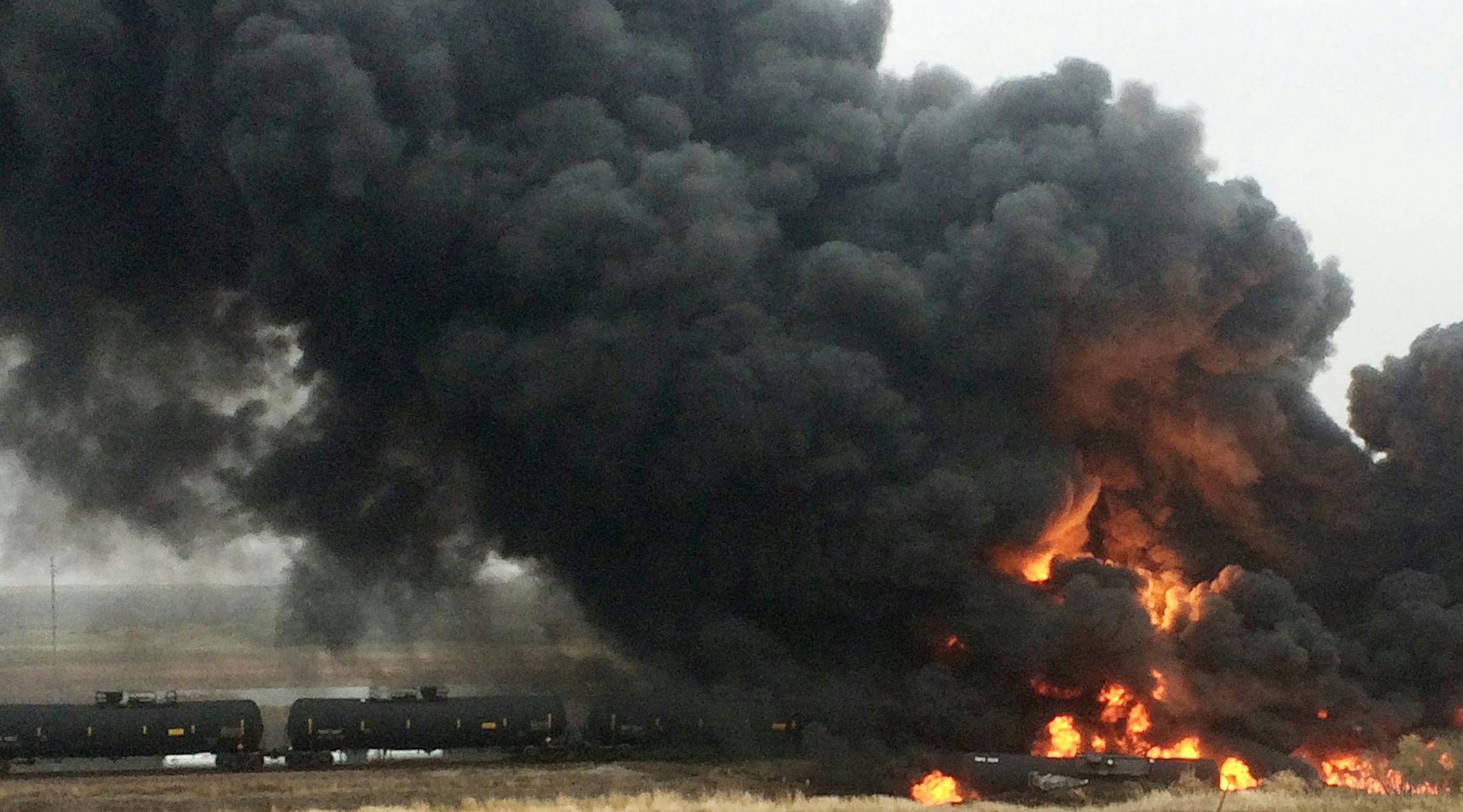
I doubt I'm the first fantasy railroad engineer ("Town evacuated as oil train burns," May 7) to ask this question: Is having 100-plus railroad cars with heavy liquid sloshing inside and moving at frequently changing speed on sometimes geologically infirm and shifting strata not an invitation to disaster? When I was 6 and set up my first Lionel train set alongside the Christmas tree, it wasn't long before I intuitively understood that number of cars, speed, continuity of speed, weight of cars and subtlety of grade were all factors in avoiding derailment, necessary calculations for arriving safely at my cardboard station.
Though I'd not yet studied algebra or calculus, my young instincts took me far, as I wondered why increasing any one of these factors as an arithmetic add-on seemed to exponentially multiply the likelihood of negative consequences. All of us who are no longer kids but now community stewards need to trust our seemingly unexpert perceptions. Let's not forget the prevailing fantasy of owners and shareholders — that profit margins and "holiday greed" unregulated continue to trump issues of public safety.
Judith Monson, St. Paul
LIGHT RAIL
When weighing expansion, know that some really value the service
There has been a running commentary on the cost of light-rail expansion in the Twin Cities. Full disclosure: I regularly use light rail, buses and bike trails — snow, rain or shine. My views will likely differ from those of a politician who only takes public transit as a publicity stunt and not as a primary means of transportation. I favor light-rail expansion.
However, I believe one big consideration should be taken into account anytime an issue like this is presented: Are politicians, and for that matter all Minnesotans, willing to look beyond themselves and their pocketbooks? Will we be willing to do something that may not directly benefit our lives but will benefit the lives of others, now and in the future? I imagine if critics of light-rail expansion were presented with personal stories from real people, their minds would change. I'm curious if the Star Tribune is willing to seek out those stories — the voices of people who need this expansion.
Frederick Messmann, Minneapolis
'FARMER-BASHING'
I've heard it all before, but the fact is, not all are good stewards
I am compelled to offer a quick response to the May 6 commentary by Noah Hultgren from the Minnesota Corn Growers Association ("Buffer bill: Enough with all of this farmer-bashing). I lived on a hobby farm in southern Minnesota for 20 years and watched my local lakes go from bad to disgusting over that time. As an avid fisherman and outdoorsman, it was very upsetting. Now that I live in northern Minnesota, I can speak out much more easily.
I was friends with my farm neighbors and my lakeshore homeowners association neighbors and watched the finger-pointing and paid close attention to the water-quality studies and statistics. There is nothing new here. I paid close attention to manure spreading, farm chemical application, plowing practices and water resources all around the area. I heard all the ag associations whining about farm-bashing and burdensome regulation and how all farmers are good stewards of the land and always use best practices. There is nothing new about that rhetoric, either.
Some farmers care about water quality, but most don't or at best feel that they can't afford to. Facts are facts, and farmers need to be forced to be accountable. The honor system is part of the problem, and money trumps honor in Big Ag, the same as in any other big business. The bottom line and the fact of the matter is that farms are responsible for the vast majority of the serious water pollution all across southern Minnesota. Kudos to Gov. Mark Dayton for putting political correctness aside and standing up to the powerful ag lobby regarding the terrible problem with water quality and with all of the wildlife and public-use issues that flow from farm runoff into lakes, rivers and streams.
Don't be fooled again.


