

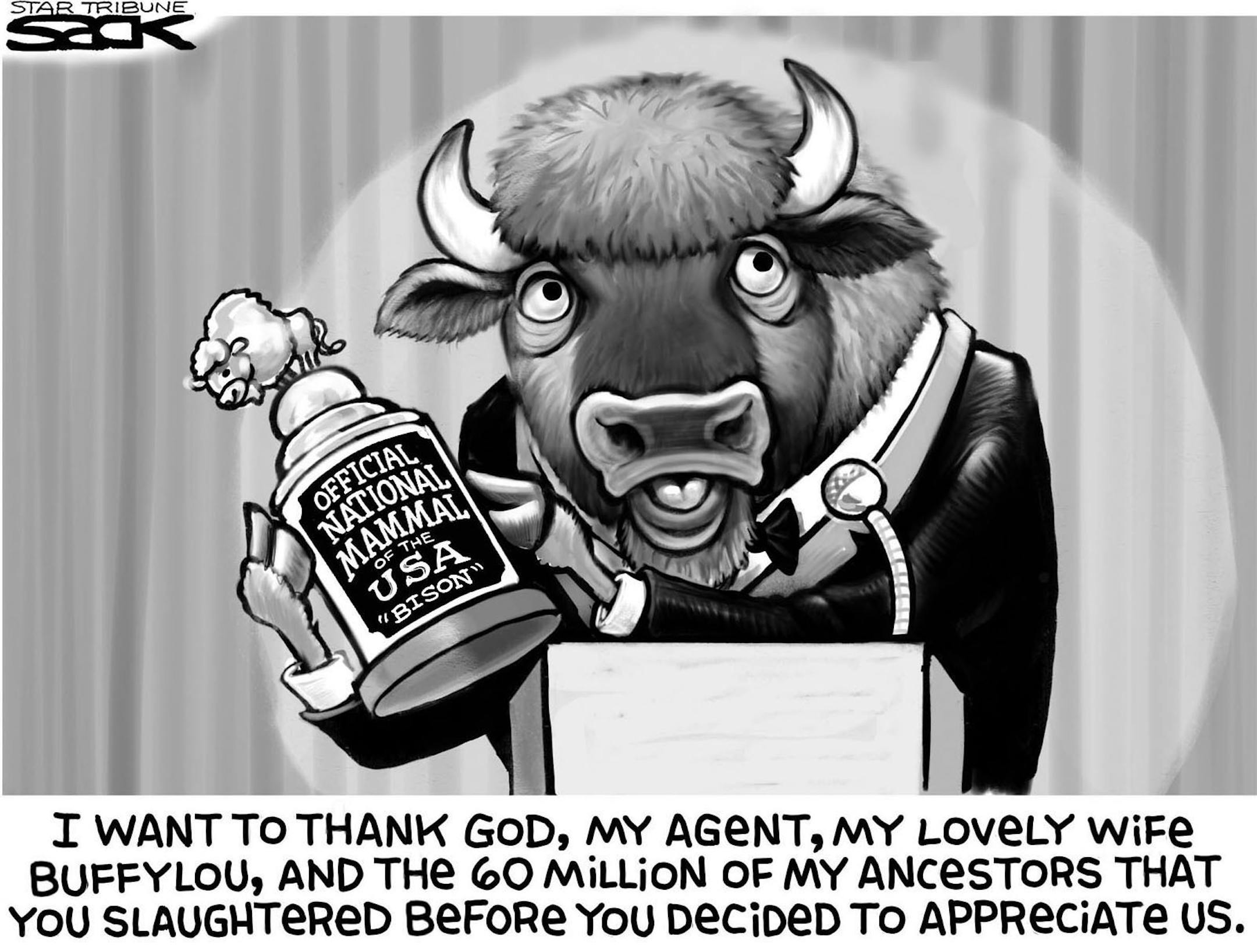
Steve Sack almost needed a small editorial to point out all of the irony he left out of the May 11 editorial cartoon. It is true that we brought the bison to the brink of extinction in this country before finally granting it the honor of being "national mammal." It was just the opposite with the bald eagle, which became our national symbol before we tried to kill it off. I hope no one's thinking of naming a national fish, because we have a pretty poor track record on this stuff.
But that isn't the last piece of irony Sack could have injected. If one wants to quibble about genetics, Congress made the Canadian wood buffalo the national mammal. After all, the numbers of bison in the U.S. had dropped so far that there wasn't enough genetic diversity to save them without significant interbreeding with the Canadian wood buffalo.
I wonder what Trump would say about that? Our new national mammal is every bit as much Canadian as one of the presidential candidates who opposed him.
Dale Jernberg, Minneapolis
UNIVERSITY OF MINNESOTA
Expenses up, tuition going up — none of this, obviously, is grounded
Next month the regents of the University of Minnesota will be voting on a budget proposal from the university's administration that includes a tuition increase for Minnesota undergraduates at the Twin Cities campus of 2.5 percent. That the university would raise tuition at a rate more than double the rate of inflation is all too familiar. But there is an element of the proposed budget that is both strange and disturbing.
The budget includes funding for need-based aid for students whose families have incomes of up to $120,000. The fact that students from families with twice the median household income for Minnesota are considered "needy" suggests that there is a serious problem with the U's "business model." It is as if the majority of Americans required food stamps in order to survive. An economy such as this could only be described as broken.
How did this disconnect between the reality of Minnesotans and the cost of their university come about? A few years ago, a U administrator was asked why tuition had increased so much. His answer: "Because we needed the money and because we could." No doubt this view is shared by thousands of highly paid college presidents and administrators across the country.
But, although large increases in college costs are common, they are not inevitable. Several years ago Purdue University's governing body began a serious effort to curb costs. From 2012 to 2015, Purdue's current operating expenses increased 3 percent; at the same time, the University of Minnesota's operating expenditures went up 10 percent. If we had been able to match Purdue's performance, the U's budget would be $200 million lower today. This is equivalent to a cut in tuition of more than 25 percent. Were the regents to adopt this model, the result would still be strange — but wonderful.
Robert Katz, Minneapolis
DEMOCRATIC PRESIDENTIAL RACE
An open letter to Sen. Al Franken
Hi, Al, I'm a lifelong Dem starting with Carter '76. While I appreciate the work that you and Amy Klobuchar do on behalf of Minnesota and the nation, I must express my profound disappointment related to your continued support of Hillary Clinton.


