

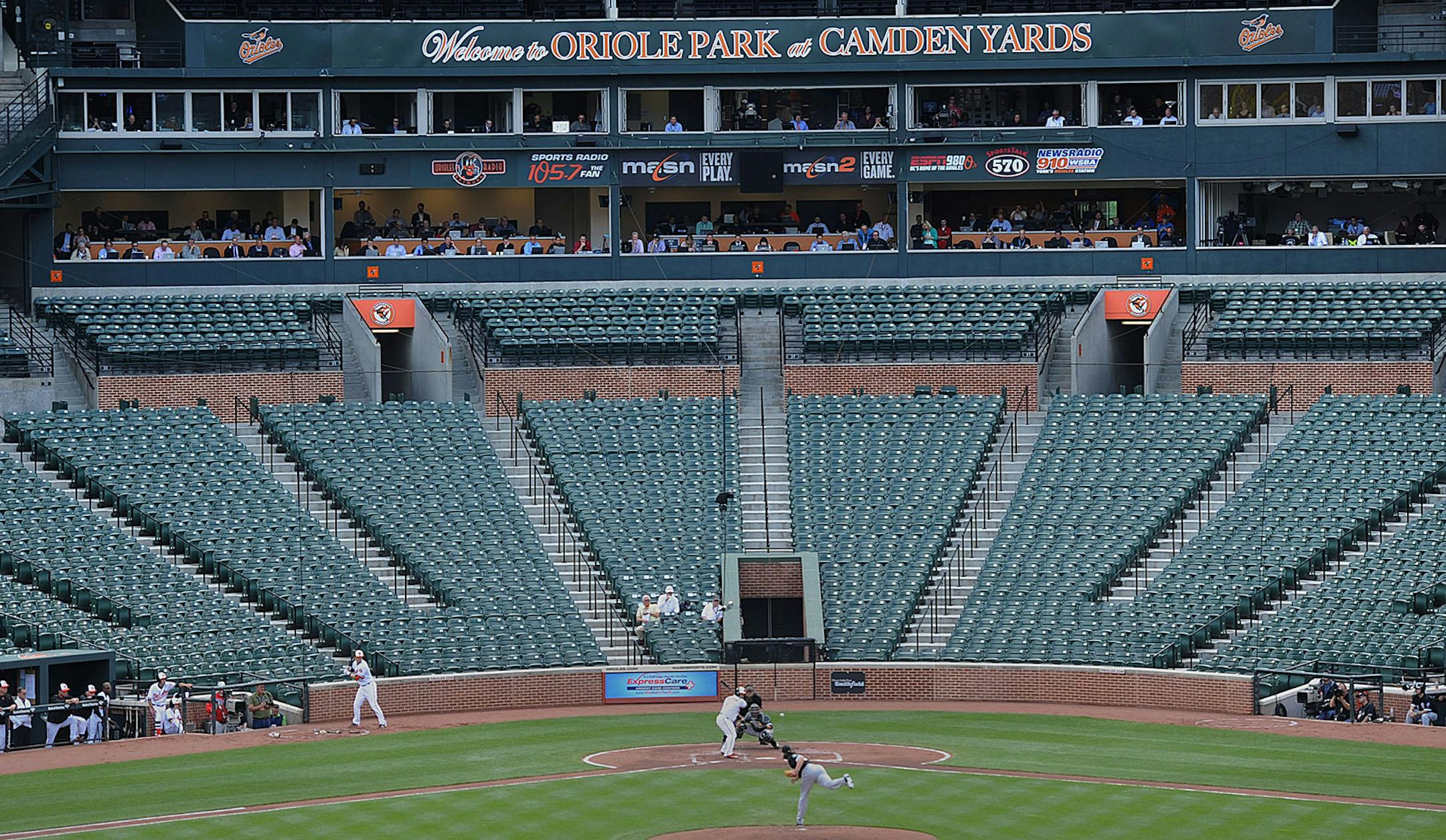
On Wednesday, the Baltimore Orioles played a baseball game at their home stadium, Camden Yards in downtown Baltimore, in front of a whopping audience of zero. That's right, no fans. (Because the doors to the stadium were padlocked.)
Never before in the history of Major League Baseball have fans not been allowed into a stadium on game day.
Maybe a better reply to the recent violence would have been for Peter Angelos, the owner of the Orioles, to just let 46,000 residents of Baltimore enjoy a day at the ballpark for free. This might have been a nice opportunity to help defuse some anger and at the same time show some support for the community.
I may be wrong, but the final score for the game in Baltimore was: Fear 1, Courage 0.
Neil F. Anderson, Richfield
LOCAL GOVERNMENT AID
Why proposed cuts for big cities are entirely appropriate
Local government aid (LGA) was created in 1971. Its purpose was for the state to collect money from all Minnesotans through a portion of the sales tax and redistribute it through a complicated formula to cities with a small tax base. The funds were to help communities with basic needs — police, fire, roads, snow removal and so on. Like most government programs, when LGA started it had good intentions, but as time goes on programs get larger and stray from their intended purposes.
I am a City Council member for the small city of Bethel. Cities like Bethel are what LGA was set up for. You don't get much smaller than us. We are in northern Anoka County, with an area of less than a square mile and a population of 466. We receive about $46,105 a year from LGA — roughly $98.94 per resident. For the past seven years, Bethel has kept its tax levy the same. Like other cities, we have to deal with increases in costs. We prioritize. There are many things we want, but we spend only on our true needs.
Recently, the Minnesota House passed a bill to cut LGA by $84 million for Duluth, Minneapolis and St. Paul. When LGA was created, it wasn't intended for big cities. Duluth receives $29 million — $337.07 per resident. Minneapolis receives $77.4 million — $193.47 per resident. St. Paul receives $60.4 million — $204.92 per resident.
So, I have a deal for you big cities: I will stop taking LGA if you stop taking yours.


