

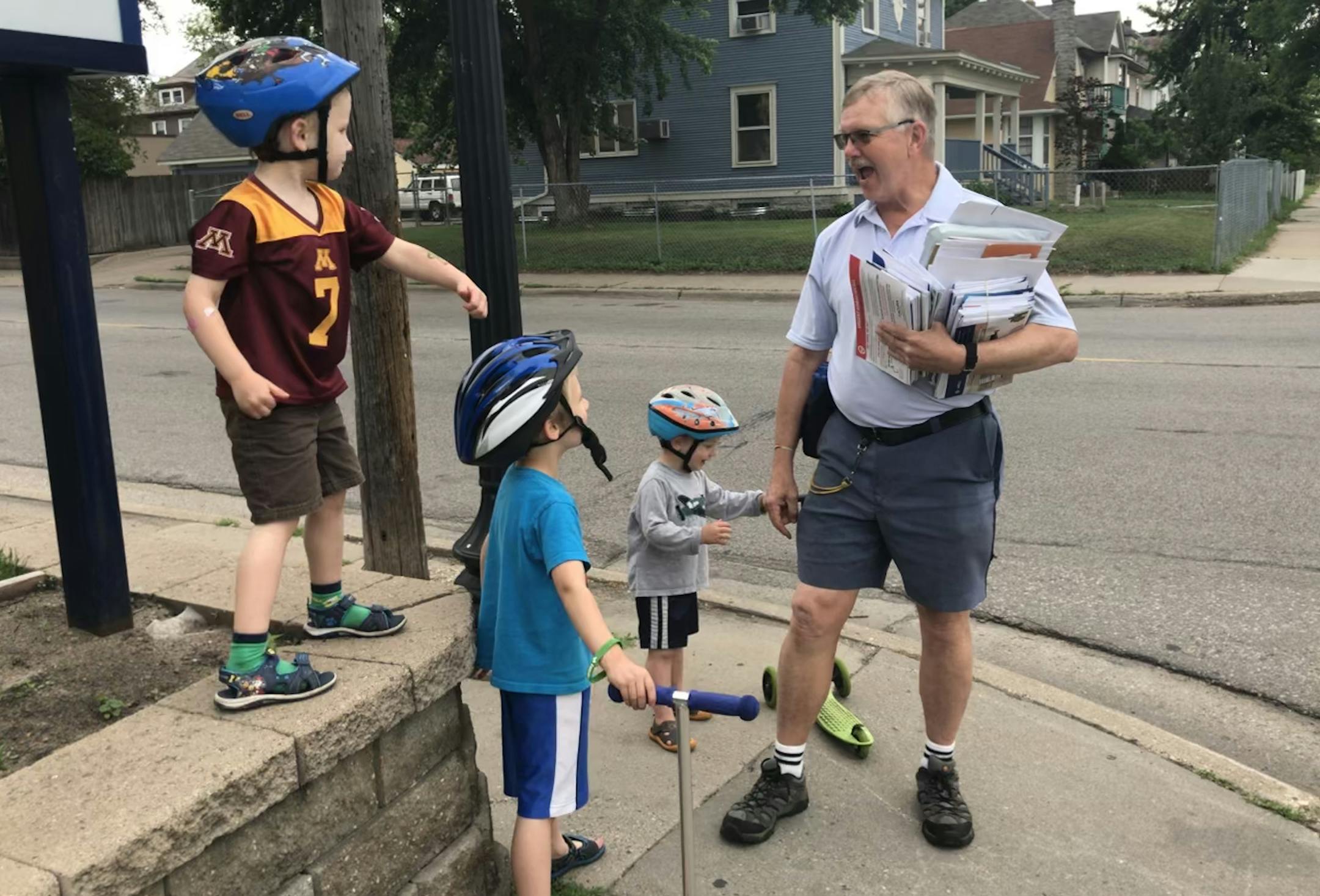
I took a picture recently in south Minneapolis. It tells a story. My husband and I were taking care of our grandsons and walked with them to Powderhorn Park. All of a sudden, as they were riding their scooters, they spotted "their" mailman. They hurried down the street to greet him. He gave them high-fives, and our 6-year-old excitedly told him that he had just "graduated." Our 3-year-old chimed in that his brother was in first grade now. Our 4-year-old was anxious to show the mailman his new "tattoo."
All the while, their mailman made them feel so special. One of the things these boys want to do when they grow up is to be mailmen. In the winter, they sit at their window and watch for the mail truck to park across the street. In the summer, they are often on the porch ready to greet their mailman. Thanks to our Postal Service for making our grandsons feel so special. Thanks to mail carriers like this who build community in their neighborhoods.
Mary Van Der Werf, Brooklyn Center
'FACTFULNESS'
All of us could be better thinkers — and here's a guide
Can our world be bad and better at the same time? Is there an antidote to the epidemic of lies, deception and ignorance in American society? Yes and yes! It's the refreshing worldview described in "Factfulness," a recently published book by the late Hans Rosling, renowned TED talk speaker, global-heath expert and sword swallower.
Bill Gates is offering the book free to every U.S. college and university graduate this spring. Wow! Why would he do that?
Gates' offer astonished me. I am 70, so I bought the book. It taught me that I am more ignorant than a chimpanzee about why and how our world is better. So is most every person (Republican, Democrat, corporate CEO, world leader, doctor, teacher — and college student) who answers questions asked in the book ranging from poverty, wealth, population, health, energy, eduction, gender and environment. Turns out none of us is less ignorant until we see our world through data.
"Factfulness" offers a fact-based worldview. It offers "data as therapy" and "understanding as a source of mental peace" even in the context of what is still bad about our world. It gives us easy tools to use for putting factfulness into practice.
It asks us if we can be humble, curious and ready to be amazed.
This is how we stop the epidemic.


