

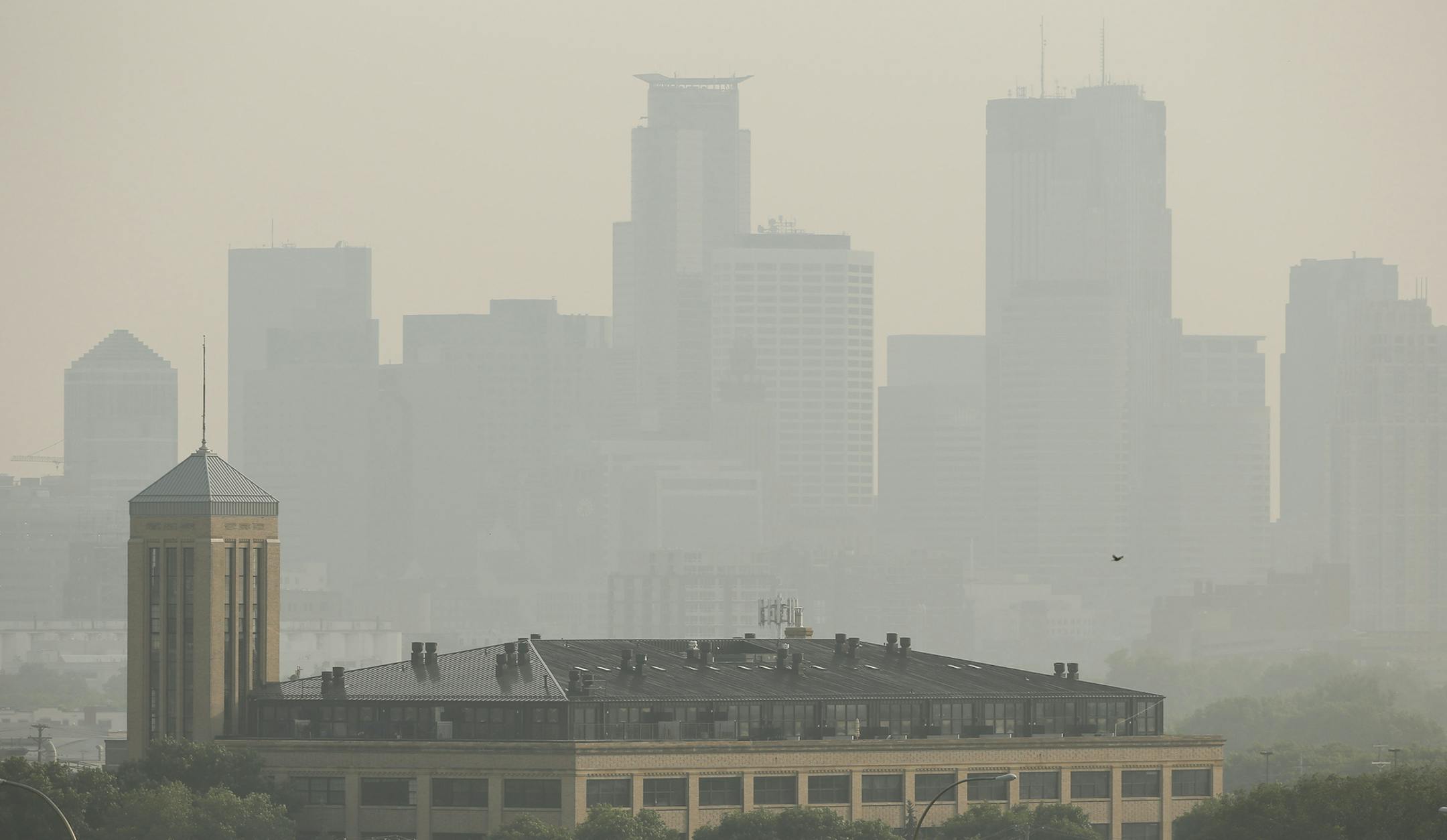
Thanks for the Star Tribune's front-and-center coverage of the smoke that invaded our city and state ("Fires render air quality 'unhealthy for everyone,' " July 7). On Monday, at my daughter's house, I urged her to step outside to smell the smoke and see the blanket of haze that covered our city. She did and said, "Oh my gosh, it feels apocalyptic!" And indeed it did. Scary. And I think about my granddaughters, and I think about a quote I just read: "We are in the mega-fire era," said Ken Frederick, a U.S. Bureau of Land Management spokesman and former firefighter.
We are living under too many blankets of fossil-fuel-laced air, which is causing record dry areas and record lightning strikes and forest fires that become almost impossible to put out. But I am enthusiastic about a solution — a steadily rising fee on fuels and a return of all the fees to households — and I urge my member of Congress, Keith Ellison, and all of Minnesota's representatives to do all in their power to get Congress to pass such a bill. Fuels need to bear their fair share of their costs, and my granddaughters need this beautiful Earth with breathable air.
Barbara Draper, Minneapolis
• • •
The picture on the front page depicting the extreme pollution and smoke from Canadian fires is my backyard on most nights, and it's not fires hundreds of miles away causing my problem; it's from those surrounding me who insist on burning their recreational fires night after night — winter, spring, summer or fall — with smoke billowing through our windows and doors until we have to close up once again.
For those of us who are sensitive and have health issues, this smoke is a real threat, not just to health but to structures when live embers land on them. Yet our state and cities, which are so intent on pollution control and air quality, allow this recreational burning of wood and garbage to continue. Until they ban these backyard fires, I have a hard time believing they are really serious and concerned about pollution and air quality in Minnesota.
Lynn Jakubik, Richfield
POLITICAL CORRECTNESS
If it bugs you, ask yourself: Do you know how racism feels?
What is political correctness? It's a sensitivity to language and symbols that are hurtful or offensive to people. We are in an uproar about the Confederate flag and its meaning in the wake of the Charleston, S.C., shootings. Some are frustrated that political correctness is ruining our country. We will PC ourselves into a corner because all symbols may have the potential to be harmful? I don't believe that this will happen.
I grew up in Albert Lea, Minn., and I cringed when I found out that the Confederate flag flew at a parade on July 3. I cringed because it was thoughtless and because I knew that the name of my hometown was going to find a nationwide audience, and that tied to it would be this awful symbol of racism.
Here is the thing about political correctness: The people who are complaining that the Confederate flag is a part of history and not harmful are undoubtedly people who are not dealing with racism on a daily basis. The trick to political correctness is to be able to see beyond our own lives to be sensitive to the experience of others. If you can't do that, you are free to complain about political correctness all you want, but you end up being only myopic in your view of the world and the people in it.


