

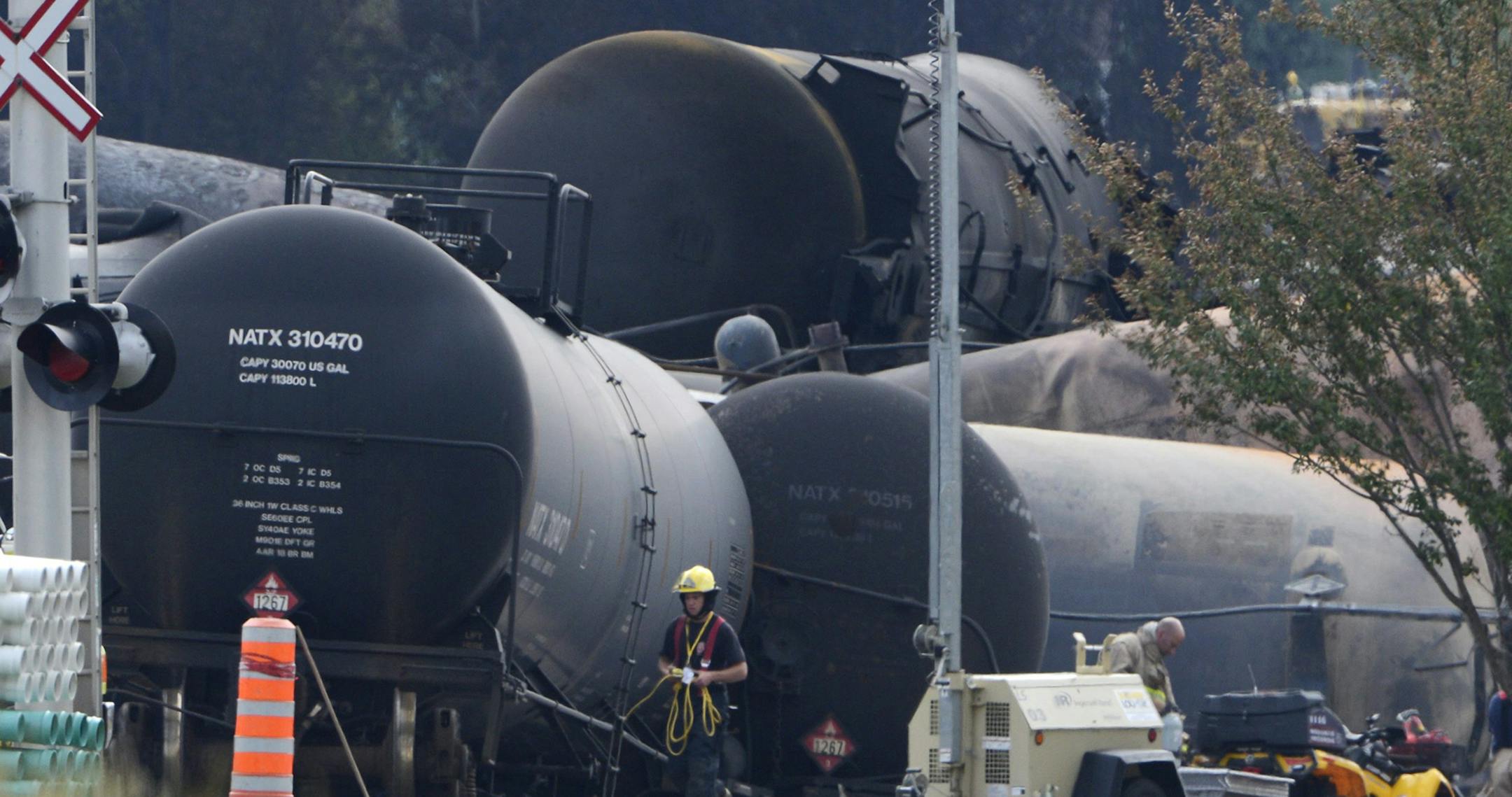
OIL TRANSPORT
Keep rail accident, risk in relative perspective
A July 9 headline ("Risk of shipping crude oil by rail cars exposed by blast") suggests that this is the most dangerous way to do that. Fact is, it's the safest. Pipelines, when they finally get built, are not only inflexible, they are subject to corrosion. It takes three big trucks to move a single tank car of material; how many of them would you like to see on our highways?
Since crude oil is not particularly volatile, a better investigative report would be about why the tank cars in that little Quebec town exploded.
CRAIG M. WIESTER, Minneapolis
• • •
Railroads are safe. But accidents happen. Just like they do with any other mode of transportation of goods or of people. No one questions the safety of air travel after the Asiana Airlines crash at San Francisco International Airport, or after any other crash. Yet, a train derails in Quebec and it calls into question the safety of shipping oil by train now that the railroad's great capacity and efficiency is being called upon to move oil.
As long as we use oil, we need to understand that it's a hazardous substance. It's dangerous to explore for, to extract (remember the BP oil spill in the Gulf of Mexico?) and to transport (remember the Torrey Canyon and the Exxon Valdez?). If anyone thinks that pipelines are a fail-safe method to move oil, try doing an Internet search of oil pipeline spills. Ask questions. But please don't call into question the professionalism and safety of America's railroads.
LOUIS HOFFMAN, Minneapolis
• • •
STATE BUDGET
How to compete? It's elementary: Cut taxes
Way back in 1964, when I first started studying economics at Ripon College, my professor uttered this economic wisdom. On Tuesday morning, I spent two hours reading and rereading Jay Kiedrowski's tortured defense of the level of state spending and taxation in Minnesota, concluding with the argument that we should avoid cuts in state taxes and state spending and instead concentrate on how state spending can be more "productive," whatever that means ("How to make Minnesota competitive," July 9).
State spending and taxation crowds the private sector out of spending and investment decisions and transfers (some) of these spending and investment decisions to bureaucrats. If we learn anything from economics, it is that bureaucrats can't make these decisions more efficiently. They face different incentives.


