

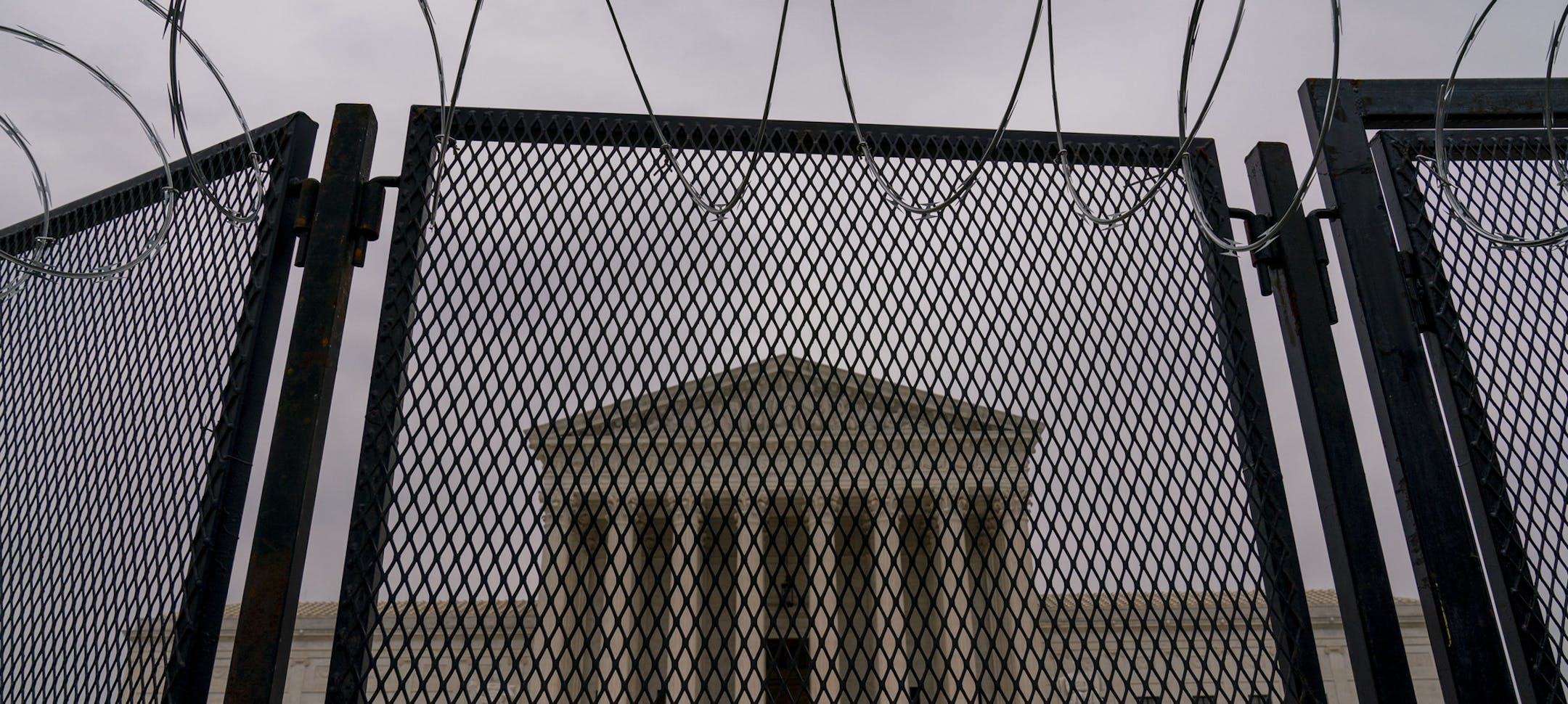
I have seen numerous articles in the last few months that refer to the number of "Republican-appointed judges" who have ruled against former President Donald Trump's lawsuits alleging election irregularities. Regardless of the merits of any of these cases, the simple fact that the phrase "Republican-appointed" is deemed necessary points to a serious flaw in our legal system, not to mention our system of justice.
These people are appointed as arbiters of justice and as such are expected to be unbiased, so nonpartisanship should be part and parcel. The fact that it is not, and the fact that these judges' apparent defection from the party that appointed them is deemed newsworthy, should not be used as a bludgeon to prove a point (namely that the allegations of election irregularities are lacking in evidence) but rather investigated to determine if partisan or personal sentiments have had any impact on their past rulings that didn't involve the extreme risks that these most recent cases have had. It's one thing to deny an outlier consideration, but if partisanship is truly a concern we have regarding our judiciary, then we must root it out, expose it and eliminate it by any means possible.
Without a truly neutral judiciary we simply cannot have justice, and the recent articles I've read that make flippant reference to the party that appointed these judges (as if that ought to make a difference) suggest either a fatalistic defeatism hedged by relief that the judge took a tack that appears nonpartisan, or an open admission that our judiciary is fundamentally corrupted by partisan sentiments, in which case we've already lost.
L.M. Rantz, Minneapolis
POLITICAL MODERATION
Still rare, still sorely needed
Elliot Richardson served under four U.S. presidents and is likely best remembered for having resigned as Nixon's U.S. attorney general when he refused to fire Watergate special prosecutor Archibald Cox as part of the events that became known as the Saturday Night Massacre. His 1996 memoir was titled "Reflections of a Radical Moderate."
In it he wrote: "I am a radical — a radical moderate. I believe profoundly in the ultimate value of human dignity and equality. I therefore believe as well in such essential contributors to those ends as fairness, tolerance, and mutual respect. In seeking to be fair, tolerant and respectful, I need to call upon all the empathy, understanding, rationality, skepticism, balance and objectivity I can muster. These are the attributes of moderation. For me moderation is not a fighting faith but a faith worth fighting for. My commitment to it is passionate, uncompromising and deep-rooted — hence radical."
Richardson's approach to public policy, to interactions with those we may not agree with and to important issues is as germane today as it was when he first described it over 20 years ago. Moderation, including fairness, tolerance and mutual respect, in politics and public policy, has fallen out of style, which is tragic and correctable. As a community, we should foster and encourage the work of radical moderates.
Dan McElroy, Burnsville
FACE MASKS
Executive order, not law, suffices
While I firmly believe that face masks, in this present moment, are absolutely necessary to limit the transmission of COVID-19 and its related strains, I think the state Democrats' proposed bill to sign a mask mandate into law is absurd.
At a time when the Legislature's efforts should be focused on streamlining the vaccine rollout and bailing out the hard-hit working class and small businesses — not to mention the ongoing crises of climate, police reform, health care, homelessness, etc. — my representative (Sydney Jordan, 60A) is using her time authoring a permanent bill for a temporary problem — a bill that will have to go through the whole legislative process to pass and then have to be rescinded in a few months or a couple of years when it becomes obsolete.

