

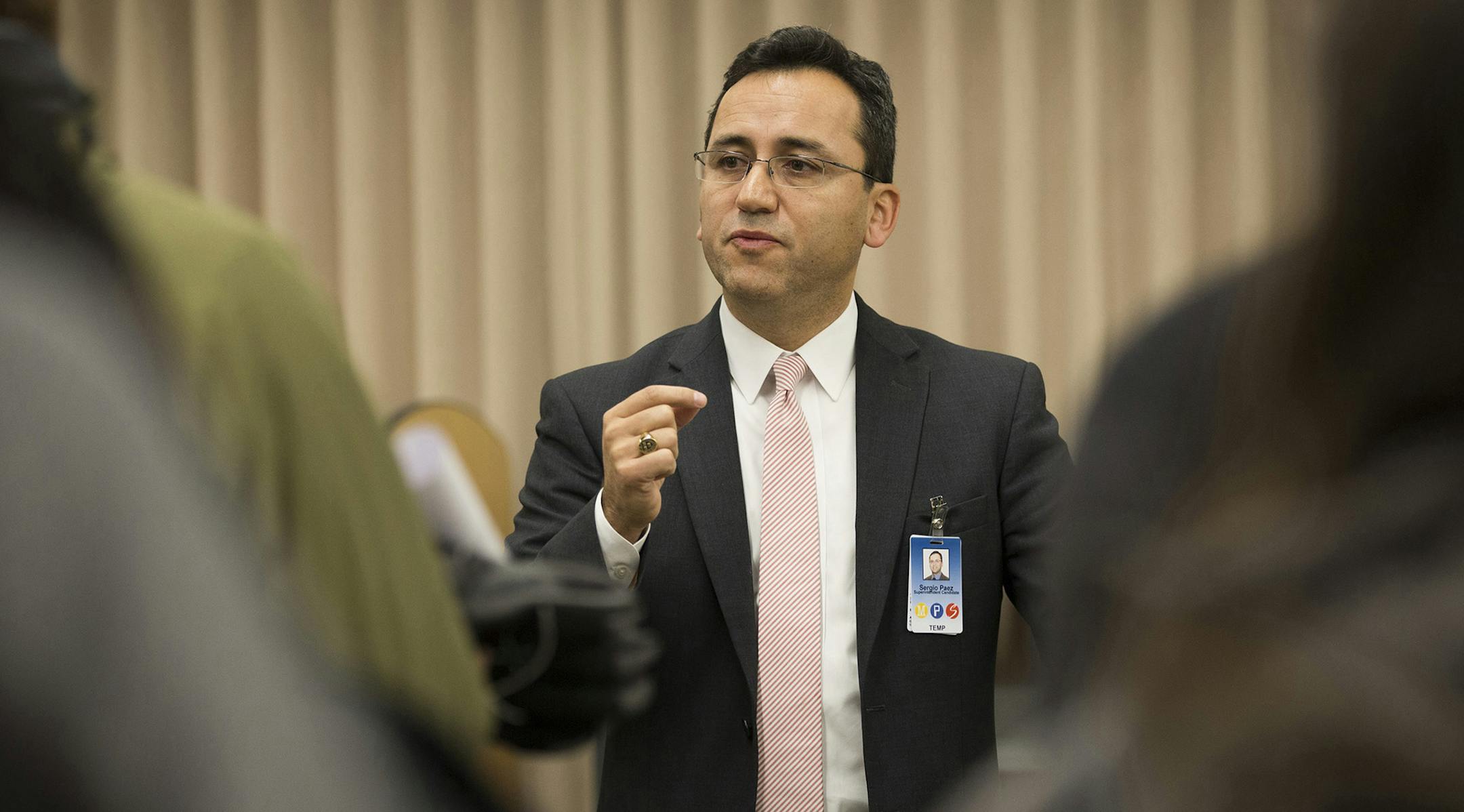
After reading articles and opinions about the prospect of Sergio Paez as the next Minneapolis Public Schools superintendent, I believe he should be hired. No official in any high-level leadership position should be held responsible for all of the actions of all of the people under her/him. The abuse that took place at one of the schools in Paez's former district is not acceptable, but his response to the problem seemed appropriate. He is qualified as a Harvard grad, with experience as a superintendent. He displayed openness, initiative and enthusiasm while lobbying for the job during a recent visit. It would make sense for the school board to hire him at a beginning superintendent's salary with a short-term contract and give him a supportive chance to prove himself. A new national search would be time-consuming and expensive and would offer no assurances that a better candidate would emerge.
Samuel G. Larsen, Minneapolis
• • •
The assessment by school board members Josh Reimnitz and Tracine Asberry after visiting the Holyoke, Mass., schools (formerly led by Paez) says it all. According to their report, Paez was able to change the educational climate. Isn't that exactly what we've been told Minneapolis is looking for in the new superintendent? Leave politics to politicians and proceed with the Paez appointment.
Alan Heider, Minneapolis
EXECUTIVE ORDERS
Their legitimacy is in the eyes of the beholder, and it evolves
A little more fact-checking on executive orders and "biased, poor thinking" (Readers Write, Jan. 8) seems to be in order. It's not the number of executive orders one should be concerned with, but the kind of orders. There are good ones and bad ones. For example, the Emancipation Proclamation was an executive order. President Harry Truman integrated the armed forces through executive order. Dwight Eisenhower desegregated public schools by executive order. FDR used executive order to make it easy to send Japanese-Americans to internment camps. George W. Bush used an executive order to restrict access to the papers of former presidents. Later, President Obama revoked Bush's executive order. Presumably, a Republican president could revoke Obama's revocation. Or Bernie Sanders could revoke Obama's recent executive orders on gun control.
There are also legal orders and illegal ones. History shows that the Supreme Court overturned five of Roosevelt's executive orders, two of Bill Clinton's orders and one of Truman's. In essence, all eight orders were found to be "dictatorial."
The chief problem with Obama's recent gun-control order is that it appears to be in opposition to congressional intent. In other words, the Supreme Court could find that Obama is making law without congressional approval and is usurping that branch's constitutional authority. I personally think what Obama asks for in this case is a good idea. But the way he is going about it is wrong. In fact, it only fuels many gun owners' perspective that government is acting unconstitutionally.
Mike Ebnet, Edina
• • •
The term "dictatorial," as in attempts to have one's own way despite the will of a majority, must be laid on a Republican extremist minority. Obama is acting in accordance with constitutional powers in a more respectful manner than the so-called loyal opposition has been doing during his two terms.


