
Readers Write: ICE’s impact, the statewide strike, rural Minnesota, the Epstein files

Is intimidation part of the job, too?

The Minnesota Star Tribune
January 24, 2026 at 12:00AM
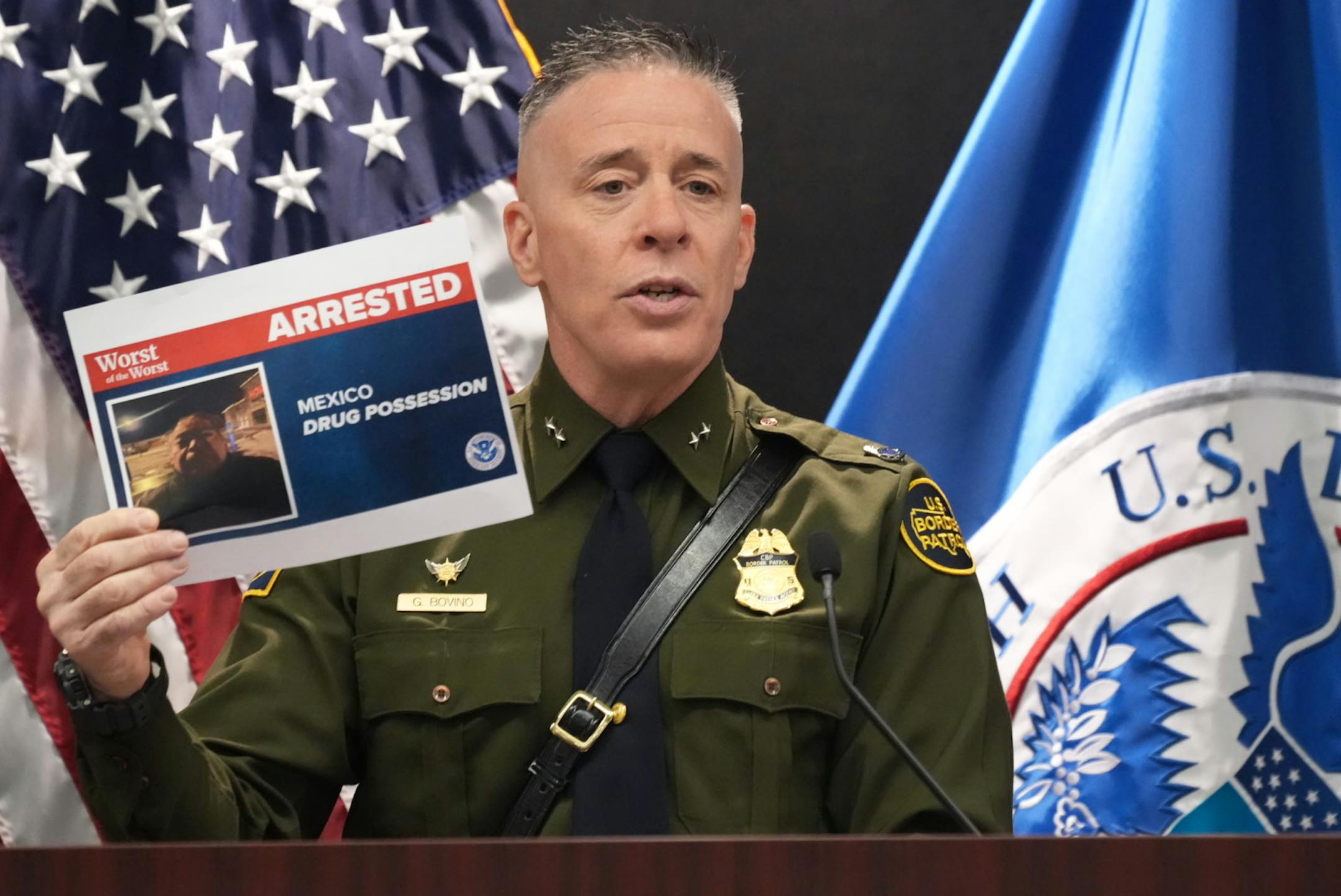
Border Protection Commander Greg Bovino speaks at a news conference on Jan. 23 in the Whipple Federal Building at Fort Snelling. (Anthony Soufflé/The Minnesota Star Tribune)

Opinion editor’s note: Strib Voices publishes letters from readers online and in print each day. To contribute, click here.

•••

Border Patrol Cmdr. Greg Bovino stated that as of Jan. 20 the Department of Homeland Security’s roughly 3,000 enforcement agents had arrested 3,000 dangerous people over the past six weeks (“Preschooler’s detention marks fourth for district,” Jan. 23). That means each agent is arresting an average of one dangerous person every six weeks. If you believe these agents are only doing their job, then Bovino’s statement should make you wonder what DHS tasks these agents to do with the rest of their time. Video after video document that they appear to be tasked with arresting, bullying and intimidating innocent people of Minnesota, including our children.

Kyle Nelson, Minneapolis

•••

Kudos to the Star Tribune and the article “Gaps in ICE ‘worst’ case.” This article starts to expose the data and results of Immigration and Customs Enforcement’s Operation Metro Surge. It’s been overly suspicious since the start that DHS and ICE hadn’t been touting their amazing success at getting the “worst of the worst” off the streets. Even more telling is once they do start touting the numbers, like Homeland Security Secretary Kristi Noem on TV on Sunday, Bovino at a local presser and President Donald Trump himself at a White House news conference, the numbers just don’t make a case for success. A quick recap: DHS has made public only 240 names of the reported 3,000 people detained in Operation Metro Surge (8% of those detained). Supposedly, this small percentage is actually considered to be the “worst of the worst,” and they are now off the streets.

What the administration isn’t saying is that the overwhelming majority (80%) of those people had already gone through the criminal system for serious felonies, and I’m glad they are off the streets. However, it didn’t take a force of 3,000 ICE agents to find and deport them; the criminal system notifies ICE of these individuals, and they get handed over. No need to harass citizens with racial profiling. No need to bash down doors of innocent U.S. citizens. No need to stalk day care teachers or detain children. No need to shoot a mother in the head.

The means do not justify the ends!

Mike Koepke, Eden Prairie

•••

Two photos in Friday’s newspaper are like a stab in the heart and so disheartening as they graphically display what is wrong with our state being occupied by undertrained, uncaring, inhumane storm troopers from ICE and Border Protection:

Sweet little Liam Conejo Ramos is just 5 years old, photographed seconds before he was scooped up by federal agents and taken away with his father. The article says that they’re already at a Texas detention center.

And the photo of a protester, face down in the street, with federal agents pinning him down and pulling his hands away from his face, while another agent sprays pepper spray directly into his eyes and nose from 6 inches away. He or she may have been irreparably harmed by this brutal action.

How does a 5-year-old child affect the safety of Minnesotans? And why spray a crowd-control device directly into the face of a protester?

The Twin Cities and its suburbs, and targeted outstate cities and towns, need protection from the lawless thugs roaming our streets. Can the governor call up the National Guard to monitor and restrain the activities of these masked and armed federal agents?

Citizens can no longer be the only restraint on the unconstitutional behavior of ICE and Border Protection agents. We need help, and it won’t come from the federal government.

Valerie Cunningham, St. Paul

JAN. 23 STRIKE

This is performative nonsense

The 1955 Montgomery bus boycotts lasted for over a year. During that time, protesters were calculated in their demands, united in their opposition, dedicated and committed to the cause. And all without social media.

We in 2026 instituted one day of an economic blackout which, in addition to hurting small and local businesses, will have almost no effect on the economy or large corporations (“State gears up for ICE protest,” Jan. 23). I am baffled as to why my fellow liberals think politicians will be suddenly impressed and/or intimidated by this single day. Politicians do not care about your solidarity; they care about money. If we want to be effective, we need several days of an economic blackout, targeted at specific corporations with specific demands.

Unfortunately, I do not think my fellow Americans are willing to be inconvenienced the way they were in the 1950s. It’s simply too easy to preach to the echo chamber, rack up the “likes” and feel like you’ve done something.

You haven’t.

Katharine Horowitz, Minneapolis

•••

I closed my child care center for the day on Jan. 23, in solidarity with child care centers that will permanently shutter if we do not get our federal funding restored. I close for a day, so we can stay open forever.

We stand in solidarity with child care centers being heavily targeted and threatened by Immigration and Customs Enforcement.

We stand in solidarity with immigrants. We are close to upholding our human rights.

Collective action and nonviolent civil disobedience work. It is what has led to democracy as we know it, our freedom of speech and our understanding of human rights. Friday will be the largest collective action and mobilization in our state’s history. I am so proud to be a Minnesotan and be able to do this in unity and solidarity with thousands of others. We will overcome.

Celeste Finn, St. Paul

The writer is the executive director and founder of Big Wonder Child Care.

RURAL MINNESOTA

The question is who speaks up when

Karen Tolkkinen’s column “I’m sure glad rural Minnesota isn’t like the Twin Cities” (StarTribune.com, Jan. 22) ultimately asks rural Minnesotans to feel morally absolved without asking them to think critically about power.

The problem is not that rural Minnesota prefers quiet roads, dark skies or fewer sirens (I daresay urban Minnesotans would enjoy that, too). The problem is the unexamined assumption that “law and order” is neutral, and that protests introduce danger rather than expose it. Protest does not aggravate abuse; it reveals it. Immigration agents’ record of racial profiling, mistaken identity and excessive force exists whether people march or stay silent.

By reassuring readers that their instincts are understandable — that thanking officers feels moral, that urban disorder explains rural distance — the column validates deference to authority while stopping short of naming its consequences. History shows that abuse flourishes not because people are loud but because too many are polite, grateful and unwilling to question who is being targeted.

The column’s strongest section acknowledges rural Minnesota’s own trade-offs: environmental harm, illness and silence bought by money. That honesty should have extended further. Gratitude toward unchecked power is not harmless culture; it is complicity.

The question isn’t whether rural Minnesota should resemble the Twin Cities. It’s whether any community is willing to scrutinize authority when it harms people who aren’t “us.” On that test, quiet approval is not virtue — it is failure.

Max Maher, Plymouth

EPSTEIN FILES

Remember those?

With Congress considering legislation to expand public access to records related to Jeffrey Epstein, President Donald Trump has responded with a surge of headline-grabbing activity. Highly publicized immigration actions, warnings about federal intervention in Democratic-led cities, proposed reviews involving Gov. Tim Walz and Mayor Jacob Frey and unpredictable foreign rhetoric — from Venezuela and Cuba to Greenland — now crowd the news cycle.

Minneapolis residents know how easily spectacle can crowd out substance. When attention is scattered, accountability suffers.

The most serious matter remains unresolved: the Epstein case, which involved the trafficking and abuse of minors and raised enduring questions about how powerful people avoided scrutiny. Trump’s past social associations with Epstein, widely reported at the time, do not establish guilt. They do, however, justify careful oversight and transparency rather than dismissal or delay.

Democracy depends on leaders answering difficult questions directly. It also depends on citizens refusing to be distracted by constant emergencies that produce more noise than solutions. Calls for transparency are not partisan attacks; they are a basic expectation of public service.

If the facts are clear, releasing relevant records and supporting independent review should strengthen confidence, not weaken it. Accountability — not diversion — is how trust is rebuilt. That principle should guide debate today.

A. Kendall Valerian, Minnetonka

about the writer

about the writer