

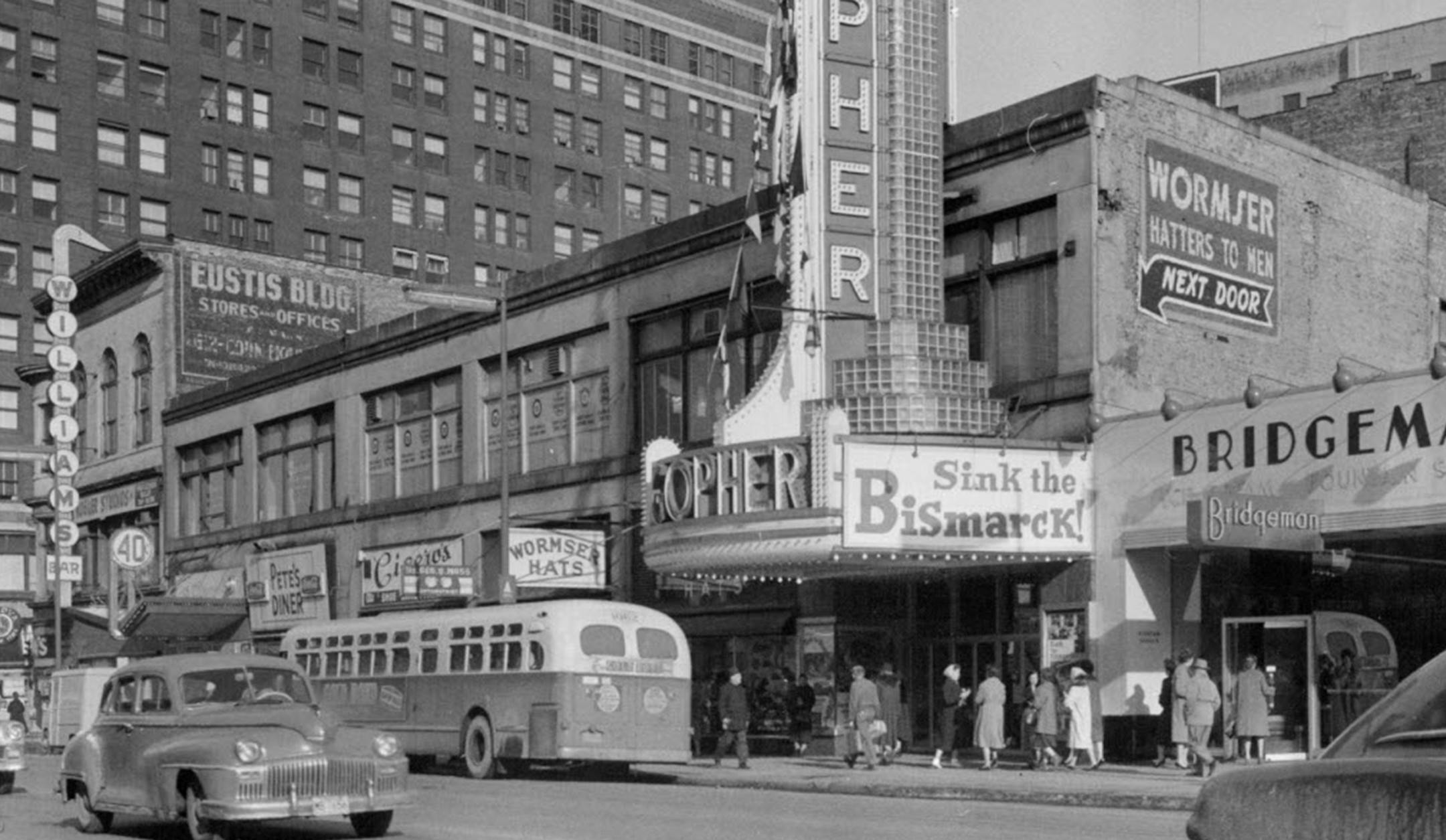
"I forbid you to go to Southdale" is what my mother used to say to us. We were, after all, city kids, and our shopping trips involved quick trips downtown on the No. 1 bus rather than long car rides to the newly built first mall in America in Edina. If our trip wasn't to Dayton's or Woolworth's or for a meal at Cafe di Napoli or the Asuka, it was to drop off a sibling at Watson's Gymnastics School, nestled above the Gopher Theatre, where "Deep Throat" and "The Devil and Miss Jones" enjoyed a continuous run. Entering on 6th and Hennepin, climbing the well-worn, steep and narrow staircase, it was a surprise to come upon the parallel bars, vaults and mats where Twin Cities gymnasts young and old were honing their skills. In "Old Minneapolis," this juxtaposition was not unusual, and despite our snickers at the X-rated sign on the Gopher's marquee, the nearby presence of a Chinese restaurant, the Nankin Café, reassured us that all was well! In "Minneapolis '60 going on '16" (Variety, Jan. 23), Rick Nelson laments the loss of that same Minneapolis. In the early 1980s, city planners and developers, trying to compete with the conveniences and commonplace of the new American shopping mall, replaced that notorious and glorious block on 6th and Hennepin with the blight that we call City Center. Mistakes were to be made again and again: Riverplace, the Conservatory, parking lot after parking lot, Block E. Indeed, the streetscape has deteriorated, and though the influx of new development in old buildings in other parts of downtown is encouraging, the places that reflected the pulse of humanity — its hope, its shabbiness, its imperfection, its seediness — have been lost and continue to be lost (Nye's!) forever. In Minneapolis, progress has always been about "cleansing," and perhaps it is for this reason that we continue to struggle with our identity as a city.
Sarah Streitz, Minneapolis
PRESCRIPTION DRUGS
Perhaps it's high time we get rid of the profit motive
Regarding the high costs of prescriptions drugs ("Curb high cost of prescription drugs," editorial, Jan. 23), here's a thought. In 2014, the Minnesota Public Benefit Corporation Act was signed into law. Unlike regular corporations, which by law must act in the monetary interest of their shareholders (generally meaning to maximize profits), public benefit corporations can elect to pursue a specific public-benefit purpose, such as "to provide prescription drugs at an affordable cost." They aren't nonprofits, but the overall motivation is legally distinct from those of existing, publicly held drug companies. Granted, I don't know much about the pharmaceutical industry, but if there ever was a clear niche for a public-benefit corporation, this would seem to be a good fit, and it might result in more affordable drugs.
Doug Norris, Brooklyn Park
• • •
Pharmaceutical companies should earn enough to finance research, development, product safety and a reasonable return on investment.
But as suggested by the editorial, what we have are some significant price-gouging, anti-competitive behavior, bans on importing and on price negotiation, and a Congress unwilling to address the problems.
Maybe it's time for a difficult but different solution: Get government (or perhaps foundation-backed nonprofits) into the drug business. Probably not possible with the feds, but perhaps a state, a large city or a consortium of government units could become a drug company for some combination of manufacturing, wholesaling, mail-order retailing, importing — whatever works.
From mail to rail to broadband to hospitals and clinics, government has gotten into businesses when or where private enterprise was seen as unable, unwilling or untrustworthy. Nearly a century ago, for instance, North Dakota got into banking and grain milling to counteract corporate interests in Minneapolis and elsewhere.
For cancer patients and others fearing medical bankruptcy or death, providing affordable drugs has got to feel at least as important as such government functions as collecting waste, plowing snow or running liquor stores.


