

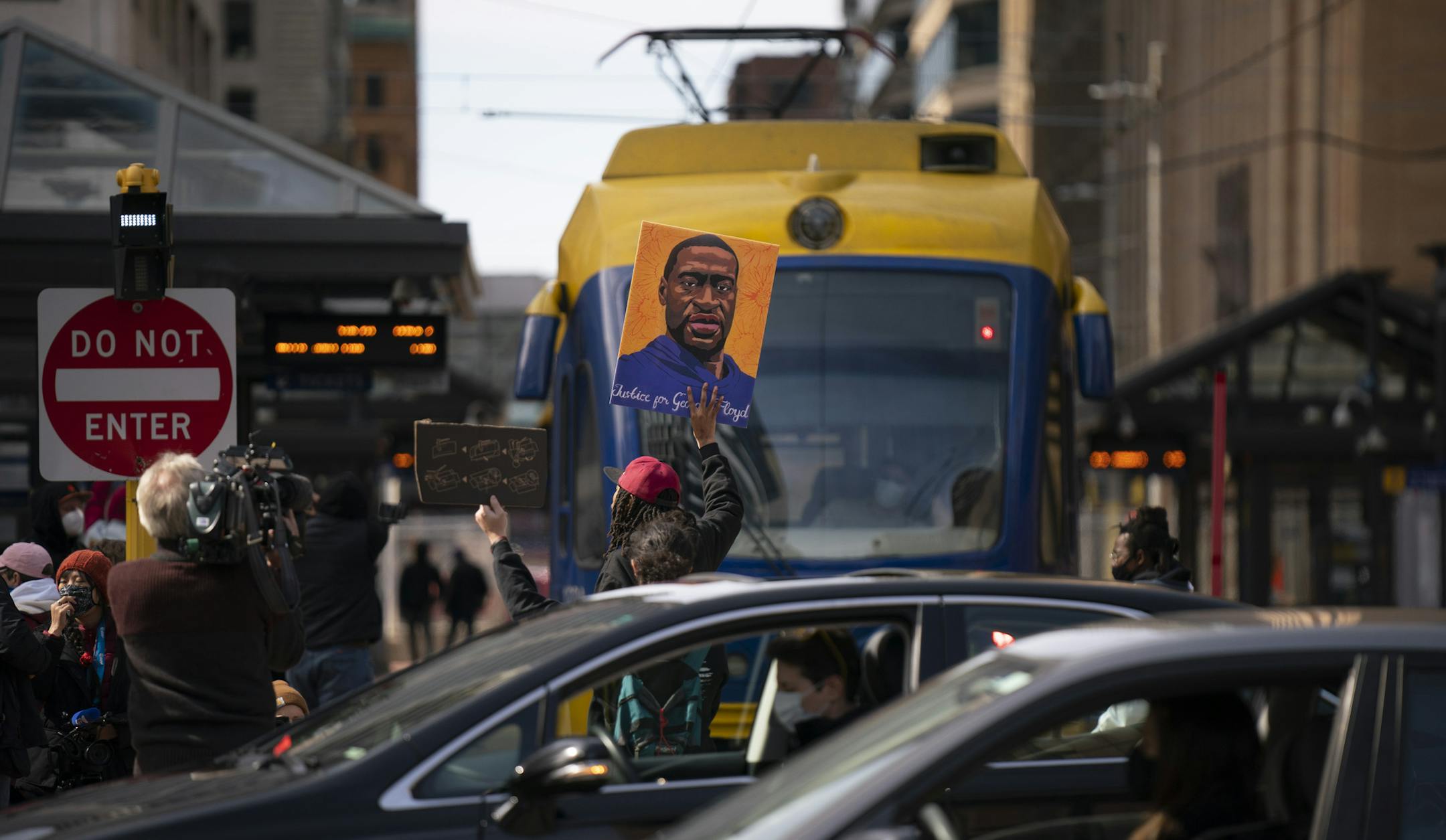
I fervently hope for justice for George Floyd, too, but I'd like to prevail upon the demonstrators to stop blocking light rail and/or traffic ("Speakers, protesters urge justice, accountability," March 29). The trial has only just begun. There have already been numerous protests. We get the message. Yes, things need to change, we need to work to change laws and police procedures. But give us commuters a break already — at least until the trial is over. Do I have to fret for an entire month about whether I can get home or not?
It is already stressful for those of us who must commute every day to work. The bus schedule has been reduced because of COVID-19. We worry about catching it ourselves, and some commuters don't wear masks, particularly on the light rail. If I miss my rush-hour bus because of light-rail obstruction, I have to wait another hour and a half to take a bus home or spend $35 on a cab. I'm sure the protesters all have a car ride home. If the downtown situation looks unsafe, the cabs and Uber don't want to come either. The time of the riot, I was afraid I'd be stuck downtown all night.
There's already the stress of dealing with panhandlers, mentally unstable people and drunk people, worrying about increased crime in downtown Minneapolis and on the light rail and, for me, waiting every night across from Target where troublemakers are always hanging around the Target entrance. I've literally witnessed a fistfight there and loud arguments and just people who are extremely loud and attention-seeking. There need to be police cars around that intersection more often.
Trust me, most of us riding light rail aren't the privileged who are driving or working from home. Why do we have to pay the price here?
Stephanie Sarich, Minnetonka
• • •
Eric Nelson, Derek Chauvin's lawyer, is quoted in the paper having written that "Mr. Floyd could not breathe because he ingested a lethal dose of fentanyl ... ." Medically, this is not possible. An opioid overdose has an effect on the brain that suppresses the drive to breathe. A lethal dose of fentanyl would cause lethargy, no awareness of a need to breathe, and hence no struggle to breathe. People under the effects of excess narcotics simply do not care if they are breathing. This was clearly not the case with Mr. Floyd, who was begging to be allowed to breathe. This raises concerns for me, as a physician, that the defense may not be committed to presenting clear medical facts.
Susan Hasti, Minneapolis
• • •
Like many, I've been feeling trepidation about the Chauvin trial. My anxiety eased somewhat when I read coverage of the opening statements in the Star Tribune and learned attorney Jerry Blackwell is helping lead the prosecution. It may be rare that someone says what I'd like to say — that I've had the good pleasure and honor of working with this attorney. Typically, not much about the legal field is uplifting, nor even sometimes completely honorable. But I can and want to make this statement: Mr. Blackwell is a wonderful man and an even better attorney. I see he's also working for the prosecution pro bono.
Best wishes on a fair and speedy trial, Minneapolis. And thank you, Mr. Blackwell, for sharing your time, talent and truth for the betterment of our public. Mr. Floyd's story is in your caring, capable hands.
M. Michele Maurer, Hopkins
DULUTH POLICE
On use of force, more questions
As a (retired) math teacher, I enjoy stories that rely heavily on math. A recent story about use-of-force incidents in Duluth is a case in point ("Duluth minorities call for equal treatment by police," March 27). In brief, the article says that the percentage of nonwhite suspects involved in use-of-force incidents is higher than the percentage of nonwhite people in the general population. For some, that shows discrimination and that's the end of the story. For others, it's the beginning.

