

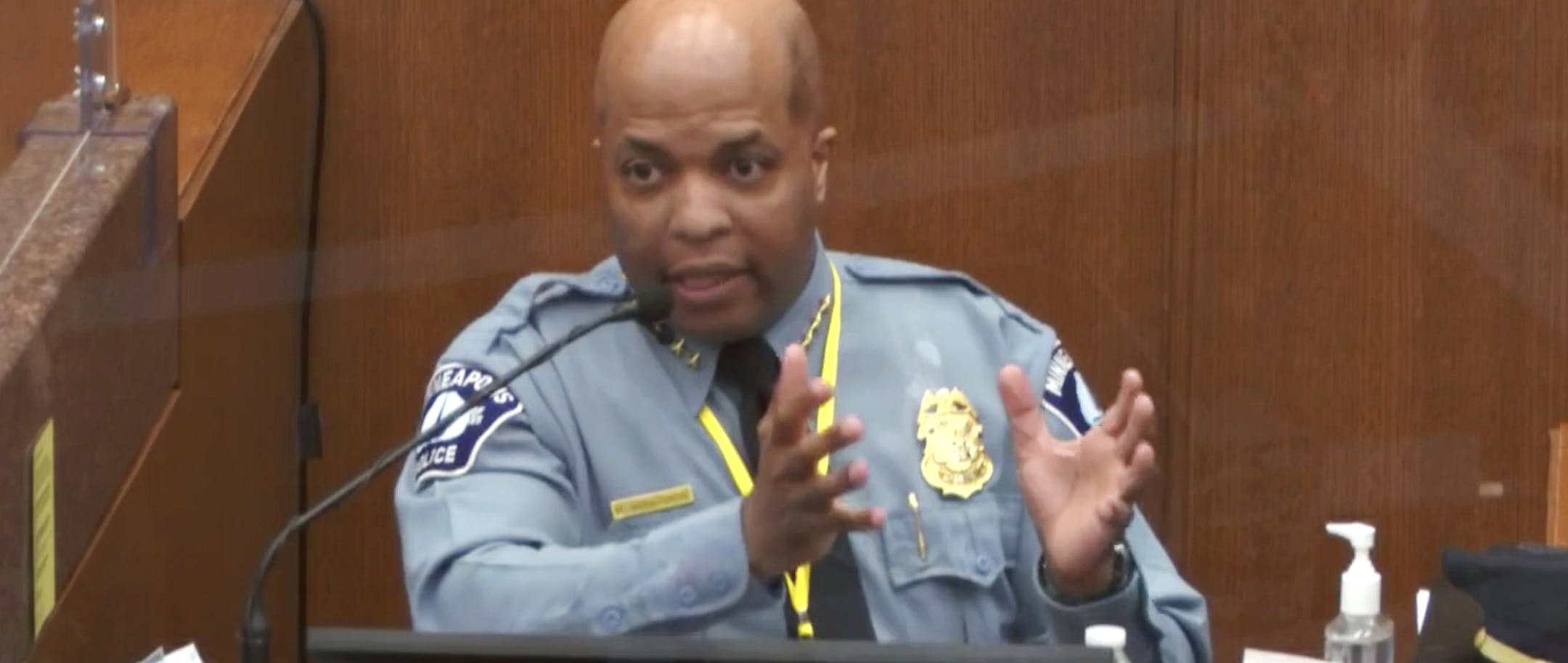
Something truly remarkable has happened in the Derek Chauvin trial: The Minneapolis chief of police testified for the prosecution and against Chauvin ("Cracks showing in 'blue wall of silence,' " front page, April 6). Chief Medaria Arradondo's testimony followed testimony by several other senior Minneapolis Police Department officers, all of them saying Chauvin used "excessive force" and violated established police procedures. In all the trials involving deaths caused by police officers, when was the last time we saw supervisory police officers so openly criticizing what an individual officer did? I cannot recall any similar instance.
After all the George Floyd protests, etc., I hope those who have been demanding justice and police reform are noticing. We can be very sure that the rest of the Minneapolis Police Department is noticing. Minnesota, in its unique way, is showing the world that breaking down the "blue wall" is what needs to happen first if you want better policing.
Richard Martin, St. Paul
• • •
The past year has been miserable in so many ways. Therefore, last week amid the ongoing misery of the Chauvin trial, it was a special privilege to see the humanity and plain goodness of people like 18-year-old Darnella Frazier, who stays up at night apologizing to George Floyd because she didn't do more to save him, 19-year-old Christopher Martin, who blames himself for accepting the bad $20 bill, and Genevieve Hansen, who broke down on the stand describing how it felt to be prevented from using her first-responder skills to help Floyd. And George Floyd himself, whom Courteney Ross told us she met when he was a security guard at the Harbor Light shelter; she was crying in the lobby and he came over and asked if he could pray with her.
The world is a better place because of people like this. May they find healing.
Bruce Peterson, Minneapolis
GLOBAL WARMING
Far from climate advocates
In its March 21 article "Spending on lobbying fell in state," the Star Tribune revealed a troubling fact: The Minnesota Chamber of Commerce is now the biggest lobbying force in the state, spending over $2 million to influence Minnesota decisionmakers in 2020 alone. That's good news for some of the chamber's members that rely on fossil fuel extraction and refining for their profits, but it's terrible news for the climate.
This legislative session, the chamber has come out against two clean energy bills that would move our state closer to the clean energy future we need: the ECO Act, which would expand incentives for energy efficiency, and the Next Generation Climate Act, which would update the state's carbon emissions goals for the first time in over a decade. Neither of these proposals is radical and both have broad support. The chamber submitted written testimony strongly opposing both of these bills when they were heard in committee this legislative session.
The chamber's actions aren't just stopping us from addressing the climate crisis — they're hurting Minnesota's most vulnerable people in the middle of a historic pandemic. Minnesota's Conservation Improvement Programs (CIP) help people who struggle with energy poverty and can make the difference between paying your bills and falling into a debt spiral. In late February, the chamber's energy lobbyist, John Reynolds, argued that the chamber supports CIP while pushing for SF 301, a bill that would substantially weaken it.
The chamber is fighting for fossil fuels in the hopes of keeping energy bills down while the cost and efficiency of renewables continues to improve. It's absurd, shortsighted and terrible for Minnesota's long-term prospects. When the chamber talks about climate, no one should listen.

