
Readers Write: Dehumanizing rhetoric against immigrants, school shootings

Countering vile attacks with decency.

The Minnesota Star Tribune
December 19, 2025 at 12:00AM
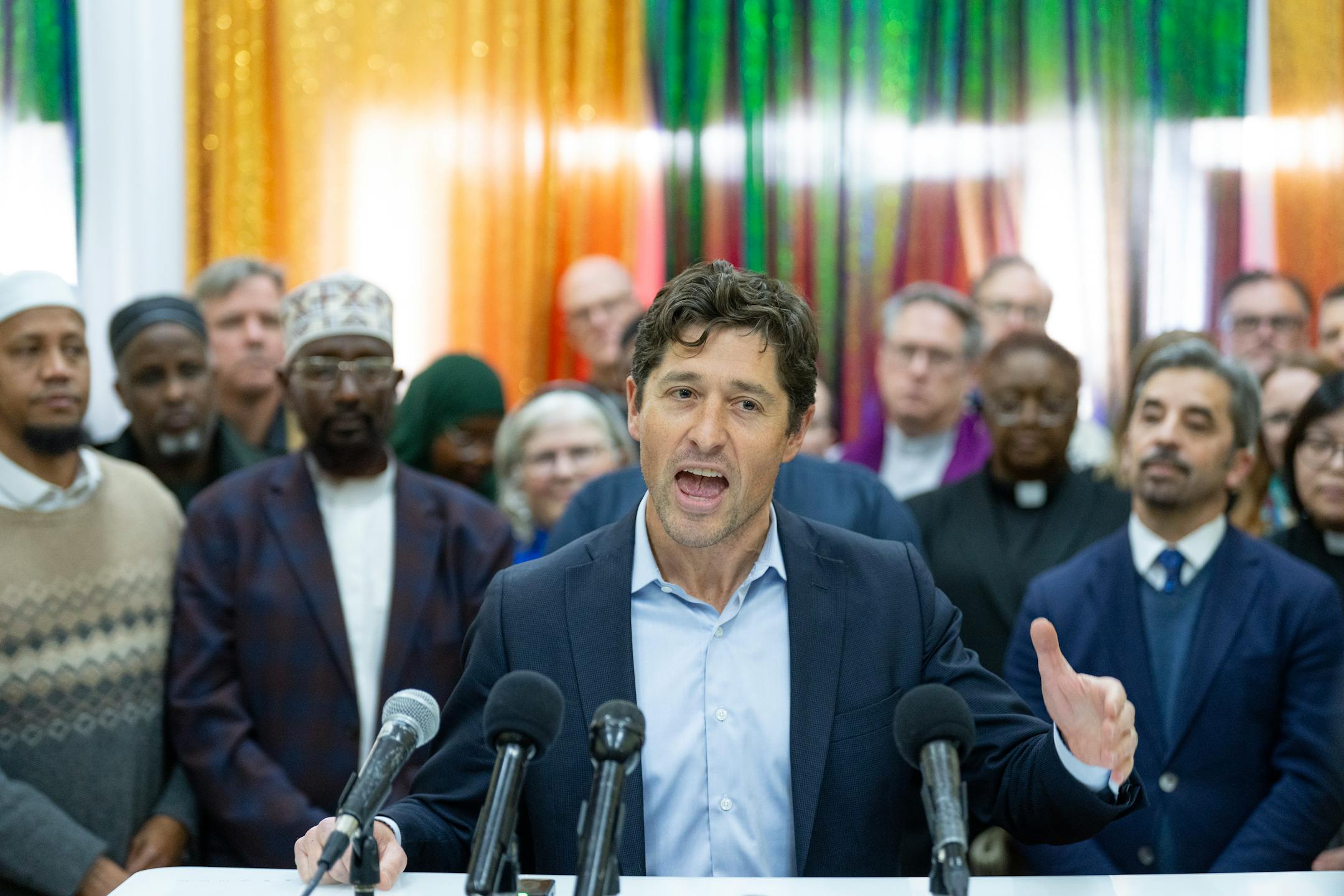
Minneapolis Mayor Jacob Frey speaks at a news conference at Umatul Islam Center in Minneapolis on Dec. 4, where faith leaders across denominations denounced President Donald Trump's order to federal immigration agents to focus on Somali immigrants. (Alex Kormann/The Minnesota Star Tribune)

Opinion editor’s note: Strib Voices publishes letters from readers online and in print each day. To contribute, click here.

•••

Thank you to Edina Mayor James B. Hovland for the moral clarity of his recent commentary (“Dehumanizing Somali Americans is a ‘moral failure,’” Strib Voices, Dec. 9).

Throughout my childhood, schoolyard bullies would insult me, my family and my Indian ancestry.

As a child, I had no response other than hurt, silence and confusion. My immigrant parents would later always tell me to brush off the insults and ignore the idiocy.

But after the president’s vile remarks about the Somali community and immigrants in general, all those memories have come flooding back, decades later, in vivid clarity. Every insult, every dirty attack, every word spoken.

As our president attacks our Somali neighbors and our Latino neighbors — my neighbors, my friends and my future constituents — know that the pain is visceral in the moment.

But also don’t forget what many of our neighbors, and especially their children, will feel in the years to come.

While our federal government has decided it worthy to wage a revolting war against its own people, I’m thankful that our local governments in Minnesota stand in lockstep with their constituents, and behave with the dignity and grace needed to meet the moment.

Kedar Deshpande, Minneapolis

The writer is the commissioner-elect for the Minneapolis Park and Recreation Board, District 3.

•••

Can we, please, wake up as a nation?

The Nov. 30 article “Claim of fraud link to terrorists unproven” pushed me over the edge.

I am an immigrant myself. I have lived in this wonderful land of (still) opportunity for over 50 years. Speaking English was my No. 1 priority. So was learning American history and learning about government institutions; assimilating into/with my new home was, I understood, important to honor my new home. Had I found out I was not able to achieve any of that, what right would I have to claim the U.S. to be my home?

Now, decades later, I read the above-mentioned article. It is shocking to read that anyone would have the thought enter their mind that the theft of hundreds of millions of dollars from us, the taxpaying citizens, might be of less consequence only because the stolen money might not have gone to terrorist organizations. Don’t minimize the crime of the fraud and the loss of the stolen money, regardless of where the money went. It all came out of Minnesota taxpayer’s pockets, regardless of where it went.

You born Americans have no idea how fortunate you are. For the sake of our children and grandchildren, please, let’s not mess up. It would be selfish and a mistake to understate this crime.

Zuzana Arundel, Woodland

SCHOOL SHOOTINGS

A political solution is still a solution

In Tuesday’s front-page article, “Walz signs executive orders to try to limit gun violence,” Senate GOP Leader Mark Johnson of East Grand Forks said the governor’s orders were “not actual solutions to keeping kids safe in school.” He said: “Addressing mental health, intervening before a crisis turns violent and active safety protocols are real solutions that Republicans support to keep our kids safe.” Tell us, elected Republicans, what have you done in those areas, and how are our kids safer now?

And can we please stop blaming politicians for politicizing the tragedy of a school shooting, as House Speaker Lisa Demuth did at the end of the article? Politicians are elected to politicize things. They choose issues and try to find political solutions to them. It’s their job.

Susan Dempsey, Eden Prairie

•••

I’m a 15-year-old student. At this time of year, I should be focused on my finals in school; instead, I’m processing the news of yet another school shooting — this time at Brown University. How many more mass shootings do there need to be before lawmakers decide to do something?

When we think about the true scale of the problem, we can easily get overwhelmed. The U.S. has more firearms than citizens. There are more licensed firearm dealers in America than there are McDonald’s drive-thrus.

Lawmakers can still take action, though. Susie Kaufman, who served as the Minnesota state lead of Moms Demand Action during the COVID pandemic, shared that some of the most effective ways to prevent gun violence include extreme-risk protection orders and secure storage practices.

Implementing effective restrictions and incentivizing new behaviors will be a challenge, but it can be done. According to Everytown for Gun Safety, Mississippi, which has few restrictions, has the highest national rate of firearm deaths: 29 for every 100,000 people. Minnesota, on the other hand, which has more restrictions, has 9 deaths per 100,000 people.

Minnesotans know how bad, scared and shocked residents in Providence, R.I., are feeling right now. After all, we’re still mourning the Annunciation shooting. This doesn’t and shouldn’t have to be the way it is. All students deserve a world in which there are no more headlines of school shootings. It’s past time to demand our lawmakers implement real legislation to stop gun violence.

Hal Gage, Minneapolis

The writer is a student at Blake.

•••

School shootings have risen in occurrence over recent years. Our protection and training mainly comes in the form of ALICE (Alert, Lockdown, Inform, Counter, Evacuate), a set of school shooting safety drills, designed to keep students prepared in the unfortunate case a school shooting happens. As a student, I find myself pondering a specific question a lot: Are ALICE drills enough?

Granted, ALICE as a plan covers many general aspects, including evacuation, staying put in a lockdown and what to do if you do have to confront the shooter. However, there are a few major aspects that aren’t covered. You can know the plans perfectly well, but the brain can overload and the student can be immersed in panic due to being in an actual threatening scenario. An additional problem is that the drills do not have the function of making the students aware of their surroundings. Rio Hanson, part of the security team at Blake High School, states, “I wish kids could know their surroundings and know there’s a possibility you could be in danger.” Rio additionally states that the drills by themselves are “not enough,” as the environment and dangers are constantly changing.

Adding parts to the drills that train the mental health and situational awareness would greatly benefit ALICE. It would allow for more circumstances to be covered, and while no plan can be perfect, it’s a step in the right direction. Ultimately, school shootings are of major importance, and it’s more important than ever to keep the students prepared.

Finn Peterson, Orono

The writer is a student at Blake.

•••

As a teacher and parent in Minneapolis Public Schools, I was frustrated to read the reporting in the article “Taking the trauma out of shooter drills” on Dec. 3. This shift to less-traumatic safety drills in Duluth, St. Cloud and elsewhere in the state is humane and logical, and I support the Legislature and the national group encouraging and supporting these changes. However, I believe Minneapolis Public Schools has never had drills with fake blood, barricading classroom doors and actors portraying shooting victims. I wonder if St. Paul, Anoka-Hennepin or other districts in the metro area have not either? Without this context, the writers give the impression that these trauma-inducing experiences are widespread. I think it’s important for readers to know more of this context and to have the experiences of metro-area students, educators and school district leaders more accurately represented.

Kate Hennessy-Fiske, Minneapolis

about the writer

about the writer