

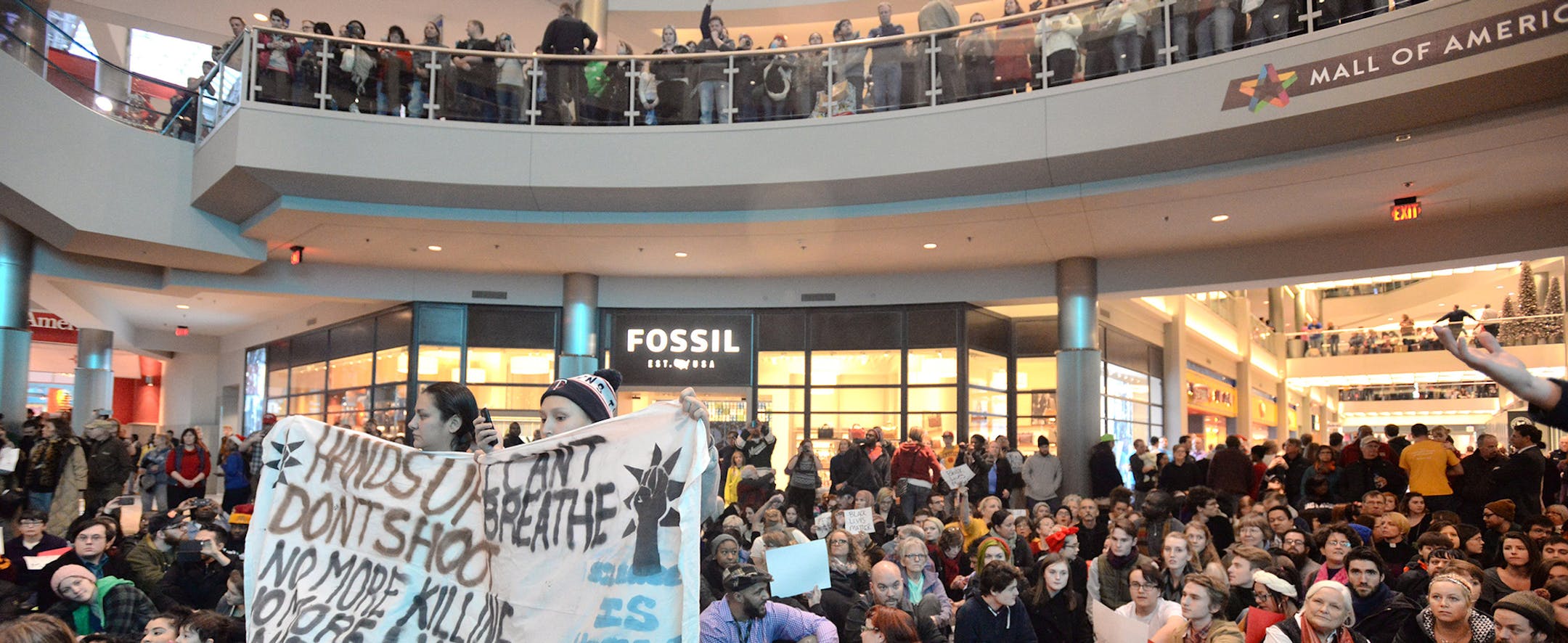
On Saturday, thousands flooded the atriums and corridors of the Mall of America to protest police brutality. At roughly the same time in New York, two police officers were ambushed and brutally murdered. Should we expect a protest in the near future against civilian brutality toward police officers? Unfortunately, we cannot; police have become the scapegoat of a racial-discrimination problem that stems much further than law enforcement. Discrimination is a societal problem that has been placed on police following horrible events in Missouri and New York. In light of those events, it is no longer politically correct, nor are people willing, to fight for the rights of those who work so hard to protect ours. This all comes at a cost. Simply put, we cannot expect our law enforcement officers to protect us if we cannot protect them.
Chris Rose, Eden Prairie
• • •
I don't need to witness a shout-in at the Mall of America to understand that black lives matter. My life matters, too, and these disruptive demonstrations are not only ineffective, they tend to alienate those of us who are otherwise supportive of their cause.
Daniel M. Mitchell, Chanhassen
• • •
Setting aside the issue of whether a foreign-owned company receiving $250 million in assorted tax subsidies and breaks from the Minnesota Legislature still constitutes absolute private property, during Saturday's demonstration at the Mall of America I saw a multiracial, multigeneration citizenry peacefully demonstrating about one of the most important issues of our times. I appreciate that it inconvenienced some shoppers who might have had to wait an hour to get into Old Navy, but I try to take a long view of American life. We are a big country undergoing a generational shift in demographics and technology. Public protest, even on private property, has been a feature of our democracy for 240 years — indeed, it gave birth to this great country. Sometimes democracy is messy and inconvenient, but it is our history and, on balance, has served us well. Tolerance of peaceful demonstration makes America stronger.
Ed Murphy, Minneapolis
• • •
David Rubinstein's nauseating opinion on why "not profiling people is foolish and dangerous" (Dec. 22) reads as a weak justification of racist practices that have contributed to the killings of innocent black people at the hands of police. His attempt to match racial profiling with the wariness that women have on the street around men is grievously uninformed. The key difference between racial profiling and women's wariness is who holds the power in the situation: Cops hold undeniable legal power over the people they kill (as we have seen in the recent lack of indictments), and often racial power, as well, if the cops are white. When women "profile" men on the street, it is because they are the historically and currently oppressed group in the situation. Rubinstein's ignorant remark that "it is not clear that race plays any role in police killings" makes me appalled that this professor of sociology doesn't see the racism that happens every single day in America.
Caroline Stevens, Minneapolis
• • •


