

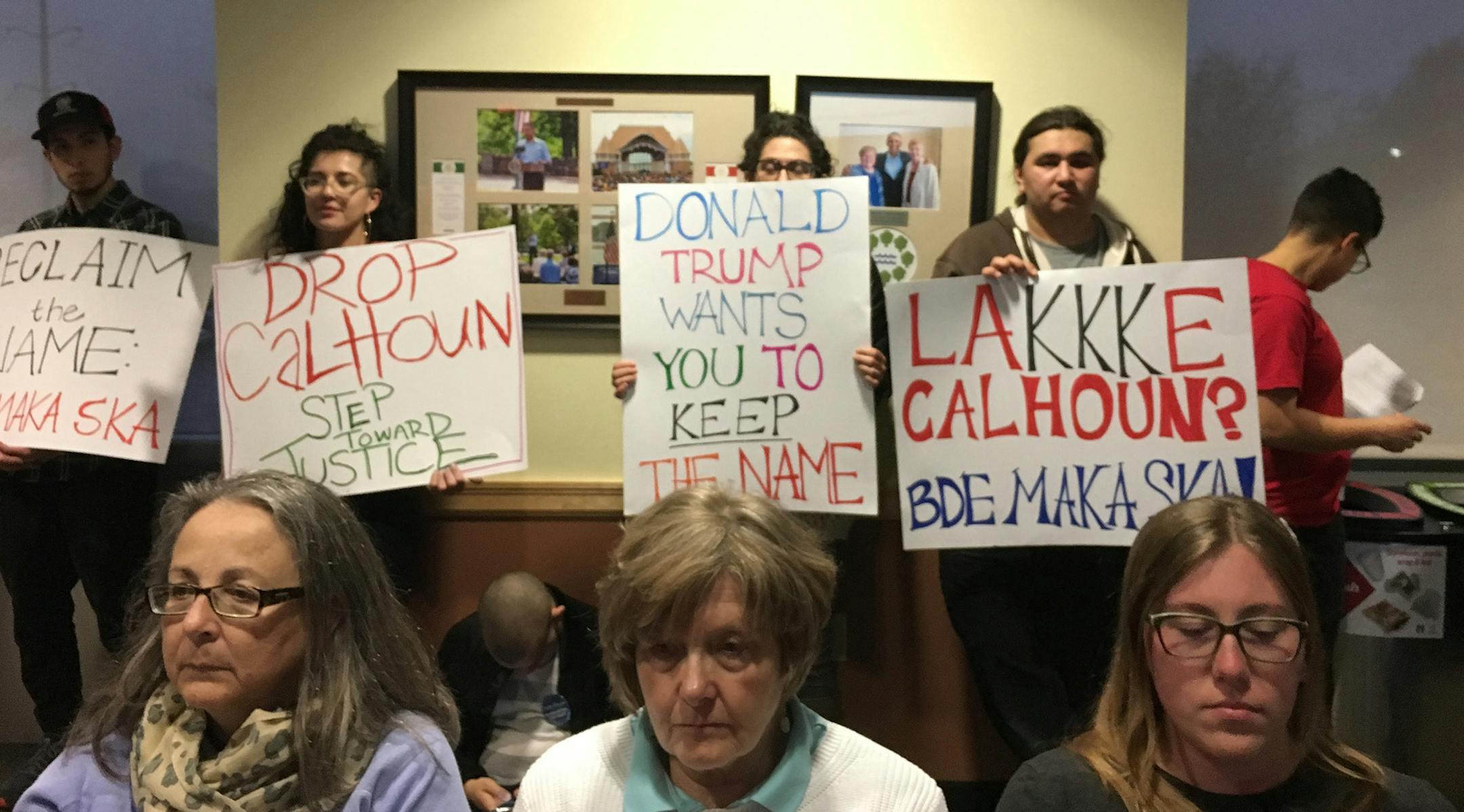
An April 20 article quoted a proponent of renaming Lake Calhoun, who declared that the renaming "would go a long way toward acknowledging the sometimes troubling history of Dakota-white relations." In what way does renaming a lake address the dire issues facing many Native Americans today, like widespread drug-abuse and lack of economic opportunity on reservations? We don't need more "acknowledging," we need action.
Consider Arizona: Just about every street, park, and mountain carries a Native American or Spanish name. How are their Native American-white and Hispanic-white relations going? If Minnesotans truly cared about the Native American people, and righting the government's wrongs, then the Red Lake Reservation would not have poverty levels comparable to a rural Afghan village.
The appearance of "Bde Maka Ska" alongside "Lake Calhoun" is perfectly sufficient. Erasing the "Lake Calhoun" name does nothing productive — but it ignores our community's history while alienating the southwest Minneapolis voters who truly care about making a tangible difference.
Michael Wellvang, Minneapolis
• • •
The Minneapolis Park and Recreation Board's planning committee was right to unanimously support changing the name of Lake Calhoun. While we live in an age too often governed by ridiculous political correctness, altering the namesake of Minneapolis' most beautiful body of water is a very worthy cause.
John C. Calhoun was a despicable figure in American history and perhaps the most influential proponent of slavery our country has ever known. Unlike the American founders, who viewed slavery as a necessary evil and sought to put it on a path of destruction, Calhoun argued that the insidious institution was "a good — a positive good." He contended that the truth articulated in the Declaration of Independence that all men are created equal "has become the most false and dangerous of all political errors." Calhoun maintained that citizens derive their equality not from their sovereignty as individuals under "the laws of nature and nature's God," but from the constitutional equality of the states within the Union. It's this philosophy that fueled the Civil War.
Minnesota's Civil War history is a proud one — ours was the first state to commit troops to President Abraham Lincoln, and the casualty rate of the First Minnesota Regiment at Gettysburg was the highest in the Union Army. Honoring Calhoun by naming one of our great urban waterways after him runs contrary to that noble legacy.
Andy Brehm, Minneapolis
EDINA AND SMOKING
Making the legal smoking age 21 will not deter teenagers
When our teenagers turn 18, we consider them an adult in most of life's experiences — such as the armed forces, buying a car, renting a house and being on their own in general ("Edina on smart track to smoking age of 21," editorial, April 24). If Edina has its way, tobacco will join alcohol as an item the 18-year-old adult is not mature enough to make a decision on. Making the age 21 to purchase tobacco will not deter that teenager from engaging in smoking or chewing tobacco. In fact, when dealing with millennials, my experience is just the opposite where teenage tobacco use could rise.


