

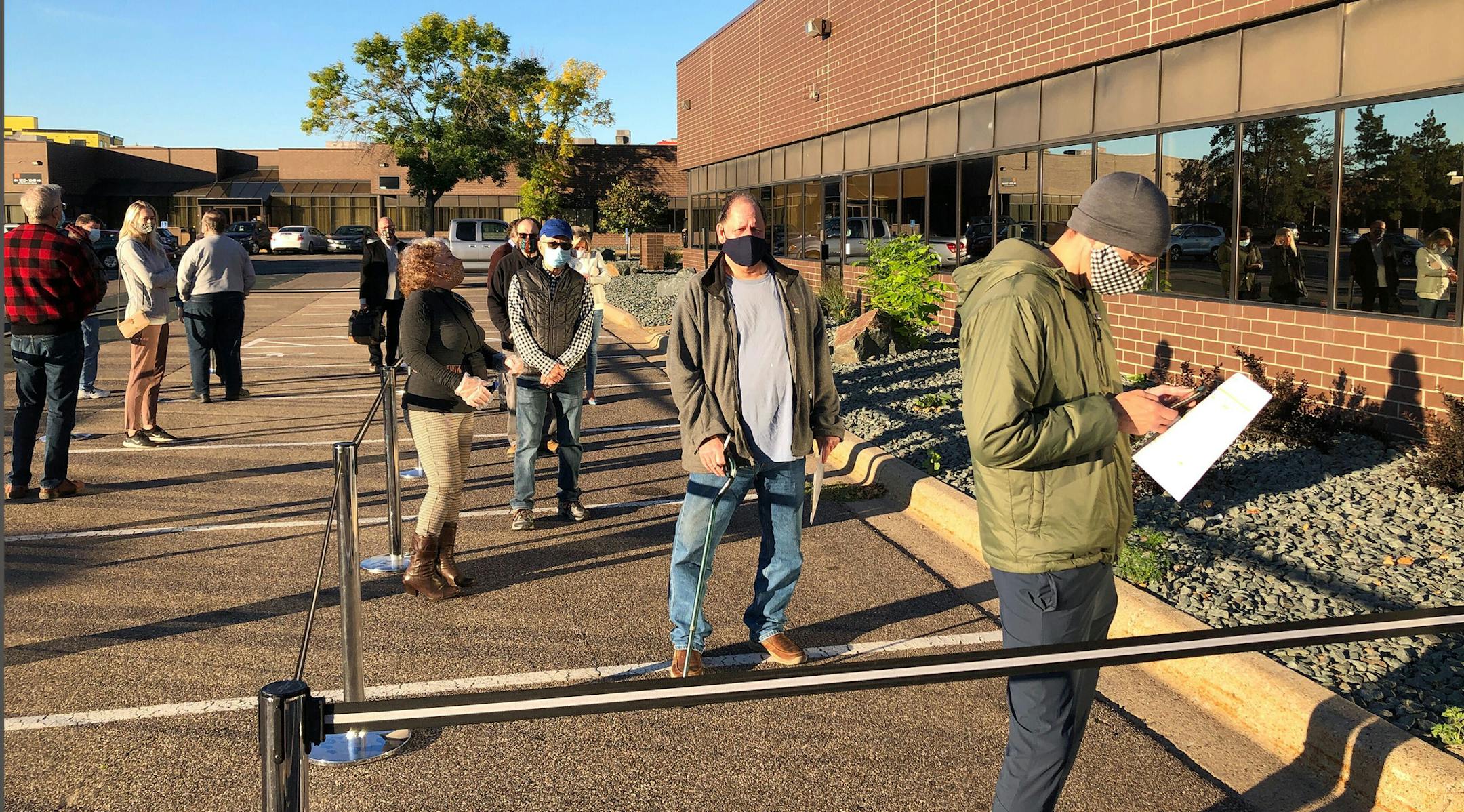
On Thursday, I voted in Eden Prairie. The process was smooth, pleasant, unhurried and safe. Before I was given an application for absentee voting (since I was choosing to be "absent" on Nov. 3), I was asked if I had requested a ballot by mail so there could be no duplication. I was handed a sanitized pen to use throughout the process, and asked to return it to be cleaned when I was done. The woman who processed my application checked everything carefully as she entered it into her computer. I was able to take my time with my ballot, ensuring that each circle was fully filled in. After I placed my ballot in the provided envelope, I used the available glue stick to seal it so I could keep my mask in place. When the poll worker received my finished ballot, she checked every line to ensure everything was correct. Then she stamped it with a bold black stamp so there could be no mistake it was valid. The whole process took less than 20 minutes.
The point is this: Vote now. It's easy and safe. And it's another reason why we can be proud to live in Minnesota, since not all states offer this privilege.
Robin Silverman, Eden Prairie
• • •
Retired Minnesota Supreme Court Justice Paul H. Anderson is correct in asserting that in-person voting should be safe ("Vote boldly, vote carefully, to ensure it counts," Opinion Exchange, Sept. 25). Based on my 15.5-hour shift serving as a primary election judge, that's true. Judges and voters wore masks, many judges wore gloves, 6-foot distancing was maintained, and we sprayed surfaces with sanitizer periodically. Anyone refusing a mask was offered service outdoors. My precautionary COVID test a few days later confirmed the safety of these precautions.
Voting in person is also safer because it alerts a voter to just the kind of voting mistakes that Anderson highlighted. The machine tabulator in use in many places alerts a voter when a ballot is poorly marked, or when she or he makes other common voting errors, such as voting twice in a contest when the voter is allowed only one vote. When a machine alerts a voter to such mistakes, an election judge can help that voter to obtain a new ballot and correct the mistake.
Steve Brandt, Minneapolis
ELECTION RESULTS
If Trump loses, he must go
Of all the absurdities, distortions, outright lies and filling of the swamp with lower life-forms, the idea that you would not accept the results of a free and fair election takes the cake ("Trump won't commit to honor votes," front page, Sept. 25). Should you lose and not concede the office (like the 2016 popular vote winner did with grace and dignity) the American people will have a say about that.
The thing to remember is that in our pandemic-driven lives there is one property that will not be subject to a moratorium on eviction. It is a large white-colored singe-family dwelling on Pennsylvania Avenue in the District of Columbia.
Republicans, where is your outrage? If Barack Obama had uttered those words in 2012, your heads would have exploded. I know it is the season of hypocrisy and going back on your words of four years ago, but reality should really sink in at some point.
Paul Schultz, Ham Lake
MINNEAPOLIS POLICE
It's not contradictory to want less crime and better policing
The Sept. 23 editorial "Hypocrisy in the air at Mpls. City Hall" creates a false dichotomy with shallow journalism. Effective City Council members can walk and chew gum at the same time. They are attempting to do what good representatives do: communicating with residents and negotiating policy recommendations while considering the impacts. You can believe in dismantling or defunding the police at the same time asking them to do their job. The City Council is not being hypocritical; the Star Tribune is.

