
Readers Write: 10th Ward convention, gun legislation, election finance, the Durham report

Pessimistic on the state of our politics.

May 16, 2023 at 10:45PM
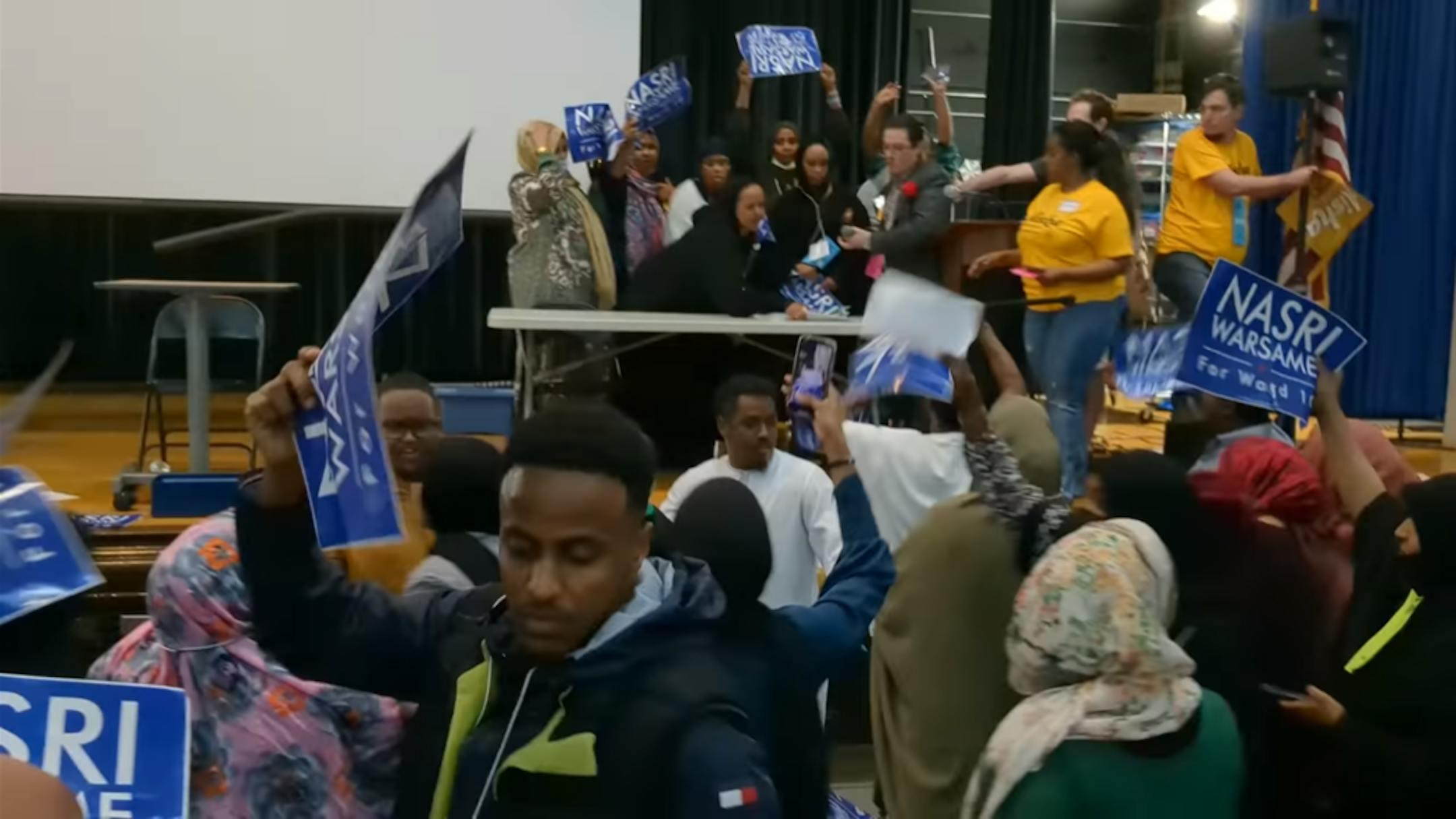
As shown in this screen grab from a video shared by blogger John Edwards, disorder reigned at the Minneapolis DFL 10th Ward convention on Saturday, May 13, as supporters of City Council candidate Nasri Warsame took over the stage and tussled with convention organizers and supporters of Council Member Aisha Chughtai. (John Edwards, Wedge Live/The Minnesota Star Tribune)

Opinion editor's note: Star Tribune Opinion publishes letters from readers online and in print each day. To contribute, click here.

•••

The 10th Ward violence has been a long time coming, and no one cares till it's filmed ("DFL melee is a sign of the times," editorial, May 16). The truth is the politics of division and derision were on display during the failed Jan. 6 coup, and at the Minneapolis 10th Ward convention. This is not a Republican or Democratic issue, this is an American political system issue.

What needs to be addressed is not only the behavior of those on the floor; there must be accountability for those running for office and seeking the party endorsement. I lived in the 10th Ward for over a decade, till two years ago. I watched the escalation, especially in the last four years, toward this politics of division, derision and hate: "Those not supporting me are the enemy."

The races are not about ideas, a vision of leadership and unity after a hard-fought race. It's us vs. them. You only talk to your base and rile them up by saying in subtle ways that your opponent and their supporters are the enemy.

Until the party stands up and holds the candidates responsible for sparking this and the supporters who follow through with the inevitable violence responsible, nothing will change. The party needs to draw the line. If violence is not the answer, then hold everyone accountable. But we all know nothing will be done and the politics of hate will just grow stronger, and everyone will lose.

David Schlosser, Minneapolis

GUN LEGISLATION

Popular in the abstract

In response to a May 15 letter about gun legislation: Thank for your spirited take on Minnesota's public safety bill. I must, however, correct a few misinterpretations.

Public policy polling doesn't equate to support for specific legislation. The devil, as they say, is in the details. When the minutiae of a policy are revealed, public approval fluctuates dramatically as people learn the actual scope of legislation.

When we question the potential political fallout for Sens. Grant Hauschild, Rob Kupec and Judy Seeberger, we're not issuing threats but merely observing the political pulse of their districts. It's not a threat to predict a storm when the clouds are already gathering.

The "cloak and dagger" approach to passing this bill, sneaking language into a 500-plus-page omnibus bill after it never saw the Senate floor, thus avoiding a clear up or down vote, doesn't scream "confidence in constituent support" to me. It's more like a shell game meant to obfuscate their intent from their voters. That's not bravery, it's political subterfuge.

And let's touch on the "independent spirit" of these senators. On the campaign trail, and even during session, they've pledged to be mavericks, but one glance at their voting record shows they fall in line with their party like ducks in a row. Independence isn't just a word; it's an action. And sometimes, it means disagreeing with your party.

We don't make threats; we advocate for the rights of Minnesota's peaceable gun owners. It'd be nice if our senators did the same.

Rob Doar, Blaine

The writer is a lobbyist for the Minnesota Gun Owners Caucus.

ELECTIONS

State can empower average voters

According to Open Secrets, 2022 national midterm elections fundraising skyrocketed to $8.9 billion, a new record. The U.S. Supreme Court's Citizens United ruling made it legal for corporations to contribute unlimited amounts to campaigns in the name of free speech. Regardless of political affiliations, wealthy special interests look out for themselves, not everyday Americans. Two items at the Minnesota Legislature are flying below the radar that could strengthen our democracy by reducing candidates' dependence on big money.

The first is in the state government and election omnibus bill. It would triple the Campaign Finance Board's public subsidy program for political candidates who register with the board. The public subsidy program was started in 1974 in response to the Watergate scandal. A candidate must sign and file a public subsidy agreement to qualify for the program. They have to abide by the disclosure and fundraising requirements the board sets.

For years the budget has stagnated at $1.2 million per biennium for candidates running for office. That amount comes from the general fund and is equally divided among all candidates of major political parties running for a specified office. If the conference committee includes this provision, it will increase by $2.1 million for fiscal years 2024 and 2025 for a total of $3.3 million. This means less money to raise and more time communicating with voters about the issues that matter to them.

The next is in the Senate tax omnibus bill. The Senate and House have proposed to increase the political contribution reimbursement program from $50 per individual to $75 and for married couples from $100 to $150. If passed, it would increase the proportional importance of small donors and average Minnesotans so that candidates do not depend as much on large contributions, lobbyists or special interests.

Earlier this session the Democracy Dollars bill was introduced that would issue a $25 dollar voucher to each voter to donate to candidates. It didn't advance. Seattle adopted this program in 2015 with great success. It's seen that it not only reduces the influence of big contributors but it encourages more people to run for office, increases the number of voters and gives everyday people a bigger voice in their elections. We've been advocating for a voucher program since 2017 and hope to see it return in the next biennium.

We must restore balance and create a system where every citizen has an equal vote and say. More public financing of campaigns is good for democracy and is a bipartisan issue. We urge the tax committee and the state government and elections conference committee to include these increases in their final reports, for the House and Senate to pass them so they can be signed by the governor and be available for the 2024 election.

Mary Hartnett, Minneapolis

The writer is executive director, Clean Elections Minnesota.

DURHAM REPORT

Where was the detailed coverage?

Admittedly the report by John Durham into the origins of the Trump-Russia collusion allegation was less than the "blockbuster " President Donald Trump promised. Nevertheless, the 306-page report should have been treated with far more importance than the Star Tribune gave it, limiting its coverage to two paragraphs on page A6, which reported only that Durham accused the FBI of a "lack of analytical rigor" ("Durham issues final Russia inquiry report," May 16). With another presidential election on the horizon, Durham's findings should have been given far more comprehensive coverage.

Durham's conclusion that the FBI "failed to uphold their important mission of strict fidelity to the law" when it launched its investigation into the Trump campaign using "seriously flawed information" is of major importance if we are to avoid a repeat in 2024. His finding that the FBI rushed to investigate the Trump campaign even as it proceeded cautiously on allegations related to his Democratic opponent suggests it favored one candidate over another. Its disparate treatment went even further, giving defensive briefings to the Clinton campaign that were denied the Trump campaign. The report went so far as to suggest the FBI should have considered whether it was being "manipulated for political or other purposes."

Democracy is threatened when its premier intelligence agency demonstrates a clear preference of one candidate over another. That is the importance of the Durham report, and for that reason it merited far more comprehensive coverage than it was given by this paper.

Ronald Haskvitz, Golden Valley

about the writer

about the writer