

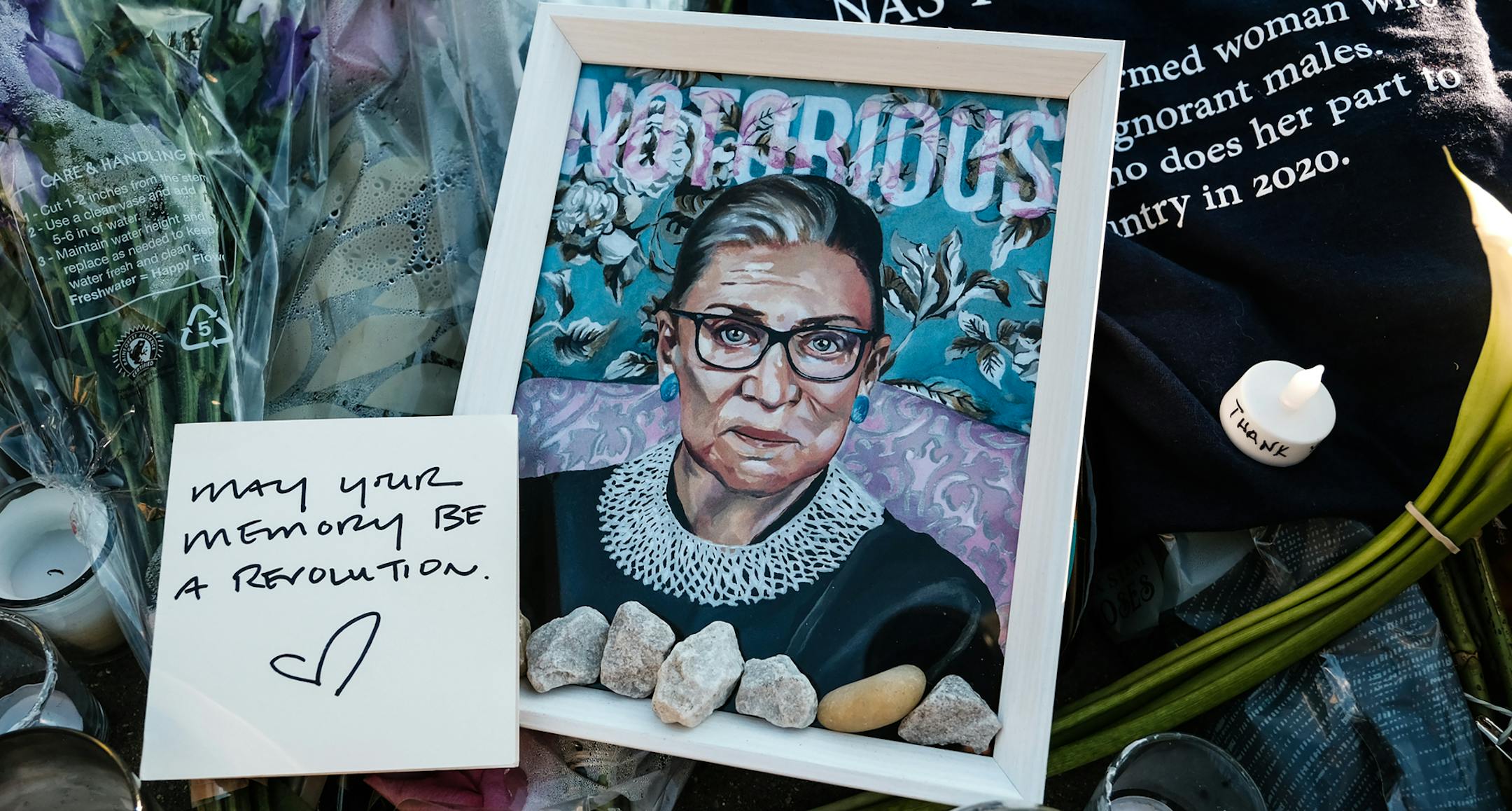
In 2014, Supreme Court Justice Ruth Bader Ginsburg, the pioneering legal mind and advocate for equal treatment of the sexes who died Friday, did something that probably none of her male colleagues were ever asked to do: She gave a tour of her office closet.
The occasion was an interview with Katie Couric after Ginsburg's strongly worded, 35-page dissent in the Burwell v. Hobby Lobby decision, in which the court sided with a corporation's desire to challenge the Affordable Care Act's contraception mandate on the grounds of religious freedom.
But Ginsburg did not seem remotely put out about starting the conversation with fashion.
Opening the imposing wood doors of her wardrobe, the justice revealed, on one side, the long black robes of the court, and on the other — taking up more than half the hanger space — her extensive collection of elaborate collars. She had them, she said, "from all over the world." She had them for every occasion, and for every kind of opinion of the court.
As much as the nickname "The Notorious R.B.G.," which came to symbolize Ginsburg's status as a pop culture hero in her later years, the collars served as both semiology and semaphore: They signaled her positions before she even opened her mouth, and they represented her unique role as the second woman on the country's highest court. Shining like a beacon amid the dark sea of denaturing judicial robes, Ginsburg's collars were unmistakable in photographs and from the court floor.
Though obviously Ginsburg's legacy of jurisprudence is her most important gift to history, her understanding of her own significance as a role model was undeniable. As the rare female law student (and student in the rarefied air at the top of the class) — not to mention the rare female lawyer — she was used to being the only one. She knew that every statement she made, every gesture, every image, would be noted, picked over and parsed. All her choices mattered. So she might as well imbue them with meaning.
Even if they were only about the collar.
In 2009, in an interview with the Washington Post, she explained how her collection originated: "You know, the standard robe is made for a man because it has a place for the shirt to show, and the tie," Ginsburg told the paper. So she and Sandra Day O'Connor, the first female justice on the court, "thought it would be appropriate if we included as part of our robe something typical of a woman." They weren't going to obscure their sex or pretend it was beside the point. It was part of the point.


