

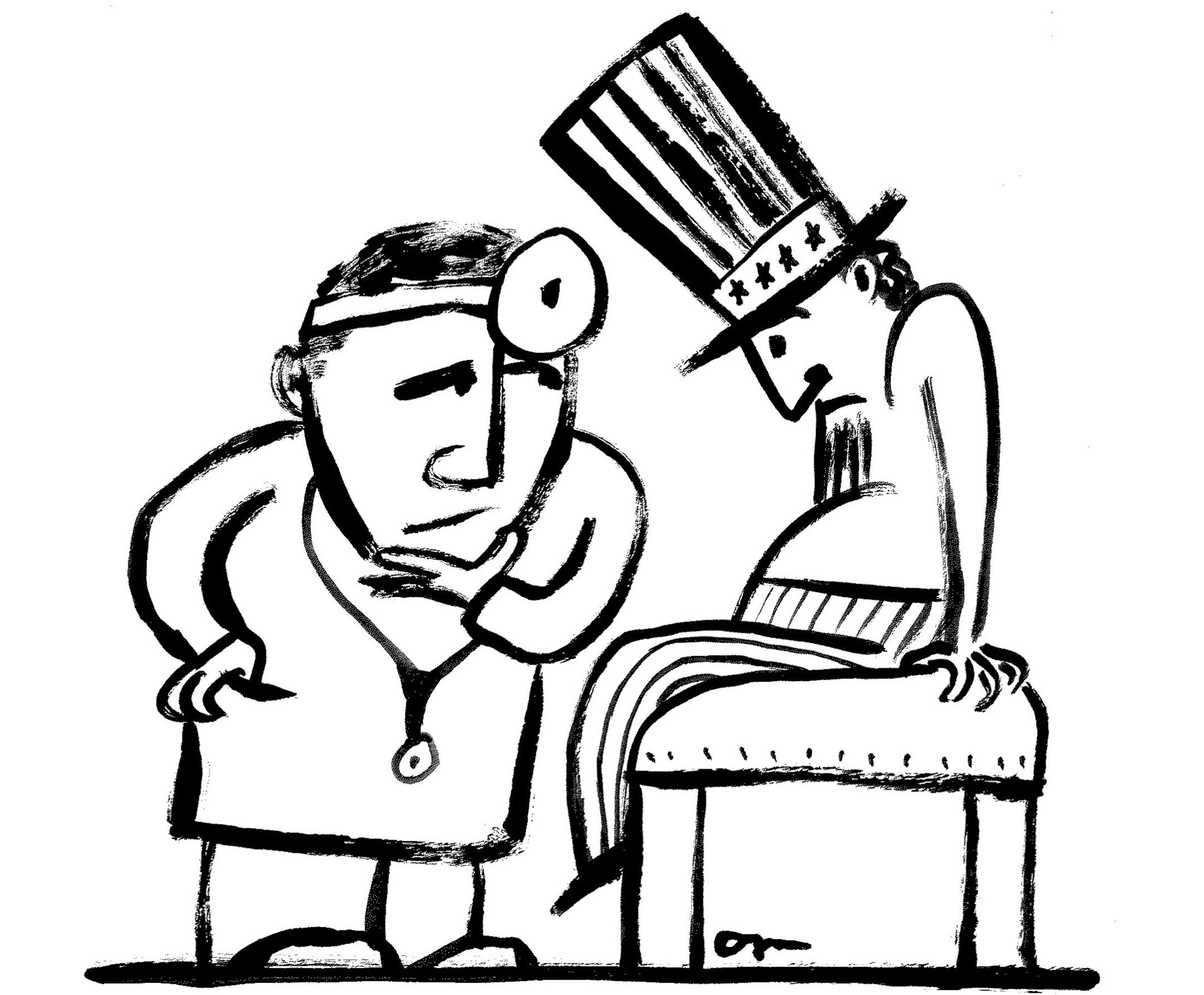
America's ongoing food fight intensified Friday with the premiere of "Fed Up," a searing indictment of the role that food manufacturers, agribusiness and Washington play in the obesity epidemic. The documentary, executive produced by Katie Couric (who also narrates) and Laurie David (who also produced "An Inconvenient Truth"), is just the latest (and loudest) voice in the cacophonous debate about nutrition.
"Fed Up" won't be considered as much of a polarizing polemic as "An Inconvenient Truth." Unlike climate change, no one denies rising obesity. But the film's conclusion that sugar-laden processed foods feed the epidemic will likely be met by a big backlash from Big Ag, Big Food and Big Government.
And oh, yeah, Big Media, too. Like previous spoonfuls of policy medicine, targeting sugar will mean the terms "food police" and "nanny state" will be heard often on talk radio and cable.
Politicians will pile on, too. Sarah Palin, for instance, drank a Big Gulp during a CPAC speech at the height of hysteria over then-New York Mayor Michael Bloomberg's push to limit oversized sodas. "Fed Up" covers that moment, but is bipartisan in its criticism. It alleges that Michelle Obama's "Let's Move!" movement has been immobilized by big business. And it singles out Sen. Amy Klobuchar, D.-Minn., for her role in intervening on behalf of Minnesota-based Schwan Food Co. in a debate over pizza and school lunches.
The oncoming counterclaims are just the latest example of how it's difficult to discern what to believe — and do — about personal and public policies on nutrition. Be it coffee, red wine or entire food groups, even qualified sources send conflicting signals.
Sources motivated by profit do, too. And their amplification makes advocacy difficult.
"A big problem with public health interventions is that they are a few exposures relative to a constant onslaught from the food industry and from the entertainment media," said Marco Yzer, a University of Minnesota associate professor who teaches in both the School of Journalism and Mass Communication and the School of Public Health. Yzer realizes that not only do health messages get outshouted, but when they are heard, it's often a literal and figurative eat-your-peas message. "As a field, we have not learned enough from our colleagues in advertising. The typical approach is to overeducate," Yzer said, adding: "There is a mismatch between audience motivation and educator objectives, and still most health education work emphasizes negative consequences of unhealthy eating too much when we are wired to turn away from those threats."
In fact, regarding nutrition, knowledge isn't often power. "More information doesn't mean that people are more informed," said Yzer.


