

Ramstad: Norway House opens center for immigration research

A grandson of Norwegian immigrants funded a library of documents, including ship registers and church records, for public use.

Columnist Icon
The Minnesota Star Tribune
October 6, 2025 at 8:25PM
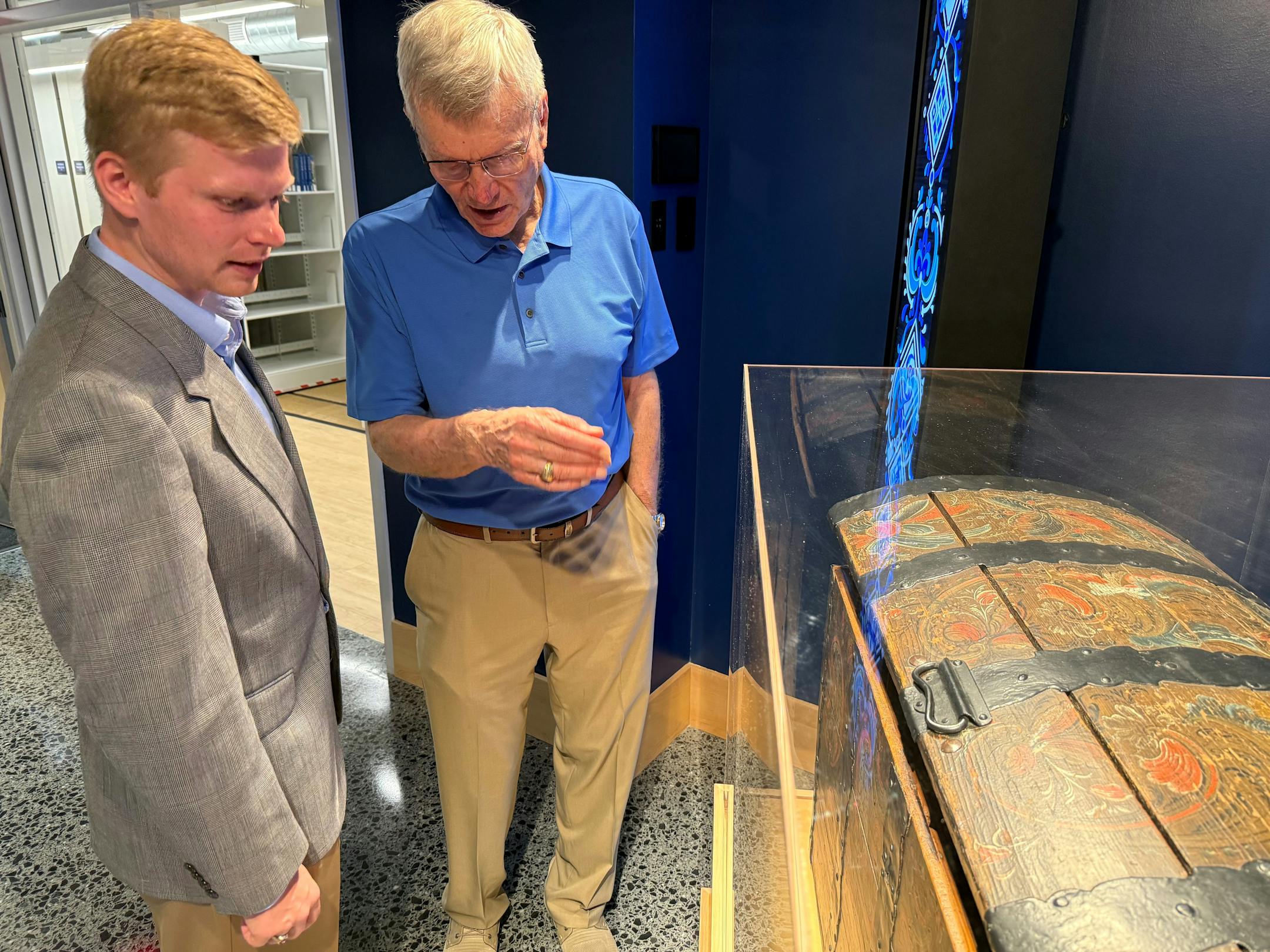
Race Fisher, left, development associate at Norway House, and John Haugo, a member of the Norway House Founders' Council, examine the trunk that Haugo's grandmother used in her journey from Norway to America. The trunk is now on display at the Saga Center, an interactive exhibit that includes a research library with materials on Norwegian migration to the United States. (Evan Ramstad)

The last step of an immigrant’s journey to the United States comes long after that person has gone, when their descendants finally understand the magnitude of what they did.

On Tuesday, Norway House, the cultural and event center in the Minneapolis Phillips neighborhood that’s still a first home for many immigrants, is expanding with an exhibit and research space called the Saga Center to explore connections between Americans and Norwegians.

The next king of Norway, H.R.H. Crown Prince Haakon, will be on hand to dedicate the new center, three years after his mother, Queen Sonja, visited it. The prince will then preside at a business conference with executives from Medtronic and other Minnesota companies with operations in Norway and Europe.

Today, the proportion of foreign-born Americans has surpassed that of the late 19th and early 20th centuries, when immigration from Norway and other parts of Europe peaked. That proportion hit a record high of 15.8% in January, according to Pew Research.

At places dedicated to recognition of past migrations, it’s easy to see how the same forces that have driven immigration throughout Minnesota’s history remain unchanged.

The poor and hungry from somewhere come to America, settle near each other here, go to school and to work and, with each generation, get richer, gain political power, intermarry and move. In time, their descendants look back with wonder at those who took those first, hardest steps.

In addition to Norway House, the looking back happens at the Minnesota African American Heritage Museum and Gallery, Danish American Center, Eloise and Elliot Kaplan Family Jewish History Center, American Swedish Institute and the Somali Museum, all in Minneapolis. There’s also the Germanic-American Institute and Hmong Cultural Center Museum in St. Paul and the Minnesota Genealogical Society in Mendota Heights.

Tucked inside the new Saga Center at Norway House is the Haugo Bibliotek, a library of Norwegian genealogical materials and computer workstations. They include country books, or bygdebøker, and church records listing families over centuries. Those records are a key reason that people of Norwegian heritage like me are able to trace their family history back generations.
“Norway is just amazing in that they have not only for hundreds of years collected these amazing church records, but they’ve also scanned and digitized all of them and make them accessible to anyone and everywhere just to do this research,” said Race Fisher, a development associate at Norway House.

John Haugo, a retired teacher and software executive, underwrote the new library. All four of his grandparents were immigrants from Norway, but it was his father’s mother who instilled in him a sense of Norway’s culture.

Haugo decided to create the library at Norway House after becoming his generation’s family historian and working with a distant cousin in Norway to put together the stories of hundreds of ancestors.

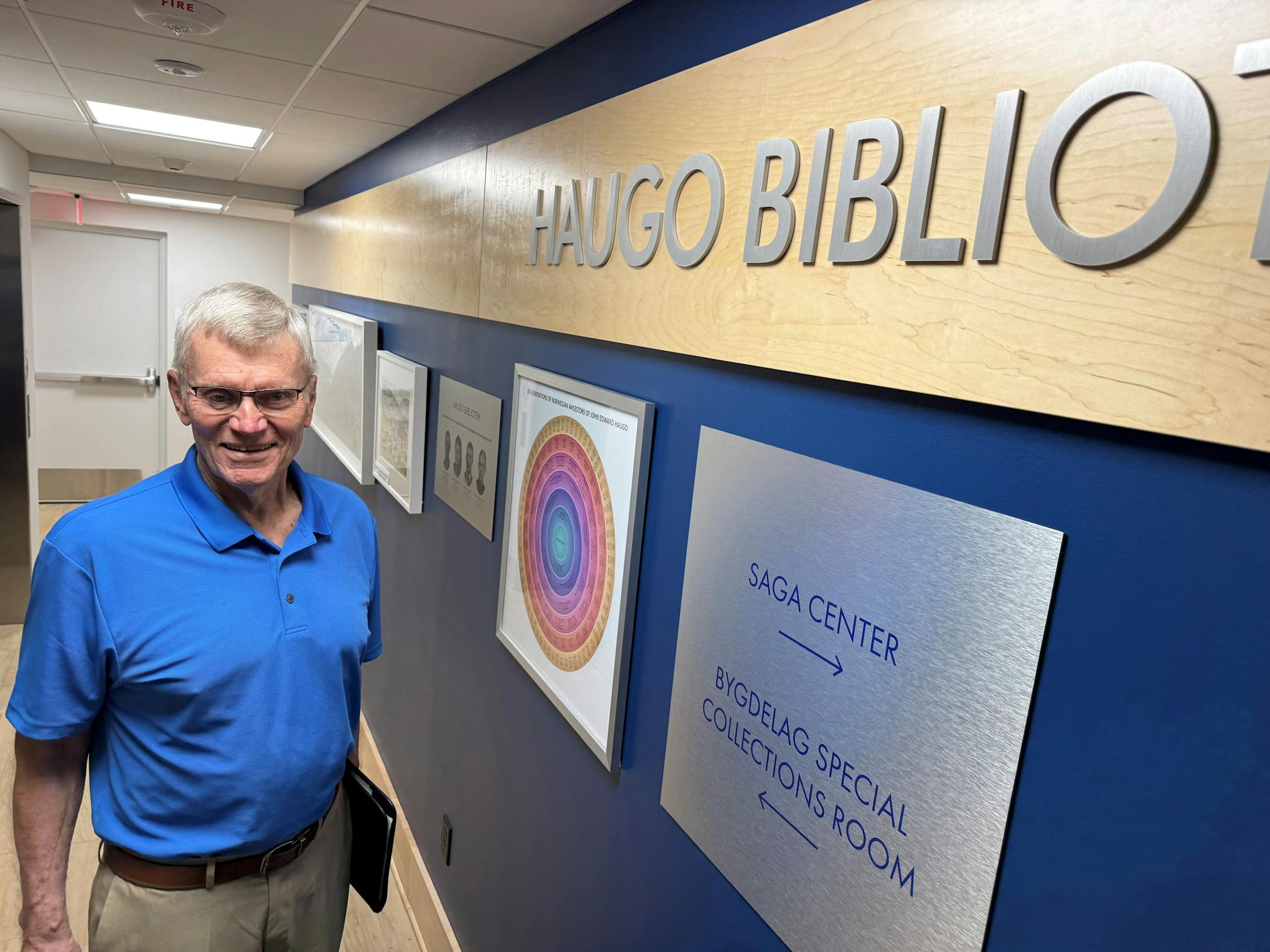
John Haugo, shown at the entry to the Haugo Bibliotek in Norway House in Minneapolis, became his family's historian after a group of Norwegian relatives came to a family reunion near Waubun, Minn. The library will provide other descendants of Norwegian immigrants with direct access to farm books and other records. (Evan Ramstad)

In 1997, his older brother hosted a reunion that drew a handful of relatives from Norway to their family farm in Waubun, Minn. Three years later, several dozen of his American relatives traveled together to Norway for a reunion with a larger group of Norwegians.

“Until that time, like a lot of us, I knew my grandparents’ [histories] and probably the names of my great-grandparents, but that was about it,” Haugo said. “So being somewhat naturally curious, I started from there.”

In each of the local government regions in Norway, there are councils that maintain and update the local genealogy records. Norway House established connections with each of them as it developed Haugo Bibliotek, Fisher said.

As well, for years, Minnesotan descendants of Norwegian immigrants have brought bygdebøker to Mindekirken, the nearby Norwegian Lutheran church.

“If a person has these books, they’re probably storing them in their basement, in their attic, you know, in a storage unit or something,” Fisher said. “Our solution was, well, let’s create a space at Norway House that is an archival-grade facility and then open it up to others.”

These days, it’s the people with northern European heritage who are farthest on from their immigrant ancestors — and, as a result, have the most research to do to understand the journey to America. They might also gain some empathy for people whose families immigrated more recently.

The modern era of immigration started in 1965, when Congress passed a law that ended decadeslong quotas that favored immigrants from Europe. In the 60 years since, the racial and ethnic diversity of the country exploded. America’s population has grown a bit less than twice as large, while its economy has grown more than 200 times as large.

In Minnesota, immigrants from Mexico and other Spanish-speaking countries in Central and South America may soon have a history center or museumlike complex.

The Minnesota Latino Leadership Alliance, a collection of Hispanic business and political advocacy organizations, for several years has been developing plans to build the Latino Center for Community Engagement. A site has been chosen in St. Paul for the center, which would host events and provide cultural resources.

about the writer

about the writer

Evan Ramstad

Columnist

Evan Ramstad is a Star Tribune business columnist.

See Moreicon

More from Business

See More
card image
Hormel headquarters in Austin, MN. ] GLEN STUBBE * gstubbe@startribune.com Friday September 11, 2015 Despite woes throughout the food industry, partly due to consumers turning away some from processed foods, Hormel has managed to continue prospering -- even though a good part of its business -- Spam, chili -- is about as processed as you can get. But the company's turkey and pork offerings are riding a hot protein trend. And over the past two years, it's made some of the biggest acquisitions in