
Ramsey County moves to prevent another 'week of utter hell'

Ramsey County is the latest Minnesota jurisdiction to offer tracking bracelets for vulnerable people who are prone to wander.

July 23, 2009 at 3:06AM
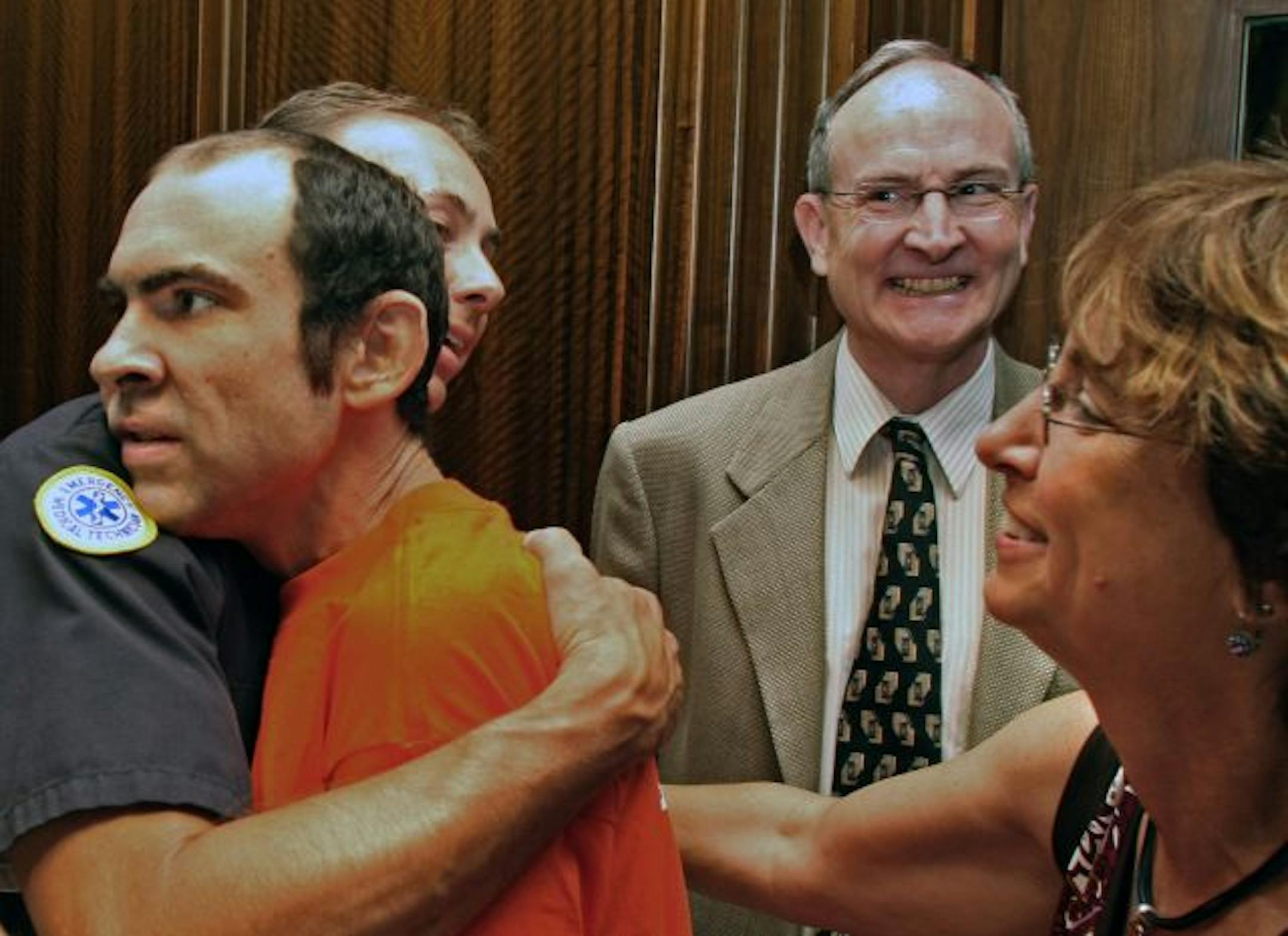
A hug from a rescuer: Keith Kennedy got a hug from St. Paul firefighter Gary Ruiz, one of the rescuers who found the 25-year-old autistic man after he was lost in dense Wisconsin woods. Watching were Kennedy's parents, Bruce and Linda Kennedy.
A hug from a rescuer: Keith Kennedy got a hug from St. Paul firefighter Gary Ruiz, one of the rescuers who found the 25-year-old autistic man after he was lost in dense Wisconsin woods. Watching were Kennedy’s parents, Bruce and Linda Kennedy. (Star Tribune/The Minnesota Star Tribune)

A year ago, Keith Kennedy, an autistic man from Shoreview, walked away from a Wisconsin summer camp, beginning "a week of utter hell," his mother recalled Wednesday. The 25-year-old eventually was found alive, naked by a creek.

Today, Kennedy is fully recovered, and as of this week, he is among the first in line in Ramsey County to get a radiowave-emitting bracelet that will aid authorities in finding at-risk people who wander.

Sheriff Bob Fletcher announced Wednesday that the county is the latest in a growing number of jurisdictions in Minnesota to join Project Lifesaver, a program that provides the technology to help track vulnerable people.

For $99 in upfront per-person costs, and $30 a month for battery replacements, caregivers applying to the program can secure bracelets for people with autism, Alzheimer's disease, Down syndrome and other cognitive impairments.

Had the program been available a year ago, and Kennedy fitted then with a bracelet, the sheriff's office could have sent deputies with equipment to track him, helping find him sooner and at a cost far less than the estimated $350,000 spent on last year's search, Ramsey County Sheriff's Cmdr. Joe Paget said.

The technology, which is the same as that used to track bears, has been used for 1,960 searches during the past 10 years, with no lives lost, according to Project Lifesaver. The average search takes 30 minutes, authorities say.

Fletcher said that the cost to the sheriff's office would be $3,000 for training and equipment, plus personnel costs that include the addition of a program coordinator who is being paid $16 an hour. The coordinator, Bob Parrott, a community service officer, helped bring the program to New Brighton. He was inspired, he said Wednesday, by his own experiences caring for a father with Alzheimer's who once wandered into a McDonald's restaurant wearing only a hospital gown and robe.

Other jurisdictions that have signed on to Project Lifesaver include Wright County, which began distributing bracelets this year; Scott County, which is taking applications on its website; and Washington County, which plans to advertise the program during its upcoming county fair.

To apply in Ramsey County, call 651-266-7332 for information, or go online to www.lo jacksafetynet.com.

Keith Kennedy's parents, Bruce and Linda Kennedy, spoke at Wednesday's news conference. They then went outside as deputies demonstrated how to use the tracking equipment, locating a bracelet-toting colleague between two parking lots across a busy street in about 10 minutes.

Afterward, Bruce Kennedy said that he was pleased that the search for his son, which he has described as life-changing and faith-restoring, continues to inspire -- this time with the county's adoption of Project Lifesaver.

And had he filed his son's application? "I finished it yesterday," Bruce Kennedy said.

Anthony Lonetree • 612-673-4109

about the writer

about the writer

Anthony Lonetree

Reporter

Anthony Lonetree has been covering St. Paul Public Schools and general K-12 issues for the Star Tribune since 2012-13. He began work in the paper's St. Paul bureau in 1987 and was the City Hall reporter for five years before moving to various education, public safety and suburban beats.

See Moreicon

More from No Section

See More
FILE -- A rent deposit slot at an apartment complex in Tucker, Ga., on July 21, 2020. As an eviction crisis has seemed increasingly likely this summer, everyone in the housing market has made the same plea to Washington: Send money — lots of it — that would keep renters in their homes and landlords afloat. (Melissa Golden/The New York Times) ORG XMIT: XNYT58
Melissa Golden/The New York Times

It’s too soon to tell how much the immigration crackdown is to blame.