

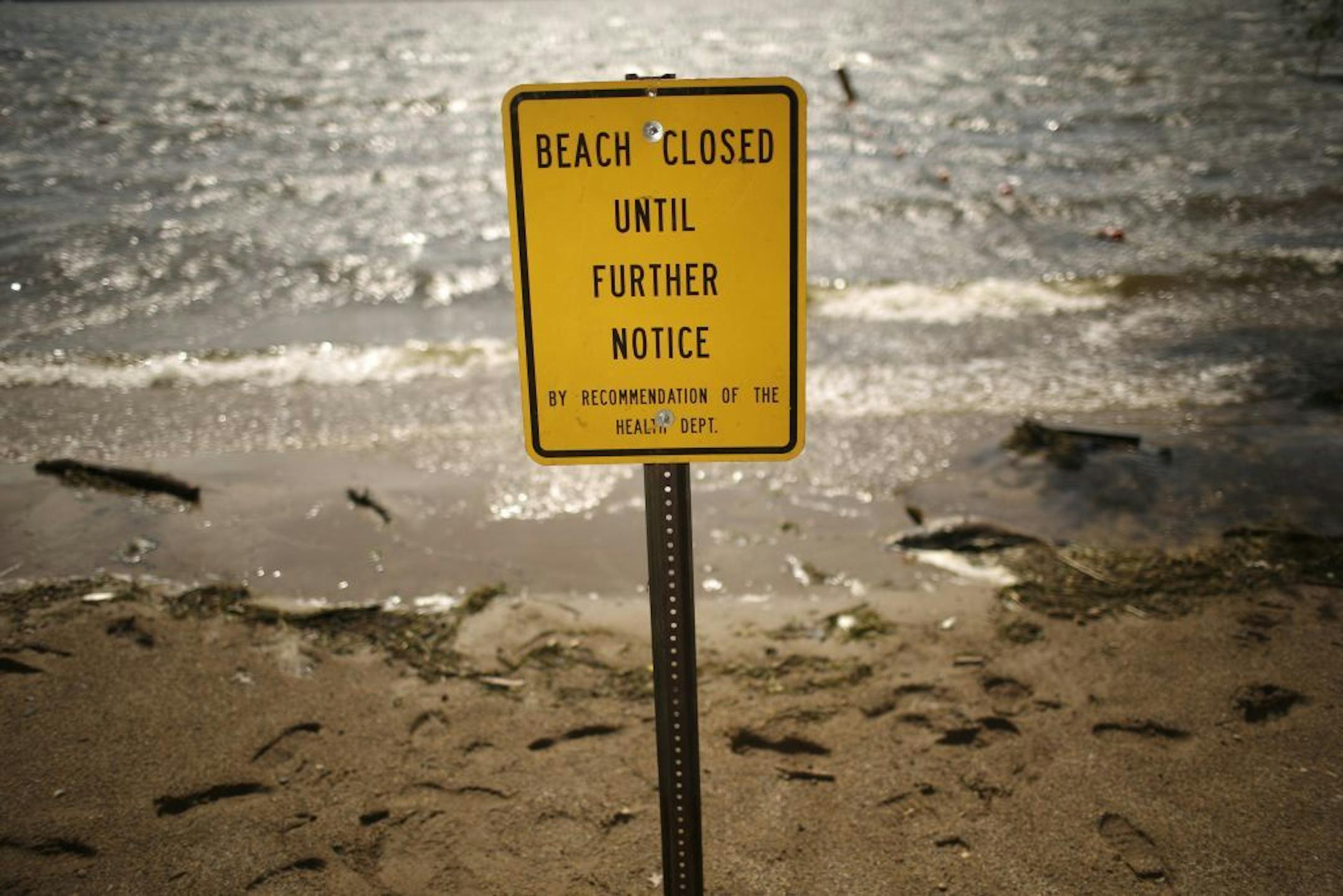
Three public beaches in the western Lake Minnetonka community of Mound were closed Monday after heavy weekend rains forced about 20 Minnesota cities and industries to bypass their sewage treatment operations and channel untreated waste into lakes and streams.
The impact was felt from the Iowa border to the Iron Range, said Wendy Turri, municipal wastewater manager for the Minnesota Pollution Control Agency. Most cities that used the bypasses were able to discharge sewage into rivers or other bodies of water not used for recreation, she said. But in Mound, an overwhelmed sanitary sewer system forced the discharge of contaminated wastewater into heavily used Lake Minnetonka.
In the coming days, contaminated runoff from streets — not from sewer pipes — could lead to other restrictions, said Duane Hudson, environmental health program coordinator for Hennepin County. Monday's beach closures were the result of "an abundance of caution," because the results of lakewater tests are not yet in, Hudson said.
The treatment-plant bypasses came when the amount of rain caused so much seepage into sanitary sewer pipes that they became clogged, creating the potential for sewage backup into homes. Nearly 1,000 homes in Mound were facing that possibility when the city notified the MPCA it was bypassing its sewage treatment plant Sunday. It returned to regular treatment operations early Monday, but about 20 homes were contaminated and will be uninhabitable until they're cleaned up, said Mound city manager Kandis Hanson.
It's not uncommon for Minnesota beaches to be closed due to E. coli contamination, since it can also be produced by waste from geese, ducks and other wild animals, as well as from boaters dumping waste overboard.
Hanson said that although the sewage discharged Sunday was clear and contained no visible solids, it was nearly certain to have contaminated water. "It should dissipate quickly — the same as goose poop," she said.
An infrastructure question?
Mound Mayor Mark Hanus said he doesn't remember the city ever having to pump sewage into the lake. He blamed the problem on what he called outdated regional sewage mains overseen by the Metropolitan Council that service the west side of Lake Minnetonka.
State Sen. David Osmek, R-Mound, said the Met Council has promised a major upgrade for about a decade but hasn't delivered. In the meantime, he said, Mound has put hundreds of thousands of dollars into fixing city mains.
![A sign that went up either Sunday or Monday Monday announcing the closing of the beach at Wychwood Beach in Mound due to an E. coli risk from raw sewage being pumped into Lake Minnetonka after storms over the weekend. ] JEFF WHEELER • jeff.wheeler@startribune.com The mayor of Mound blames the Met Council for his city having to pump untreated sewage into storm sewers feeding into Lake Minnetonka after heavy rains over the weekend. He was photographed in Mound Monday, June 2, 20](https://arc.stimg.co/startribunemedia/3L6MFNRWNUG33EJKPOINU6QN7U.jpg?&w=1080)
![Harold Enamorado made a sand castle with his son, Alessandro, on the beach at Surfside Park Monday afternoon while Harold's mother, Nelsa, sat nearby. Alessandro's mother, Jayme, said he was very disappointed that he couldn't go in the water because the sand castle tools and the trip to the beach were a reward for good behavior. The family is from Spring Park. ] JEFF WHEELER • jeff.wheeler@startribune.com The mayor of Mound blames the Met Council for his city having to pump un](https://arc.stimg.co/startribunemedia/X5QZSUFYUJONZEHJWIYWUYQNTI.jpg?&w=1080)
![Mound Mayor Mark Hanus at Surfside Park Monday afternoon along with state senator Dave Osmek on one of the beaches that was closed because of an E. coli bacteria risk from the raw sewage. ] JEFF WHEELER • jeff.wheeler@startribune.com The mayor of Mound blames the Met Council for his city having to pump untreated sewage into storm sewers feeding into Lake Minnetonka after heavy rains over the weekend. He was photographed in Mound Monday, June 2, 2014, at Surfside Park along wit](https://arc.stimg.co/startribunemedia/7FYJJFRSZZF426LIJLGYHYOJVE.jpg?&w=1080)


