

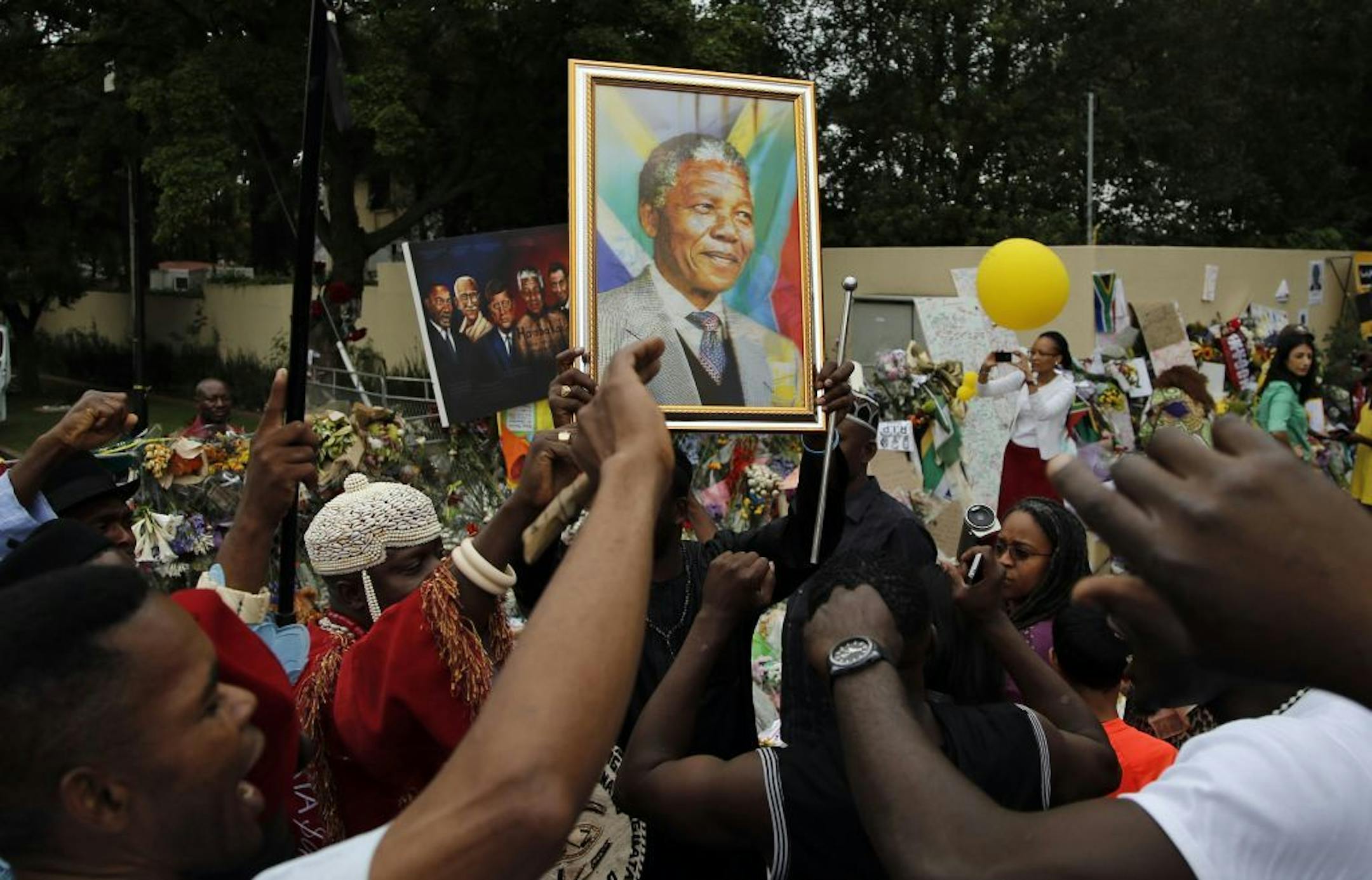
JOHANNESBURG — Along a street lined with walled mansions shaded by graceful jacaranda trees, mourners, black and white, by the thousands rubbed shoulders Monday outside the villa where Nelson Mandela died, placing flower bouquets and condolence notes on top of piles already knee-high. Others danced while singing praise for the anti-apartheid leader — a vivid example of the "Rainbow Nation" unity of race-blind multiculturalism championed by Mandela for South Africa.
As players for the nation's top Kaizer Chiefs soccer team were escorted inside the villa in one of the city's most exclusive neighborhoods to grieve with Mandela's relatives, hospital receptionist Nelson Jabulani Dube said the crowd of black, white and mixed race mourners transforming a street corner into a makeshift shrine was evidence that Mandela succeeded in breaking down barriers in a country defined for generations by race-based hate.
"It's all because of him, because he forgave the enemies at that time, they no longer are the enemies," said Dube, 33. "For me the outcome is really stunning and unites us, and what you see here is a reflection of that."
Michele Marija, an elderly white Johannesburg resident, spontaneously hugged a black woman, calling her "my sister," after the woman made space for her so she could get a better view of the shrine. Then Marija's daughters also hugged the woman.
Marija insisted that her daughters and granddaughters visit Mandela's house, saying his decision to forgive his white oppressors after being released from 27 years in jail saved South Africa from brutal bloodshed.
"We could easily have had a revolution and here we are now all living happily together which is something like a miracle and it's all due to Madiba," Marija said, referring to Mandela by his clan name.
Diane Mathabatha, a 60-year-old member of Mandela's Xhosa tribe visiting Mandela's house with her grandsons, remembered in the 1990s being bent on revenge along with much of her generation until Mandela got out of prison and said that would be wrong.
"He came out and embraced everybody and taught us that, you know, sometimes with your enemy, when you bring him closer, it's much better than fighting him," Mathabatha said.


