

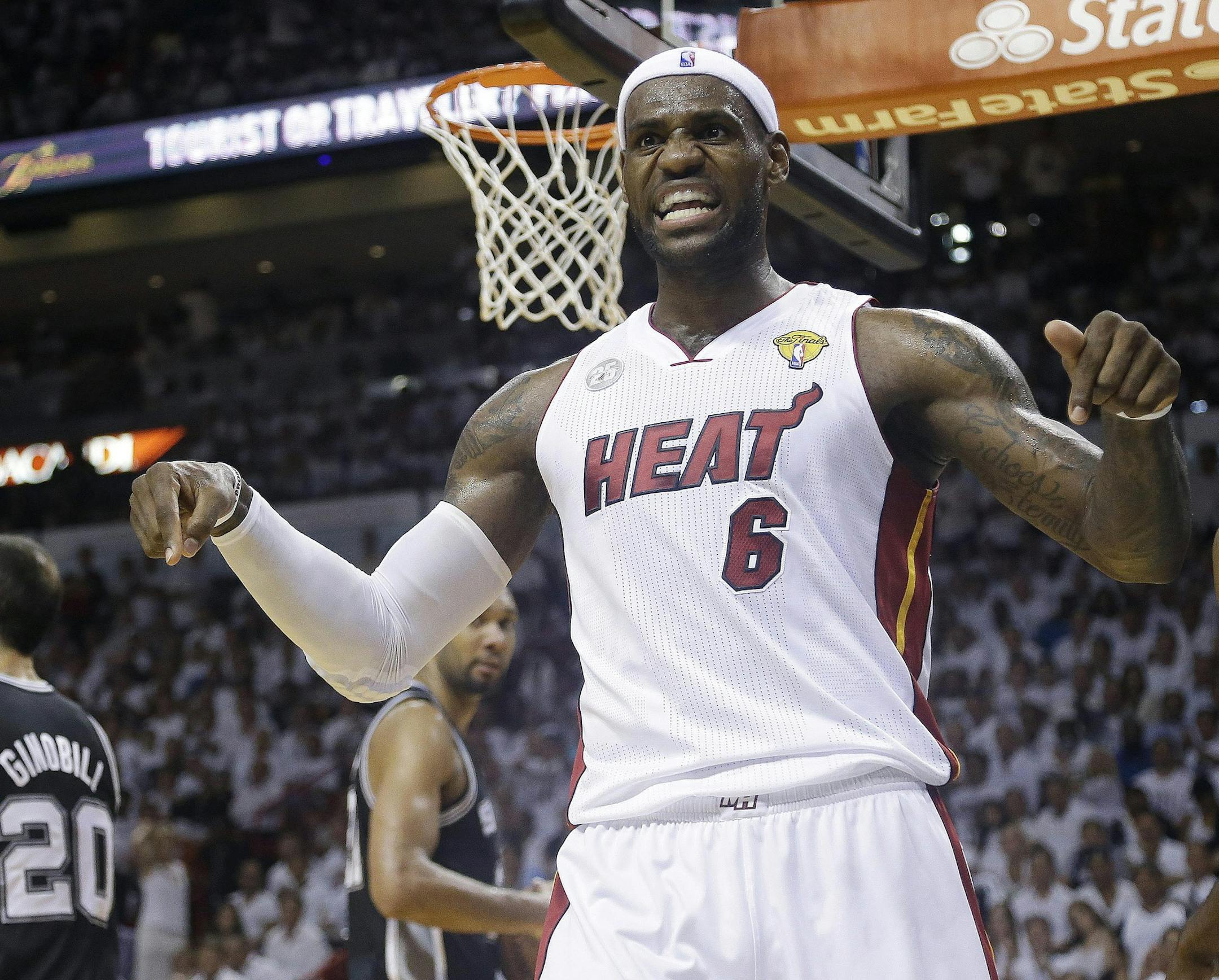
As the NBA season gets underway, there is no doubt that the league's best player is 6-foot-8 LeBron James, of the Miami Heat. James was born poor to a 16-year-old single mother in Akron, Ohio. The conventional wisdom is that his background is typical for an NBA player. A majority of Americans, Google consumer survey data show, think that the NBA is composed mostly of men like James. But it isn't.
I recently calculated the probability of reaching the NBA, by race, in every county in the United States. I got data on births from the Centers for Disease Control and Prevention; data on basketball players from basketball-reference.com; and per capita income from the census. The results? Growing up in a wealthier neighborhood is a major, positive predictor of reaching the NBA for both black and white men. Is this driven by sons of NBA players like the Warriors' brilliant Stephen Curry? Nope. Take them out and the result is similar.
But this tells us only where NBA players began life. Can we learn more about their individual backgrounds? In the 1980s, when the majority of current NBA players were born, about 25 percent of African-Americans were born to mothers younger than 20; 60 percent were born to unwed mothers. I did an exhaustive search for information on the parents of the 100 top-scoring black players born in the 1980s, relying on news stories, social networks and public records. Putting all the information together, my best guess is that black NBA players are about 30 percent less likely than the average black male to be born to an unmarried mother and a teenage mother.
Need more evidence? The economists Roland G. Fryer and Steven D. Levitt famously studied four decades of birth certificates in California. They found that African-American kids from different classes are named differently. Black kids born to lower-income parents are given unique names more often. Based on searches on Ancestry.com, I counted black NBA players born in California in the 1970s and 1980s who had unique first names. There were a few, like Torraye Braggs and Etdrick Bohannon. But black NBA players were about half as likely to have a unique name as the average black male.
From 1960 to 1990, nearly half of blacks were born to unmarried parents. I would estimate that during this period roughly twice as many black NBA players were born to married parents as unmarried parents. In other words, for every LeBron James, there was a Michael Jordan, born to a middle-class, two-parent family in Brooklyn, and a Chris Paul, the second son of middle-class parents in Lewisville, N.C., who joined Paul on an episode of "Family Feud" in 2011.
These results push back against the stereotype of a basketball player driven by an intense desire to escape poverty. In "The Last Shot," Darcy Frey quotes a college coach questioning whether a suburban player was "hungry enough" to compete against black kids from the ghetto. But the data suggest that on average any motivational edge in hungriness is far outweighed by the advantages of kids from higher socioeconomic classes.
What are these advantages? The first is in developing what economists call noncognitive skills like persistence, self-regulation and trust. We have grown accustomed to hearing about the importance of these qualities for success in school, but players in team sports rely on many of the same skills.
To see how poor noncognitive skills can derail a career in sports, consider the tragic tale of Doug Wrenn. Wrenn was born five years before James, also to a single mother in a poor neighborhood. He, too, was rated among the top basketball players in high school. But Wrenn, unlike James, was notoriously uncoachable and consistently in legal trouble. He was kicked off two college teams, went undrafted, bounced around lower leagues, moved in with his mother and was eventually imprisoned for assault.


