

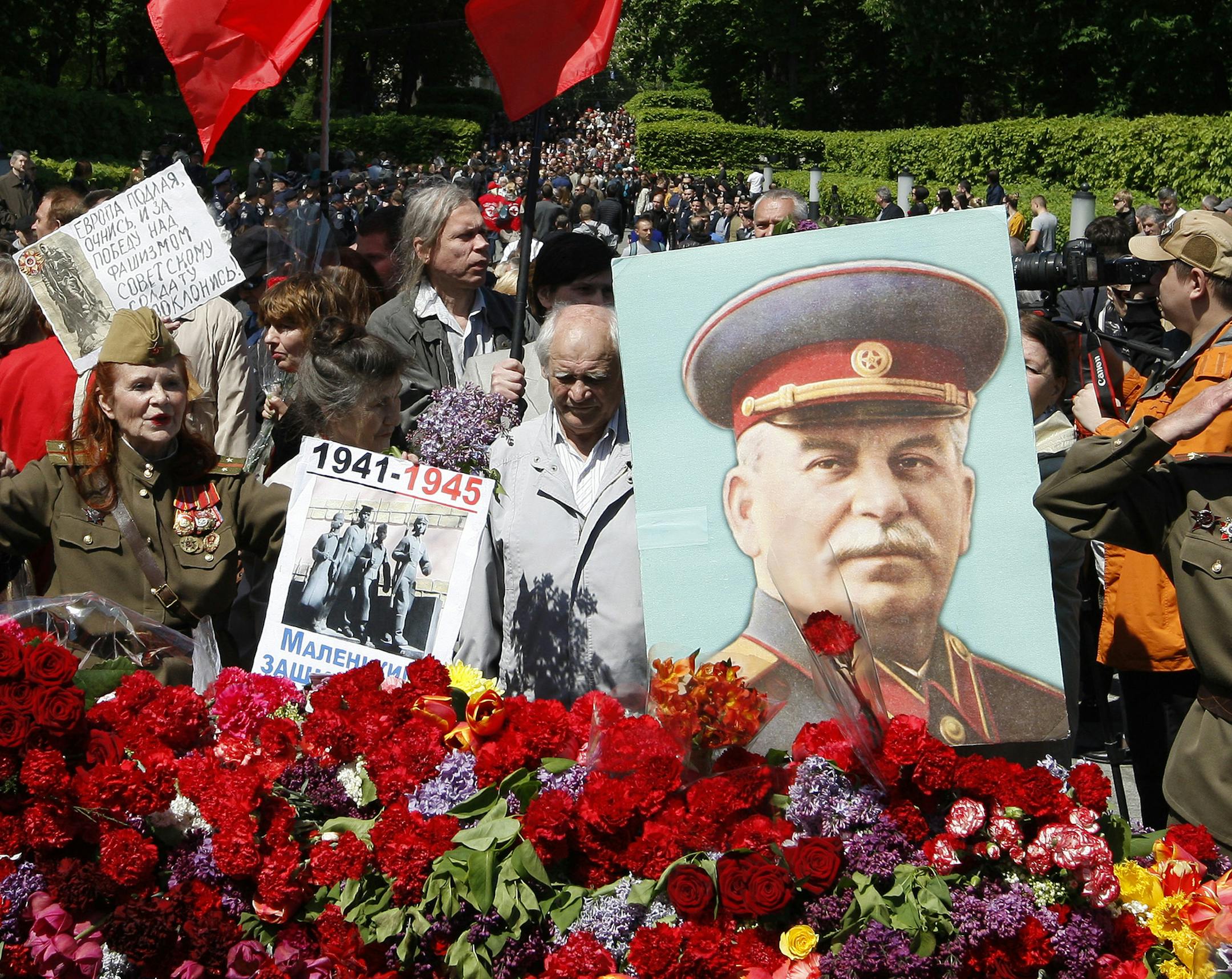
As Russia prepares to mark the 75th anniversary of the victory in World War II, President Vladimir Putin is stepping up his defense of Josef Stalin and digging in against calls to open up secret archives on the Soviet state's killing of millions of its own citizens.
At Butovo, for instance, more than 20,000 victims lie in a mass grave in a former Czarist-era estate about 20 miles outside Moscow. Some were gassed to death in the back of trucks that transported them in their underwear to the killing grounds during Stalin's "Great Terror" of 1937-38.
"We need to know the truth," said Kirill Kaleda, a Russian Orthodox priest whose grandfather was among those killed and who's part of a campaign for full disclosure of the fate of victims of Stalin's repression. "We shouldn't try to cover it up."
With the Kremlin inviting world leaders to major commemorations in May of the victory in what Russians call the Great Patriotic War, Putin is cranking up his rhetoric against western powers over the 1939 Molotov-Ribbentrop pact between Stalin and Hitler. In September, Russia denounced a European Parliament resolution that equated Nazi Germany with the Soviet Union and said the pact's secret deal to carve up Poland and the Baltic States "paved the way" for war.
The president's prickliness over Stalin's historical legacy reflects his view of the Soviet role in WWII, in which 27 million of its people died, including a brother he never knew during the Nazi siege of Leningrad, now St. Petersburg.
He's made the war victory the center of ideological efforts to rally Russians behind his vision of a powerful nation that's unapologetic about its past and able to stand up to the West after the Soviet superpower's humiliating collapse.
It's a vision that flies in the face of the mass repressions under Stalin and the history of Soviet occupation of Eastern Europe following the war. Preparations for the WWII anniversary are also taking place in parallel with constitutional changes Putin's pushing through that may allow him to continue ruling Russia after the end of his presidential term in 2024.
Putin has stoked patriotism to retain public support in the confrontation with the U.S. and its allies over his 2014 annexation of Crimea and military intervention in eastern Ukraine, as Russians have endured five years of falling incomes amid international sanctions.


