

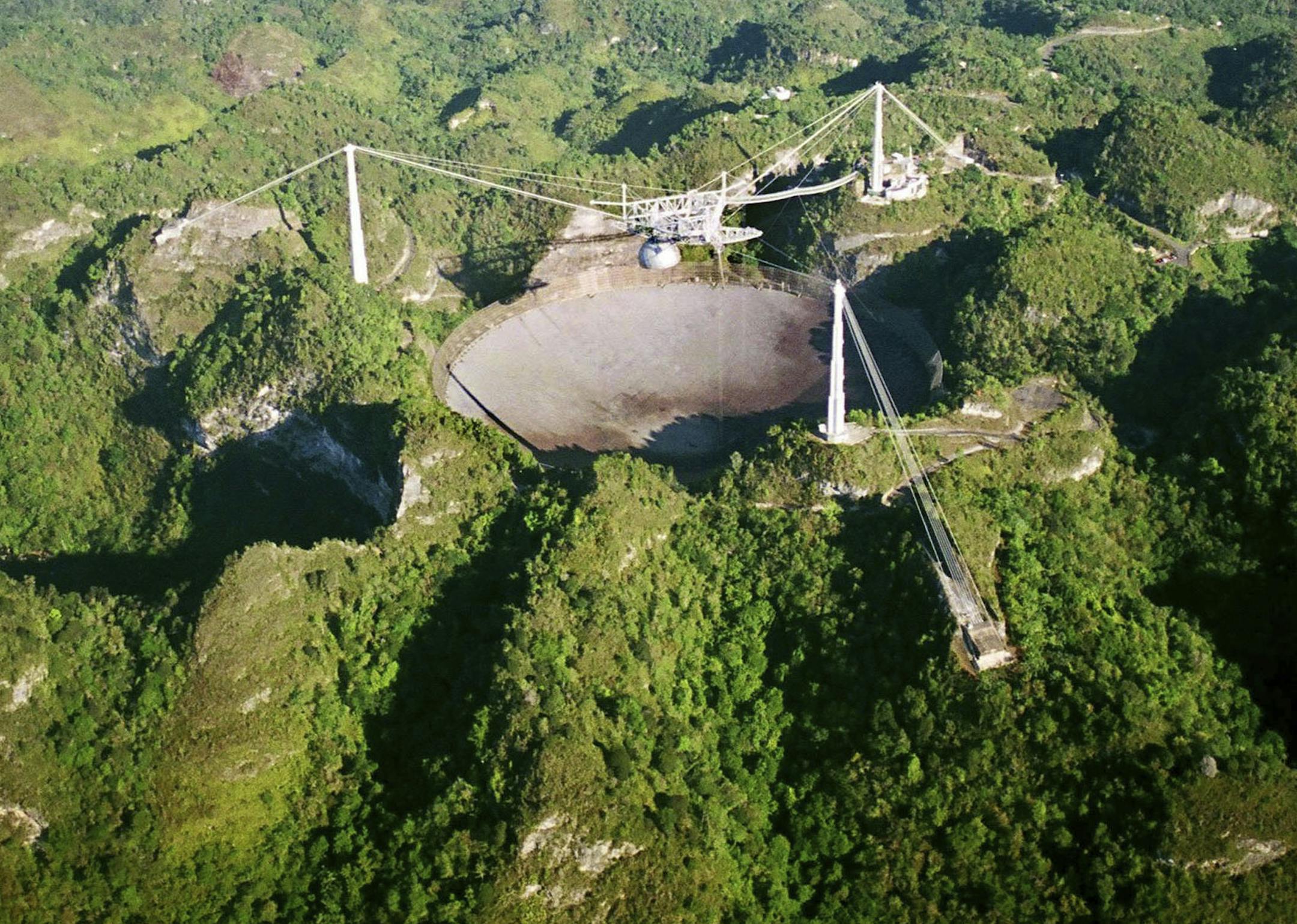
ARECIBO, Puerto Rico – While the vast majority of Puerto Ricans are living in a technologically deprived state without power and poor communications, there's one high-tech oasis on the island that wasn't blown back to the dark ages by Hurricane Maria.
The Arecibo Observatory, a massive radio telescope built in 1963 in the mountains of central Puerto Rico, was raked by the eye of the storm but was almost unscathed.
Within seven days, the observatory was up and running on generators — tracking pulsars and receiving data from across the galaxy.
The heart of the observatory is a silvery 1,000-foot-diameter dish that sits in a valley and makes Arecibo the largest operational single-dish radio telescope in the world. China recently built a 1,650-foot-diameter telescope, but it's still not running.
The machine is composed of more than 38,778 individual reflective panels that bounce radio waves from the cosmos at an array of antennae 435 feet above the ground.
"When you see it at first it looks very fragile, but it's actually very resistant," said Francisco Cordova, its director.
When Maria slammed into the installation on Sept. 20, packing 110-mph winds, the storm tore off a few panels and broke one of the two 430 megahertz radars. But the telescope was left fully operational.
Most nonscientists know the observatory from its star turns in Hollywood. The telescope played a central role in "Contact," the 1997 movie based on a Carl Sagan novel.


