

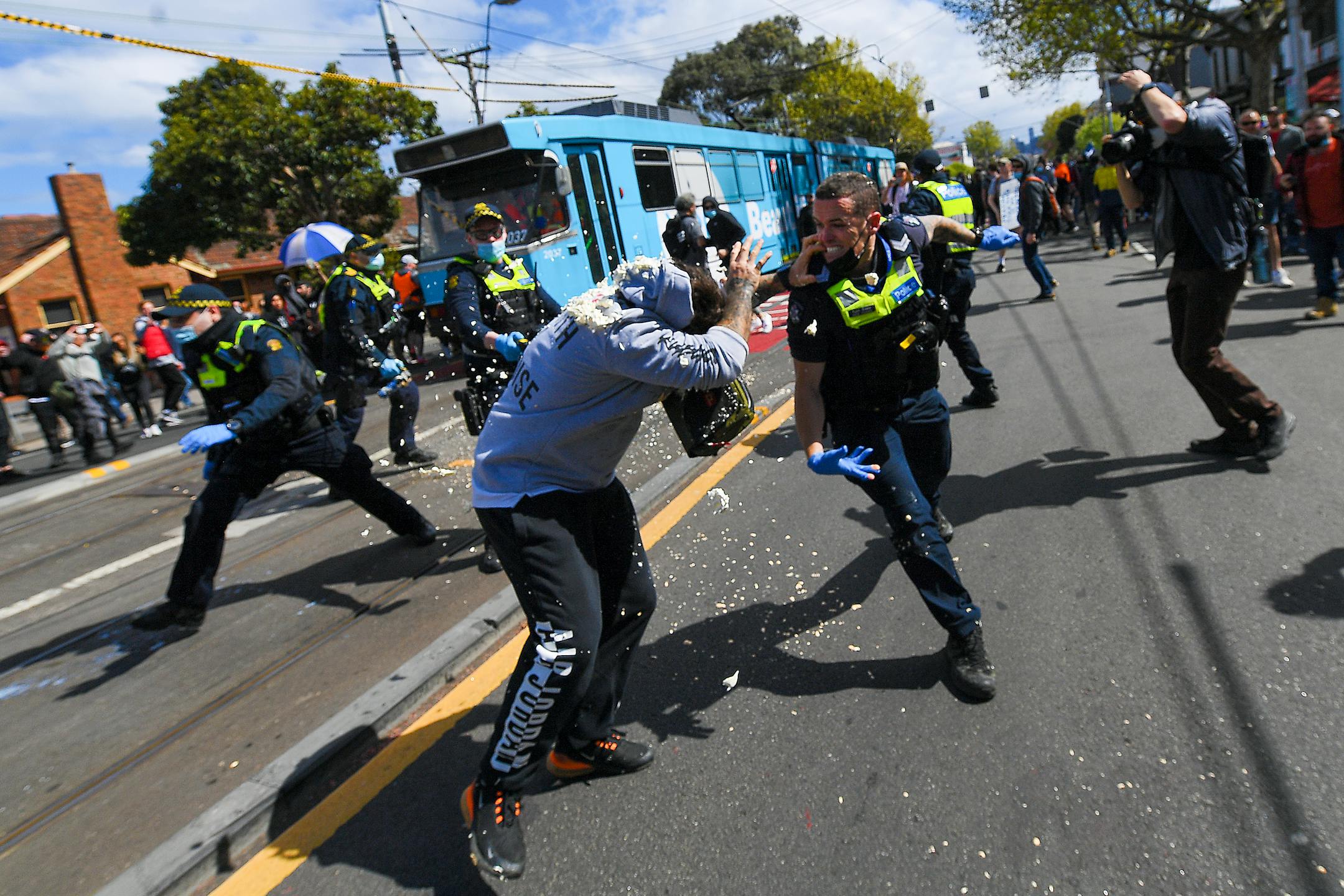
September was turbulent: More than 200 Australians arrested during citywide protests and a temporary no-fly zone declared over Melbourne. Rubber bullets and tear gas unleashed by the Thai riot police into an angry crowd. Health care workers assaulted in Canada. Rallies of up to 150,000 people across the Netherlands.
The pandemic has coincided with an upsurge in protests across the globe. Over the past 18 months, people have taken to the streets in India, Yemen, Tunisia, Eswatini, Cuba, Colombia, Brazil and the United States. The Armed Conflict Location & Event Data Project reports that the number of demonstrations globally increased by 7% from 2019 to 2020 despite government-mandated lockdowns and other measures designed to limit public gatherings.
What is driving this international discontent?
Some experts argue it is the pandemic itself. People of poorer nations are protesting the lack of available vaccines or personal protective equipment, while those of wealthier countries are objecting to perceived civil liberties violations.
But the continuing protests in both poor and wealthy countries cannot simply be explained away as reactions to the pandemic. The presence of simultaneous uprisings in countries with a range of income levels, government types and geopolitical significance indicates a deeper disillusionment: the loss of faith in the social contract that shapes relations between governments and their people. Put simply, the governments of today seem incapable of offering both representative and effective governance. And ordinary citizens have had enough.
The rise in protests globally actually began long before the pandemic. Following the 2008 economic crash, mass demonstrations — including Occupy Wall Street and the Arab Spring — called for a fundamental rethinking of the existing post-Cold War social contract between governments and their people. Since President George H.W. Bush's announcement of a new world order in 1990, this contract was largely founded upon the notion that market-centric policies would lead to global prosperity and peace.
But the financial crisis in 2008 shed light on this social contract's shortcomings. Both political and economic in nature, the ensuing protests demanded that governments respect the basic rights of citizens and address the growing gap between the haves and the have-nots. Around the world, authoritarian and democratic leaders alike responded to the financial crisis with more neoliberal policies such as fiscal austerity and the privatization of public-sector services — policies that only further galvanized popular anger.
This frustration has carried over in the so-called COVID protests of today. While many demonstrations explicitly invoke the pandemic, the bigger, latent concern is the inability of modern governments to serve the majority of their populations, especially the middle and poorer classes. This failure is made visible by the growing number of monopolies, the increasing political power of corporations, the unremitting spike in economic inequality and the policies that are exacerbating climate change.


