

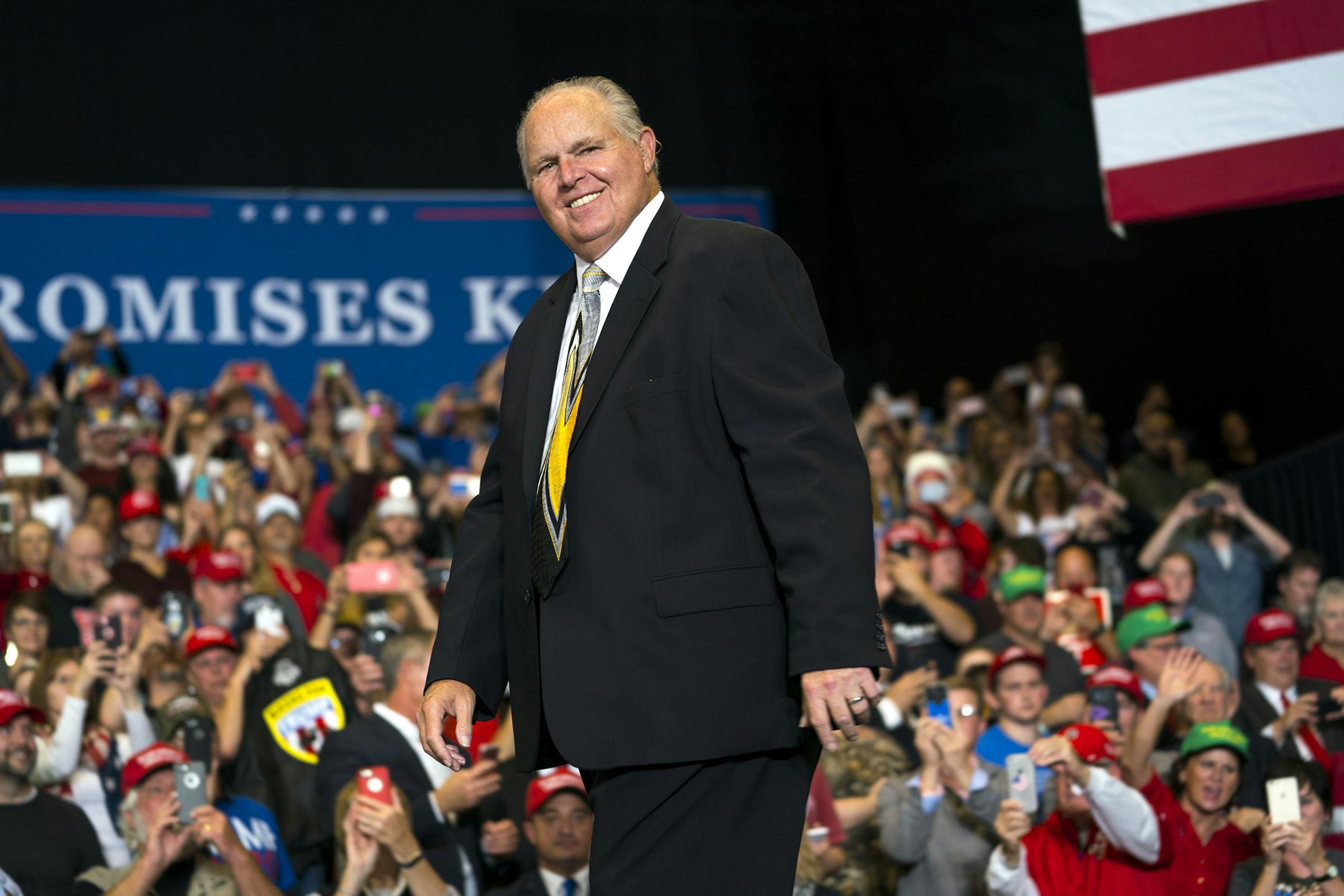
"Not proud of this," a friend wrote to me in a text message mere minutes after the news broke Wednesday, "but feeling really good about Rush Limbaugh dying."
I understood. I myself wasn't mourning the passing of a man who had been so contemptuous of people who didn't share his political views, so prone to cruel mockery, so proudly prejudiced, so recklessly divisive. In his last months, he sought to undermine democracy by ardently promoting the fiction that the 2020 election was stolen from his beloved Donald Trump. The world will hardly be worse for Limbaugh's absence.
But it's the "not proud" part of my friend's message that compels me to share it. It's the "not proud" part that makes him one of my nearest and dearest. He's a humanist, he's decent, and he was acknowledging that death isn't a moment for rejoicing or gloating — that the only thing served by that is our own debasement. He was making clear that what he was confiding to me he wouldn't be stitching on a throw pillow, posting on Facebook or putting in a headline.
"BIGOT, MISOGYNIST, HOMOPHOBE, CRANK: RUSH LIMBAUGH DEAD." Those were the words, capitalized and adrenalized, that HuffPost splashed across its home page. Several other left-leaning sites took the same tack and tone.
Of course, they were positively restrained in comparison with Twitter, which is basically talk radio's less windy bastard child. "Rest in piss" had currency there. The F word, followed immediately by Limbaugh's name, was taken out for a spin. There was speculation that Limbaugh had gone to a very hot place reputed to have nine circles and a red, horned ruler. There was wishing that he would rot there. One tweet said that Limbaugh "brought a lot of people a lot of joy by dying." It was liked by more than 35,000 of the morbidly contented. I don't begrudge them their relief that he's no longer ranting. But is that really what they want to lavish a cute little heart symbol on?
I also don't quibble with the accuracy of the nasty nouns in HuffPost's damning litany. But were they necessary at that exact moment and in that particular context? All of them were justly and repeatedly slung at Limbaugh when he was alive. In real time, his critics labeled his hate and his ignorance — which were his steppingstones to fame and riches — for what they were, exposing them and pushing back at him. That was just. He earned it. If you're going to fling your opinions at the world, you must be braced for the world to fling its reaction back at you. Those are the terms of the contract.
And it would be journalistic malpractice and morally wrong to publish obituaries about Limbaugh that merely noted his role in the rise of talk radio and his adoration by millions of listeners. Those appraisals were obliged, for the sake of history and accuracy, to note and be reasonably blunt about how he used his format, what listeners were thrilling to and what impact it had on the country's political culture.
The New York Times' obituary did precisely that. I don't always agree with the approach and decisions of the news organization that employs me and have never felt any pressure to play cheerleader for it, but I think it handled Limbaugh's death expertly.


