

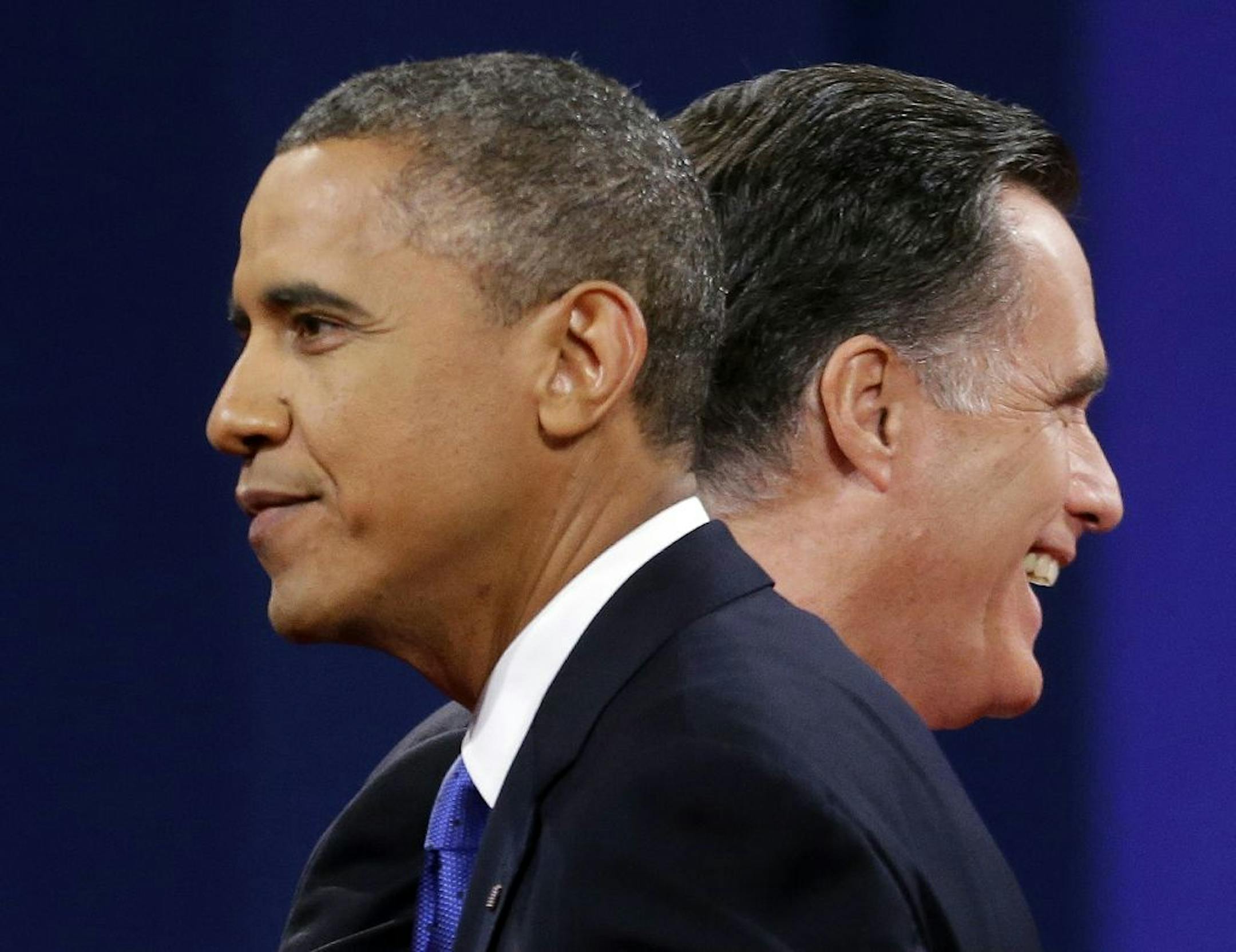
Mitt Romney brought a knife to a gunfight. A butter knife. In the third and final presidential debate, focused on national security and foreign policy, the Republican challenger seemed to be living by the Hippocratic oath: Do no harm. In this case that meant a mostly passive, heavy-on-agreement discussion with his opponent the commander in chief. President Obama, by contrast, was on the attack, repeatedly calling Romney reckless and looking every bit like the politician who thinks he's behind in the race.
Obama won the third debate, articulating his policies more forcefully, offering more detail and a coherent foreign-policy rationale. Romney generally presented bromides and talking points in a style that was at times tentative. He occasionally sounded like a student trying to prove that he'd crammed for the test, rattling off the names of countries and bullet points he'd recently committed to memory.
In the end, though, the political question is not who won the policy debate, but whether the challenger cleared the bar as a plausible commander in chief. For Romney, that probably meant no mistakes (and there were no obvious gaffes). The country will now return to talking about the economy, the issue he wants to talk about.
The immediate exit polls were mixed. CBS polled undecided voters, and they gave the night to Obama, 53 percent to 23 percent. CNN's poll of registered voters gave the narrow edge to Obama, 48 percent to 40 percent. While Obama called Romney reckless several times, there was nothing the former Massachusetts governor did or said that seemed reckless. He took no risks by mounting a serious and sustained challenge of the president. In the CBS poll, 49 percent said Romney could be trusted in an international crisis. That was only a few points above what people thought going into the debate. If he's clearing the acceptability bar, that number suggests it's not by much.
When Romney talked about non-foreign-policy issues during one of the debate's many cul-de-sacs into domestic policy, it was like a switch had been thrown. He once again sounded more confident. Romney so thoroughly abandoned the aggressive, fact-checking style that got him into trouble with the president over Libya in their second meeting, it was hard to imagine he was the same candidate. Moderator Bob Schieffer raised tougher questions in his introduction of the topic than Romney ever did.
Obama was able to even use Libya as an example of his foreign-policy approach, which he argued showed what you could accomplish if you tend to your allies. "I and Americans took leadership in organizing an international coalition that made sure that we were able to, without putting troops on the ground at the cost of less than what we spent in two weeks in Iraq, liberate a country that had been under the yoke of dictatorship for 40 years."
Like a boxer hugging his opponent to kill time, Romney signaled agreement with Obama on Syria, Iranian sanctions, defending Israel, Afghanistan and the ouster of Egypt's Hosni Mubarak. When he fought back against Obama's attacks, his stock phrase was generic and with an eye toward swing voters: "Attacking me is not talking about an agenda."
Romney wasn't going to do anything to make suburban women, that key voting bloc, think that he was going to get into any wars. "We can't kill our way out of this mess," he said about the Middle East. He talked about alliances, promoting foreign aid and working to promote democracy.


