

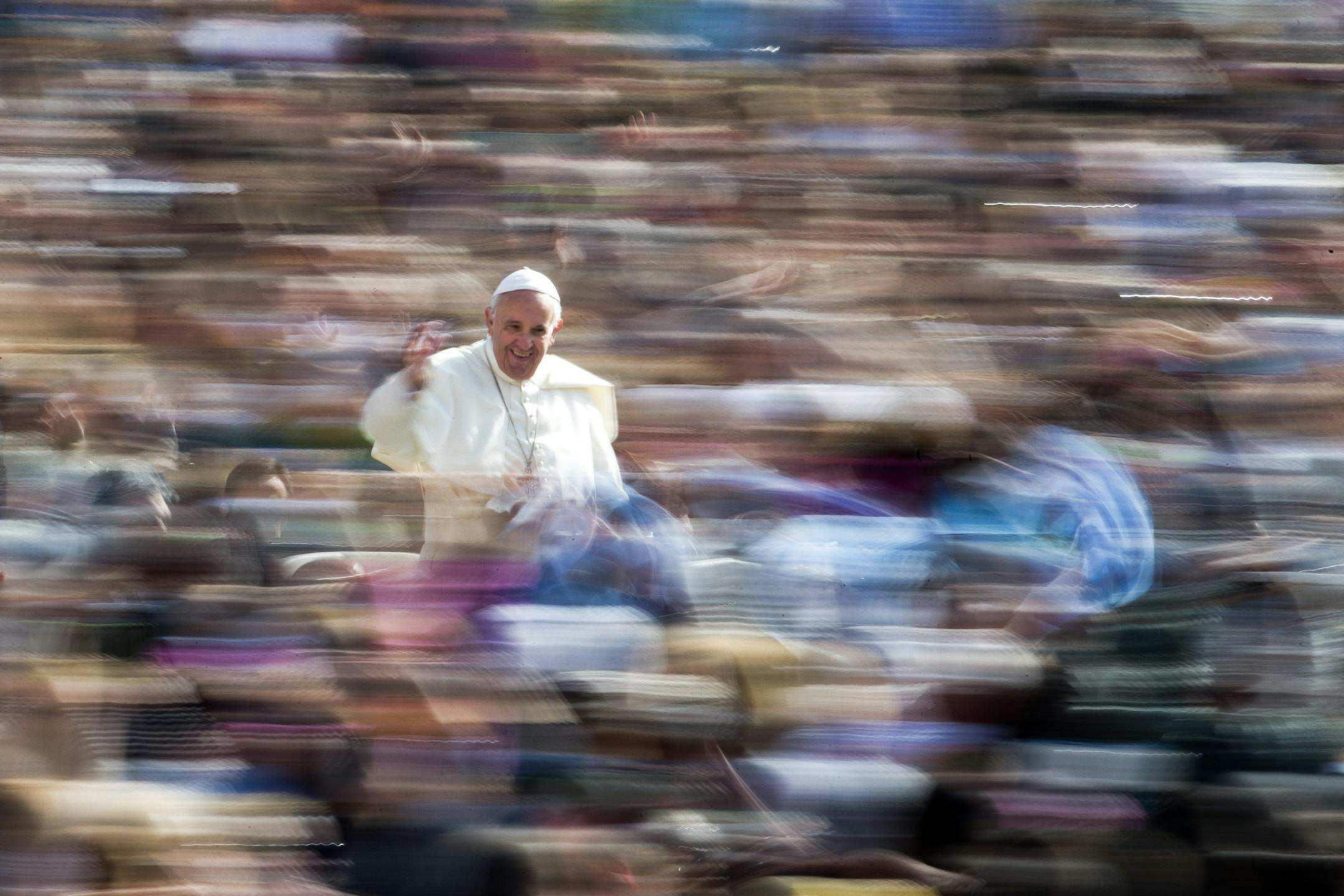
There is hardly anyone in the world by now who is unfamiliar with the affable, down-to-earth, conspicuously humble persona projected by Pope Francis. His style of governance, however, is a far cry from this carefully cultivated public image. Influenced by the Peronist ideology of his native Argentina, he rules the Roman Catholic Church with the idiosyncratic passions, and the disciplined commitment to an agenda, of a true ideologue. And "Amoris Laetitia," Francis's 260-page, nearly 60,000-word, post-synodal apostolic exhortation on marriage and family, which was at long last released on Friday, is the clearest example yet.
Francis' "People's Pope" persona has always belied an autocratic temperament that is coldly efficient at achieving his aims, if not winning allies to his cause. In his National Geographic profile of the pontiff, formerly known as Jorge Mario Bergoglio, Robert Draper relates that:
"[Francis has] an awareness that his every act and syllable will be parsed for symbolic portent. Such prudence is thoroughly in keeping with the Jorge Bergoglio known by his Argentine friends, who scoff at the idea that he is guileless. They describe him as a 'chess player,' one whose every day is 'perfectly organized,' in which 'each and every step has been thought out.' Bergoglio himself told the journalists Francesca Ambrogetti and Sergio Rubin several years ago that he seldom heeded his impulses, since 'the first answer that comes to me is usually wrong.' "
Robert Mickens, editor in chief of Global Pulse, an online Catholic magazine, described Francis as a "master tactician" who was able to "make a move to outflank various groups and people that continue to oppose many of his initiatives."
Such cold and calculating determination has been in evidence throughout the process leading up to Friday's publication of "Amoris Laetitia." Never in my lifetime as a Catholic has a papal document been more anticipated — or feared — than this follow-up to the two-part Synod of Bishops that originally convened in October 2014. Institutionally, the document's roots can be traced back even further, at least to the consistory, or meeting of cardinals, in February 2014, at which the octogenarian Cardinal Walter Kasper, bishop emeritus of Rottenburg-Stuttgart, was personally asked by Francis to give the keynote address. It was here that Kasper — once a lightning rod of theological controversy who had already begun to fade into the obscurity of retirement — had new life suddenly breathed into his ecclesiastical career as he was lavished with praise by the unconventional new pope for his "serene theology."
At the core of this theology was a novel conception of mercy that appeared to preclude repentance. While paying lip service to the church's long-established doctrine on the indissolubility of marriage, Kasper proposed the exploration of "new paths" to respond to the alleged "deep needs of divorced people who have remarried," offering the idea of a "period of penance" after which they might be "readmitted to the sacraments." This "Kasper Proposal," as it came to be known, was nothing new in his native Germany, where he had advocated it (and implemented it in practice) for years, but thrust into the spotlight of Rome it became an immediate point of contention for orthodox Catholics. It represented the possibility of an institutional embrace of adultery, as well as permission for those living in grave sin to be readmitted to Holy Communion — a practice that had been understood previously as sacrilege. Nevertheless, it formed the locus around which both the extraordinary and ordinary synods on marriage and family would trace their orbits in October 2014 and 2015, respectively.
For his part, Kasper — with a strong papal endorsement in hand — continued to pitch the idea as he went on a world tour to promote his book "Mercy: The Essence of the Gospel and the Key to Christian Life." Francis, who described Kasper early in his papacy as a "superb theologian," said that his book "has done me so much good, so much good." As pressure mounted against the Kasper Proposal from more conservative quarters within the church, the cardinal responded with an appeal to authority: "I agreed with the pope. I spoke twice with him. He showed himself content [with the proposal]. Now, they create this controversy. A cardinal must be close to the pope, by his side. The cardinals are the pope's cooperators."
With no correction from the Vatican, Kasper's testimony stood, in the eyes of many of the faithful, as proof that Francis was an advocate of his position. And as the list of unorthodox prelates invited personally by Francis to the synod grew, so too did the suspicion that the pope was, in fact, entertaining the unthinkable: a blessing for changes in Catholic practice that would fatally erode the very doctrine they purported not to change.


