

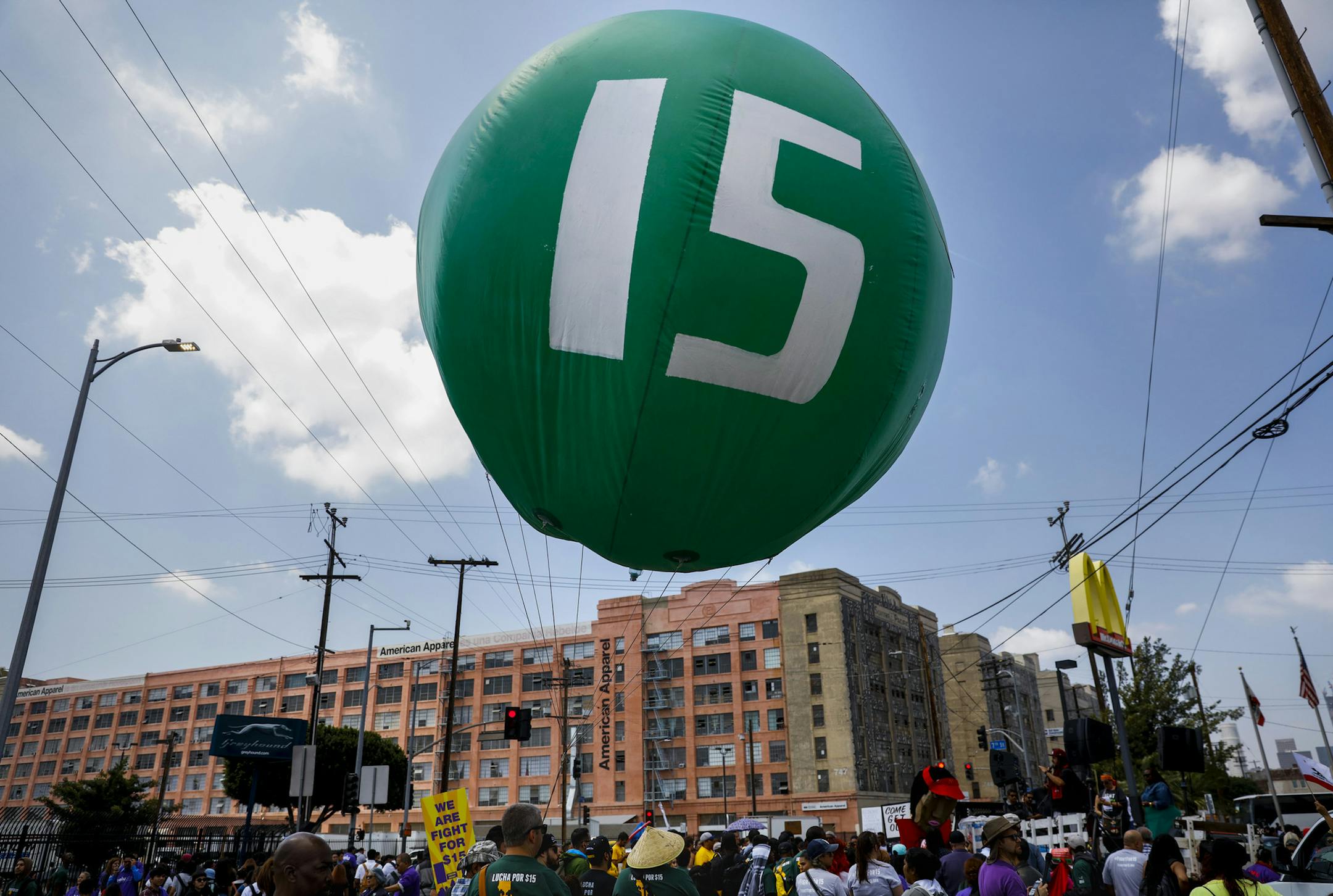
One of the biggest policy battles between Democratic presidential contenders Hillary Clinton and Bernie Sanders has been about the minimum wage — not whether to raise it, but how high it should go.
Sanders, who supports raising the minimum wage to $15 an hour, has used his stance as a wedge to win liberal primary voters away from Clinton. She backs a national rate of $12 per hour, with some localities able to go as high as $15.
Largely lost in the tumult is just how rapidly the debate over the minimum wage has shifted during the past few years, at least on the Democratic side. (Republicans, by and large, are skeptical about raising the minimum wage, though Donald Trump said on May 8 that he "would like to see an increase of some magnitude, but I'd rather leave it to the states.")
Among Democrats, the minimum-wage rhetoric has moved so fast that it's outrun academic research on the subject. This has left Sanders touting support for a minimum wage level that hasn't received much academic vetting — and that leaves unanswered the question of what the downside of a large wage increase could be.
In his first presidential campaign in 2008, Barack Obama promised to raise the minimum wage to $9.50 by 2011. Once in office, he largely avoided the issue until 2013, when he adopted the cause of a $10.10 minimum wage.
Now, both Democratic candidates are on record saying $10.10 is far too low.
Sanders calls instead for an increase of $7.75. That's more than double the present level — which has been steady at $7.25 since 2009 — and it's 40 percent higher than the all-time highest inflation-adjusted minimum wage level, $10.69 in February 1968. (Sanders' bump, it should be noted, wouldn't come all at once; a bill he introduced in 2015 would phase in the $15 wage incrementally by 2020.)
Why is such a sizable increase being proposed now? The biggest factor is probably the success of city-based efforts to raise the minimum wage to $15 in Los Angeles, San Francisco and Seattle in recent years.


