
Playground or graveyard to be built at site of Osama bin Laden's hideout

The Washington Post
August 4, 2016 at 12:04AM
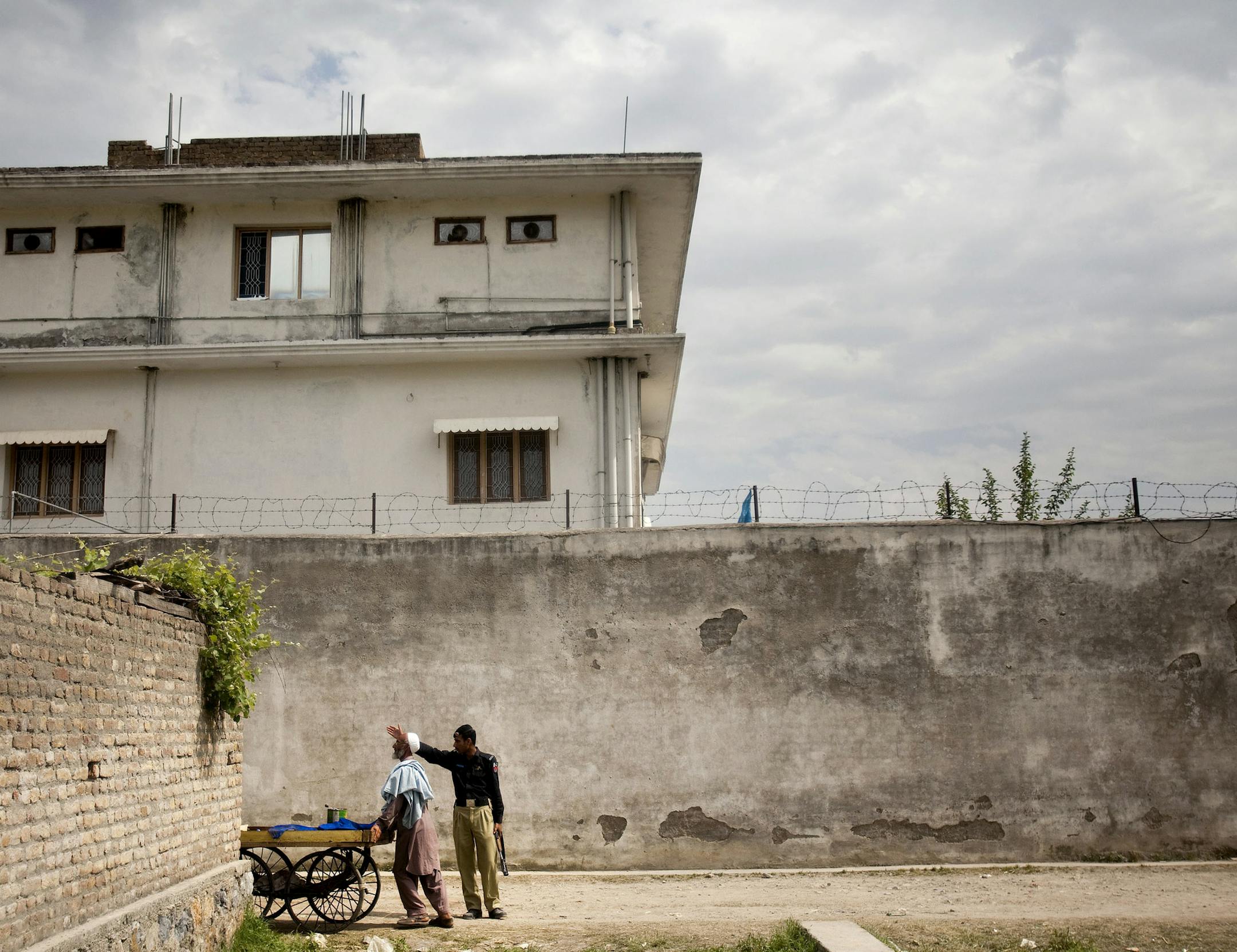
FILE -- A Pakistani policeman tells a vendor to move away from the compound where Osama bin Laden was killed in Abbottabad, Pakistan, May 5, 2011. In the memoir "No Easy Day," a member of the Navy SEALs team that killed bin Laden recounts his story. (Warrick Page/The New York Times)
After Osama bin Laden’s death in 2011, a Pakistani policeman told a vendor to move away from the compound. (The Minnesota Star Tribune)

A yearslong Pakistani land dispute pitting the military against the civilian government is culminating in one seemingly simple question: Should the field where Osama bin Laden's compound once stood be turned into a playground or a graveyard?

The local administration, largely controlled by the military, is pushing for the graveyard. They seek to rectify "a serious shortage of graveyards in the area," said Zulfiqar Ali Bhutto, an administration official.

The government, though, wants a playground. Mushtaq Ghani, the information minister of the Khyber Pakhtunkhwa provincial government, said, "You can't develop a cemetery in the middle of houses."

But this seemingly minor disagreement is a reflection of years of disputes between the two stakeholders over who, exactly, controls the 38,000 square feet in Abbottabad, Pakistan, where Bin Laden hid for five years.

For a year after Navy SEAL Team Six raided the compound in May 2011, killing the Al-Qaida leader and mastermind of the Sept. 11, 2001, attacks on the United States, the property remained vacant. "Nobody went near the place and nobody claimed its ownership," said Omar Farooq, deputy director of the cantonment, or military camp. "According to the law, we took charge."

Reporting by the BBC, however, found that authority over the land was given to the provincial government.

The dispute isn't surprising, given that the government and military have overlapping authority in the area. The compound lies within the Khyber Pakhtunkhwa province, so naturally, the provincial government has some claim.

But it also lies within the boundaries of the Abbottabad Cantonment, an area that has significant military facilities alongside civilian residents and private businesses. The cantonment administration, mostly senior military officers who ultimately report to the country's ministry of defense, regulates construction in the area, among other area operations.

Between these two ruling groups, neither is unilaterally supreme, causing the continued dispute.

In 2012, under order of the government, the military demolished the compound and the wall surrounding it in an effort to prevent it from becoming a pilgrimage destination for jihadists.

Ever since, the plot has remained an empty field, its ownership still not resolved. Children frequent it to play cricket or fly kites, according to NBC News. But this year, the land dispute started to heat up.

In May, the military occupied the area and surrounded it with a rope fence. It was promptly taken down after an intervention by the local government.

But two months later, in mid-July, the military built a 3-foot-high wall surrounding the area, taking government officials by surprise. The wall "secured this place from encroachment" by the provincial government, Bhutto told the AFP.

Ghani insists that the wall is "on land that belongs to the provincial government." The wall remains in place today. And both the military and local government still claim ownership of the land.

Which brings us back to the initial question: playground or graveyard?

Local residents tend to want to loosen the association between their neighborhood and the terrorist who once lived among them. According to the Times of London, for many, this means favoring the playground, which doesn't conjure up thoughts of death and destruction.

Others think the graveyard would be better at achieving this goal. "A graveyard would be the safest bet, as nobody would like to call it the Bin Laden graveyard," one Abbottabad journalist told the BBC.

And some, still, have other ideas for the property, like a girls' school, according to the BBC.

For now, the walled-off plot remains empty.

about the writer

about the writer

Kim Soffen

More from No Section

See More
FILE -- A rent deposit slot at an apartment complex in Tucker, Ga., on July 21, 2020. As an eviction crisis has seemed increasingly likely this summer, everyone in the housing market has made the same plea to Washington: Send money — lots of it — that would keep renters in their homes and landlords afloat. (Melissa Golden/The New York Times) ORG XMIT: XNYT58
Melissa Golden/The New York Times

It’s too soon to tell how much the immigration crackdown is to blame.