
Play ball 1860-style in Washington County!

Spring means baseball, and while some teams are looking ahead to the excitement of new seasons, teams that play by the old-time rules are looking back and reminding people of a simpler age.

March 20, 2011 at 3:02AM
DAVID BREWSTER � dbrewster@startribune.com Sunday_9/9/07_Denmark Township DENMARK DEMONS vs. St.CROIX BASE BALL CLUB
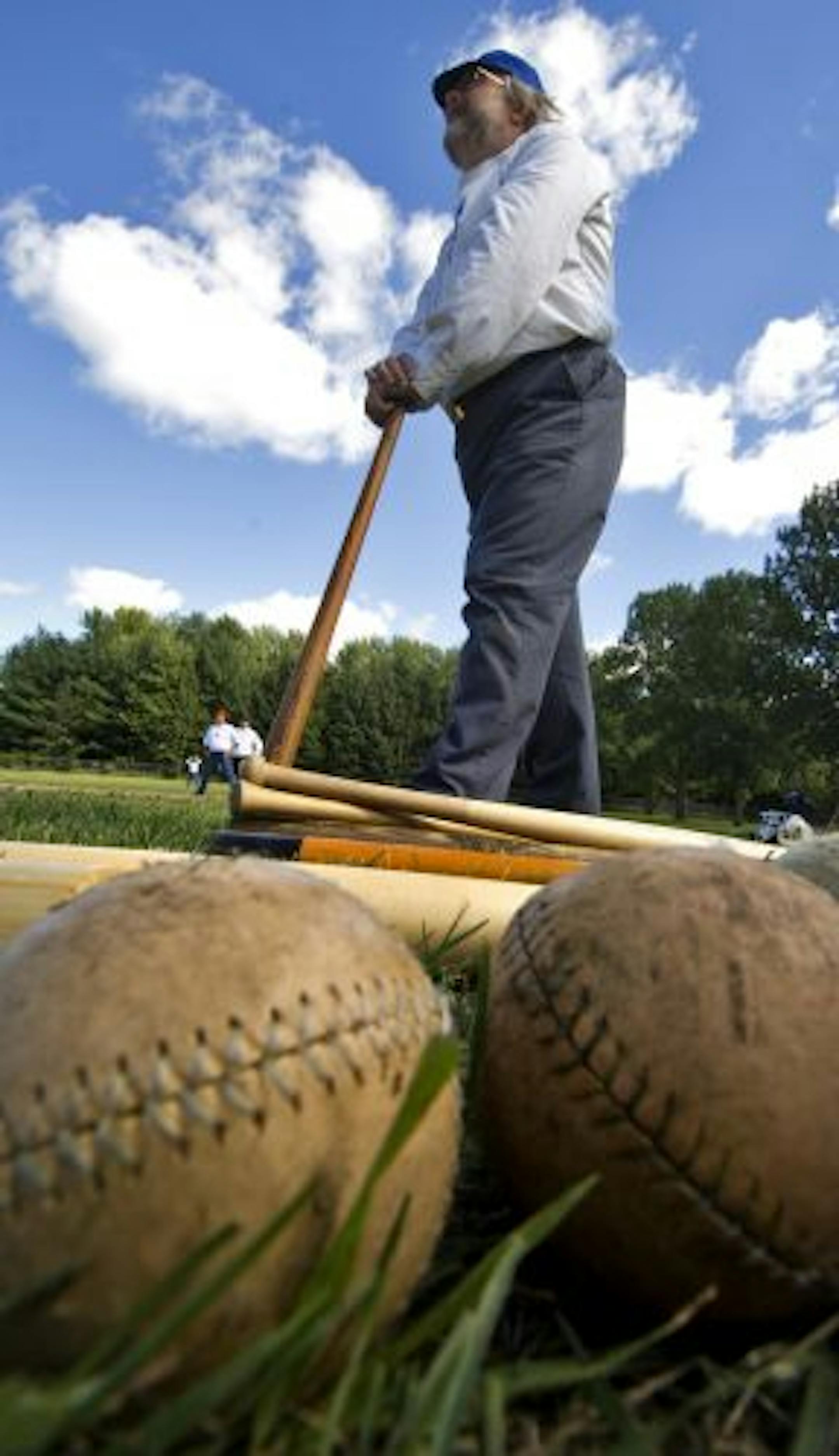
Playing by 1860 rules takes some practice. For starters: No gloves. No swearing. No spitting. Here, the St. Croix Base Ball Club took on the Denmark Township Demons in Denmark Township, with Don Hammer taking his turn at bat. (Jm - Star Tribune/The Minnesota Star Tribune)

As hints of spring begin pushing away winter's remnants in earnest, the anticipation is building among the "ballists" of "club nines," not to mention the "cranks."

Players (ballists) for the St. Croix Base Ball Club, the Afton Red Socks and the Denmark Township Demons (club nines) are preparing for another season of baseball, 1860-style. The teams have been delighting fans (cranks) for the past several years.

The teams dress and play their games by pre-Civil War rules, which means a lot of bunting, trying to bounce the ball from fair to foul territory and throwing the ball at runners to get them out.

It's all great fun, but it also carries an educational message.

Brent Peterson is executive director of the Washington County Historical Society and captain of the St. Croix Base Ball Club that it sponsors (he goes by "Skinny" on the field, and still winces when recalling how he separated his shoulder in one game).

"The mission, from my perspective as the director of the Historical Society, is to show how families can get together and have fun with history," he said. "It is getting the mission statement of the historical society out to all ages.

"On our team, we've had people play who've been 13, 14, 15 years old. We've also had people play who are 70 and 75 years old. And so it's really a multi-generational program and it brings a lot of people together."

The Afton Historical Society sponsors the Red Socks, and in Denmark Township, the local historical society backs the Demons.

"One of the things our historical society does is try to do different things that bring history to the people," said Jean Boyd, who manages the Demons and is active in the Denmark Township Historical Society.

The old-fashioned charm of the games is a crowd-pleaser. "It's fun because of the rules -- you can't swear and you can't spit, or you get fined two bits," Boyd said.

Century before the Twins

More than a century before the Twins arrived in 1961, long before the old St. Paul Saints and Minneapolis Millers and before the heyday of modern town baseball, the national pastime took hold in Minnesota, even before it became a state in 1858.

"There's notations in the newspapers in the 1850s of communities having ball teams playing each other, from St. Paul down to Nininger and also Stillwater," Peterson said. "And they were just about starting to have a league when the Civil War broke out."

The war disrupted baseball, but also helped it expand -- especially in the South -- when soldiers played during idle moments in the camps. When soldiers came home, they brought the game back.

The St. Croix Base Ball Club (yes, baseball was originally two words) was formed in 1866, and it joined the state's first league the following year, Peterson said. Henry Sibley, the state's first governor, was its president.

"He loved baseball -- he never played it, but he loved baseball," Peterson said. The first trophy was a silver baseball, and teams could challenge the winner to a two-out-of-three playoff for the state championship.

"In 1868, the St. Croix Base Ball Club of Stillwater defeated the Minnehaha club of Northfield and won the silver ball," Peterson said. "And they would never let them forget it."

The rivalry endures, and the teams play on July Fourth, at Northfield's Defeat of Jesse James Days and during Stillwater's Lumberjack Days.

Different strategies

The essence of the 1860 game is the same as the modern game, but there are some significant differences.

The ball is softer and heavier than today's, and catching it after one bounce constitutes an out.

It's not as easy as it sounds. "It really is something you need to practice -- that's a little bit different," Boyd said. "That ball does bounce a little bit differently than you might expect."

Infielders also stand closer to the bases, Peterson said, and while positions are the same, the shortstop is a "rover."

The hitting rules involved more strategy than just trying to smash the ball as far as you can, as hard as you can.

"In 1860, the players were not wearing gloves, so it was bare-handed," Peterson said. "If the ball is hit and it bounces fair but goes foul, it's a fair ball, so it matters where the ball hits. And that was a very strategic thing back in that time frame.

"It was called the fair-foul hit. People would actually try to chop down at the ball and hit it right in front of the plate and let bounce off either to the left or to the right."

And as for the umpires, who roam around in top hats explaining the rules to the crowd, they mainly just call balls foul or fair -- there are no balls or strikes called, Peterson said. And runners aren't called out at bases unless an umpire is asked. The umpire often consults with the crowd on calls. In 1860, Peterson said, the umpires were usually respected members of the community, like judges or ministers.

Despite the differences, the games still bring communities together, just as they did 150 years ago.

Players are "doing this out of pure enjoyment, and there's a lot of different people that come into this vintage baseball thing," Peterson said. "There are people who love playing baseball. There are people who are just into the history of baseball. There are people who want to play a sport but aren't all that athletic. These rules give those people an equal shot with everybody."

Jim Anderson • 651-735-0999

about the writer

about the writer

Jim Anderson

Multiplatform editor

See Moreicon